
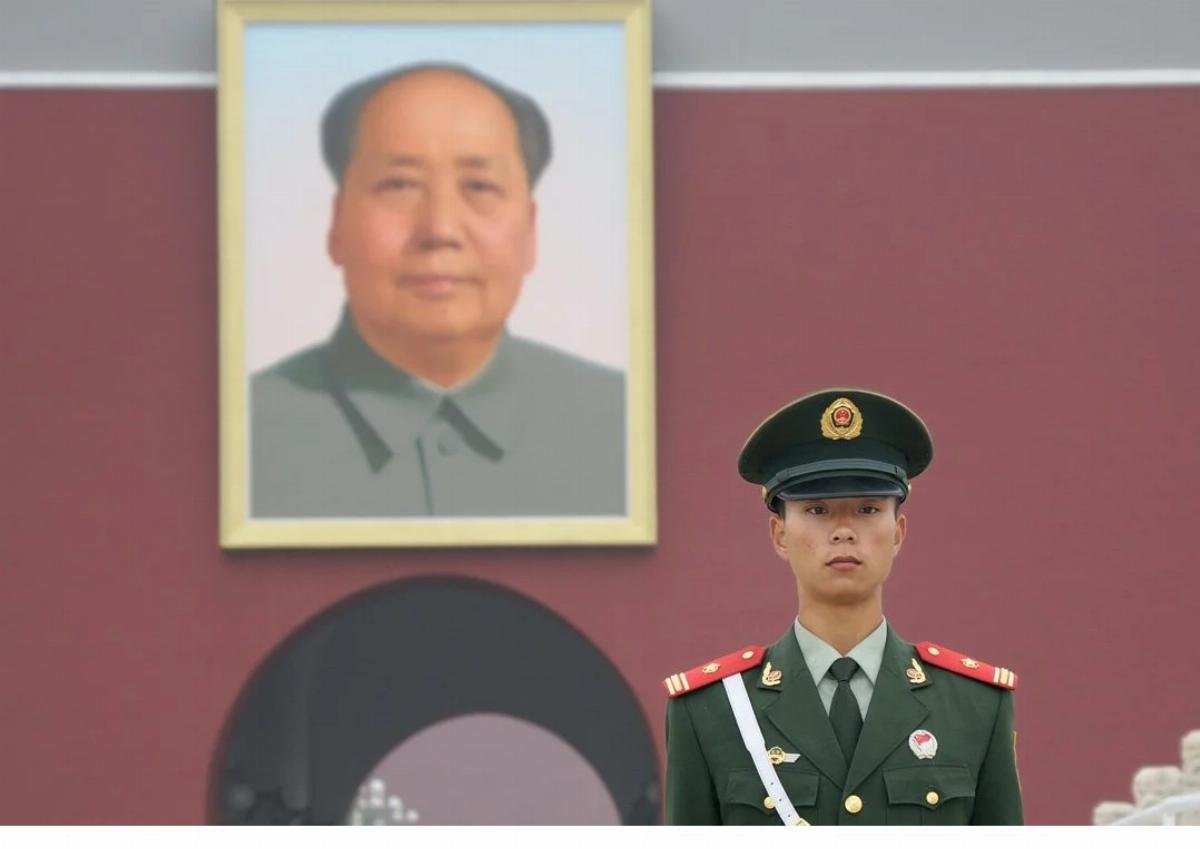
As Chinese President Xi Jinping made a state visit to the United States in the third week of September, an essay in American Thinker argues that Washington has spent more than a quarter-century misreading Beijing’s intentions — and that the cost of that misreading is now coming due.
The piece, written by Mike Phelps, opens with a blunt framing: China is not interested in living alongside a strong America. Instead, Phelps writes, Beijing is pursuing “a long-term strategy to weaken and supplant America.” That argument runs through the entire essay, which is less a report on current events than a call for a fundamental shift in how the United States understands its relationship with China.
A quarter-century of misjudgment
Phelps traces the problem back to President George W. Bush, who described the Chinese as strategic competitors more than 25 years ago. In Phelps’s reading, that characterization was a polite way of saying the Communist regime was no friend — but he argues that neither Bush nor his successors acted on the insight.
Rather than decoupling, the essay says, America’s economic ties to and dependence on China only deepened. Phelps points to the pandemic he attributes to China, writing that it left millions dead worldwide, caused billions in economic damage and produced incalculable losses in livelihoods, freedoms and social connections. The response from Presidents Obama and Biden, in his telling, amounted to acquiescence in the face of an increasingly aggressive Chinese posture. He lists hacking of American computer networks, theft of intellectual property and military technology, and information warfare on platforms such as TikTok as provocations that were largely met with indifference.
Phelps is not uncritical of President Trump. He writes that Trump “has not been perfect on this issue either” and still appears to believe a grand accommodation with China is possible. If that is the case, Phelps argues, the president misunderstands China’s endgame: China is not seeking accommodation but victory.
The doctrine behind the strategy
For evidence of resolve, Phelps turns to Unrestricted Warfare, the 1999 book by two Chinese colonels. Interviewed after its publication, the officers explained that “the first rule of unrestricted warfare is that there are no rules, with nothing forbidden.” Phelps concedes the observation is nothing new — it largely echoes Sun Tzu’s The Art of War. What matters, he writes, is that the book demonstrates China’s determination to realize its ambition of ascending to world dominance. No one, he concludes, should be content with that outcome.
The essay also invokes a 2021 State Department report on human rights abuses, quoting former Secretary of State Mike Pompeo’s finding that the Chinese Communist Party had committed crimes against humanity against predominantly Muslim Uyghurs and other ethnic and religious minorities in Xinjiang. The abuses described in the passage include the arbitrary imprisonment or severe deprivation of liberty of more than one million civilians, forced sterilization, torture of many of those detained, forced labor, and draconian restrictions on religious belief, expression and movement — crimes, Pompeo wrote, that are ongoing.
Follow the money
Phelps is candid about the difficulty of separating genuine misunderstanding from self-interest. He asks how much of Washington’s indulgence toward Beijing reflects a legitimate failure to grasp the nature of the regime, and how much reflects officials and businessmen making a great deal of money in China.
As one illustration, he raises Elaine Chao, the wife of Senator Mitch McConnell, who was accused of improperly using her position as Secretary of Transportation to help her father’s shipping company, which does business in China. Phelps argues Chao should have to explain why she held positions associated with the CCP while serving in the Bush and Trump administrations — whether she was improperly trying to influence U.S. policy on China’s behalf or acting solely for her own economic gain. Neither possibility, he writes, is good.
He also reaches back to the 1990s, recalling that President Clinton’s 1996 reelection campaign accepted $300,000 from a donor named Johnny Chung, who obtained the money from the head of China’s military intelligence. The media, Phelps notes, paid little attention at the time, perhaps because China was not yet seen as the threat it is today.
Canada’s role
The essay pivots north, warning that Canada — long viewed as America’s mild neighbor — has become a less dependable ally as its politics have swung left. Phelps asks whether distaste for President Trump is a sound reason for Ottawa to seek common cause with what he calls the West’s greatest threat, and whether Canadians genuinely fail to recognize that China is not their friend.
He suggests recent Canadian moves strengthen China at the West’s expense. Canada’s acceptance of Chinese-made cars, he writes, is a direct challenge to the American automobile industry — and he argues China is not looking to compete but to weaken and ultimately destroy that industry, thereby eroding U.S. heavy industrial capacity. Phelps reminds readers that the commercial auto industry also builds military equipment for the Pentagon, and that China’s long-term strategy involves strengthening its own military and projecting power farther from home while weakening America.
Red Fascism and generational drift
Phelps devotes attention to the domestic political dimension. Socialism and communism, he writes, have become fashionable in the Democratic Party, particularly among Generation Z, who have grown up on social media and been exposed to misinformation and left-wing indoctrination with little genuine education. He spreads part of the blame to teachers from grade school through college.
He describes China’s totalitarianism as “Red Fascism,” noting that it pays largely lip service to Mao and its Communist origins. Russia, in his telling, survives as a shadow of its Cold War self, while China survived civil war and revolution and then flourished with Western help to become the world’s second most powerful country. Now, he warns, Beijing is exploiting the West’s self-imposed decline in a bid to replace the United States as the global superpower.
President Trump and the MAGA movement, Phelps allows, have temporarily paused that decline. But he poses the question he wants readers to sit with: do Americans want to find out what the country would look like under a Gavin Newsom or Alexandria Ocasio-Cortez presidency, and what either administration would do to resist China’s ascent? He notes that the Democratic Party has cozied up to the Democratic Socialists of America.
The bottom line
Phelps closes with an unsparing characterization: China is an authoritarian dictatorship that murders its own people to keep control in the hands of an oligarchy, and that oligarchy is committed to a long war aimed at weakening and replacing the United States as the world’s sole superpower. A Chinese victory, he writes, would be a true global disaster — and America must accept that reality before China can be defeated.
The essay lands as a piece of advocacy rather than reporting, and it is candidly one-sided. Yet its core claim — that Beijing’s objective is not coexistence but primacy, and that U.S. policy has been slow to internalize that — is the fault line running beneath the Xi visit and much of the debate over trade, technology and Taiwan. Phelps’s contribution is to insist that the question is no longer whether to compete, but whether Washington is willing to name what it is competing against.
Source: www.americanthinker.com — https://www.americanthinker.com/articles/2026/09/there-can-be-only-one-preventing-china-from-becoming-a-superpower/