
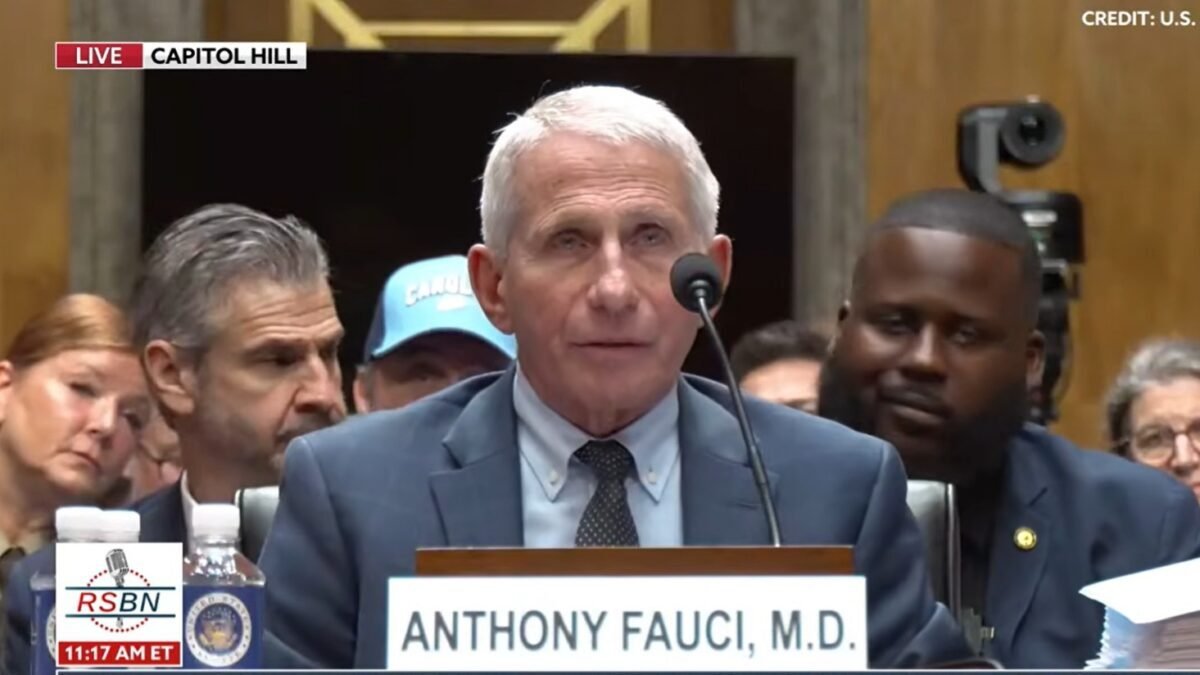
Dr. Anthony Fauci’s appearance before the Senate Homeland Security and Governmental Affairs Committee last week ended in a standoff when the former director of the National Institute of Allergy and Infectious Diseases invoked his Fifth Amendment privilege against self-incrimination in his opening statement and refused to answer questions throughout the hearing.
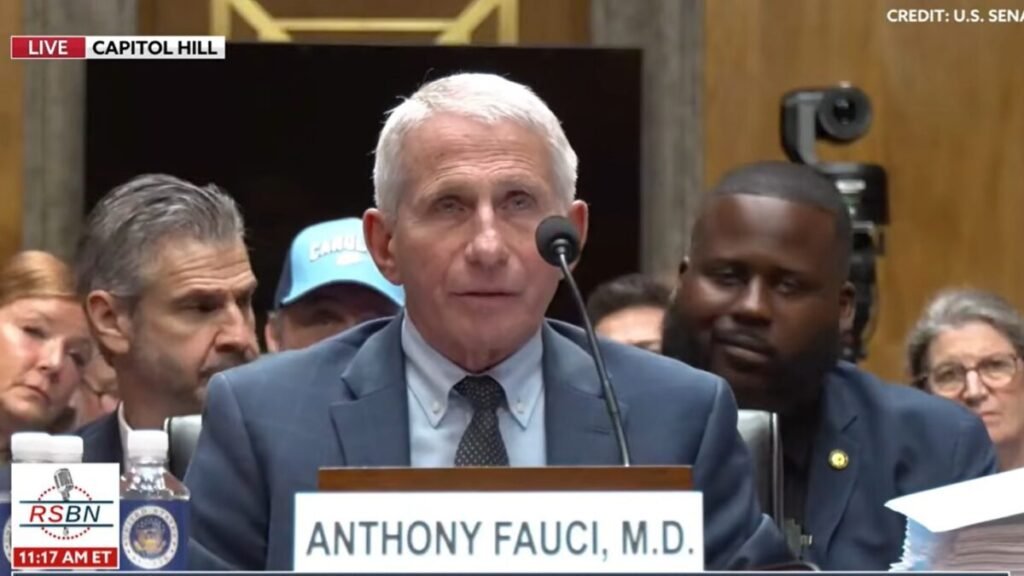
According to The Federalist, Fauci invoked the Fifth Amendment 111 times during the nationally televised hearing, creating a complex legal predicament that may undermine the presidential pardon he received from President Biden or expose him to criminal contempt charges.
The hearing came days after Fauci’s diary was released to the public, reportedly found on a federal government server. Committee Chairman Sen. Rand Paul (R-Ky.) stated at the hearing that the diary’s contents contradicted Fauci’s previous congressional testimony and public statements regarding gain-of-function research funding, mask efficacy, and the likelihood that a laboratory leak in Wuhan, China caused the COVID-19 outbreak.
The Biden Pardon
President Biden issued Fauci a pardon on January 19, 2025, covering “any offenses against the United States which he may have committed or taken part in during the period from January 1, 2014, through the date of this pardon arising from or in any manner related to his service as Director of the National Institute of Allergy and Infectious Diseases, as a member of the White House Coronavirus Task Force or the White House COVID-19 Response Team, or as Chief Medical Advisor to the President.”
This 11-year period spans nearly all federal statutes of limitations, including the five-year limit for false testimony to Congress. The pardon was preemptive, issued before any charges were filed against Fauci.
Legal Contradictions
The invocation of Fifth Amendment rights by someone holding a presidential pardon raises significant legal questions rooted in Supreme Court precedent. In Mason v. United States, the Supreme Court established that pleading the Fifth is “confined to instances where the witness has reasonable cause to apprehend danger from a direct answer.”
Furthermore, in Brown v. Walker, the Court clarified that “the danger to be apprehended must be real and appreciable… not a danger of an imaginary and unsubstantial character, having reference to some extraordinary and barely possible contingency, so improbable that no reasonable man would suffer it.”
Legal experts have pointed to several situations where the Fifth Amendment cannot be legitimately asserted, including when a person holds amnesty, testimonial immunity, statutory immunity, or when the statute of limitations has expired. A presidential pardon falls into this category of circumstances that may prevent invocation of the Fifth.
Senators repeatedly asked Fauci questions related to his previous testimony about COVID-19 origins, the lab leak theory, masking policies, school closures, and funding for gain-of-function research. According to The Federalist, Sen. Bernie Moreno (R-Ohio) even asked mundane questions about the color of Fauci’s necktie and the carpet, to which Fauci responded with the same invocation of the Fifth Amendment.
The Burdick Precedent
A 1915 Supreme Court case, Burdick v. United States, presents a particularly relevant precedent. In that case, George Burdick, an editor at the New York Tribune, received a preemptive pardon from President Woodrow Wilson for any federal offenses related to publication of an article about alleged fraud. Like Fauci, Burdick had not been charged with any crime.

Despite holding the pardon, Burdick refused to testify before a grand jury, asserting his Fifth Amendment right against self-incrimination. Crucially, Burdick never affirmatively asserted or declared his pardon. The Supreme Court concluded that “it was Burdick’s right to refuse [the pardon]” and stand on his Fifth Amendment objection.
In other words, the Court established that invoking the Fifth Amendment can constitute abandonment or refusal of a pardon.
Waiver Through Opening Statement
Additional legal complications arise from Fauci’s opening statement. Before invoking the Fifth Amendment, Fauci referenced his “decades-long cooperation with Congress,” which legal analysts view as an oblique defense of his previous testimony. Courts have held that making such statements before invoking Fifth Amendment protections may constitute a waiver or forfeiture of the right to assert the privilege altogether.
The Supreme Court has also established that the self-incrimination privilege refers only to past activities, not to potential future perjury or false statements resulting from current testimony. Additionally, the Fifth Amendment cannot be invoked simply because truthful answers would “have the tendency to disgrace” the witness.
Potential Criminal Consequences
The legal situation creates a dilemma for Fauci. If he maintains that his activities were covered by the presidential pardon and he is immune from prosecution for those activities, he may face charges for criminal contempt of Congress for improperly invoking the Fifth Amendment when he had no genuine legal jeopardy.

Conversely, if Fauci’s repeated invocations of the Fifth are deemed to constitute abandonment or refusal of his pardon under the Burdick precedent, activities covered in the pardon period may become subject to prosecution once again. In that scenario, his diary could serve as evidence in any proceedings.
There appears to be no feasible state or local prosecution that could result from alleged previous false testimony before Congress, as only federal law would apply to such testimony. This eliminates any potential danger from state-level charges that might otherwise justify invoking the Fifth despite holding a federal pardon.
Contempt Referral
Sen. Paul has indicated he will make a criminal referral to the Department of Justice as early as this week. The Justice Department will need to examine these narrow legal concepts and determine whether charges should be brought for either criminal contempt of Congress or for underlying offenses during the pardon period if the pardon is deemed abandoned.
The situation bears similarities to contempt prosecutions of Trump administration officials during the Biden administration, where refusal to answer congressional questions resulted in criminal charges.
According to The Federalist’s reporting, if Fauci had testified truthfully during the hearing, even if that meant admitting he previously gave false testimony before Congress during the covered pardon period or misled the American public, he would face no legal consequences due to the pardon’s protective scope.
Instead, by invoking the Fifth Amendment 111 times under oath before the U.S. Senate, Fauci now faces potential legal jeopardy on multiple fronts while damaging his public legacy.
Source: thefederalist.com — https://thefederalist.com/2026/08/04/why-faucis-refusal-to-answer-congress-puts-his-pardon-in-jeopardy/