
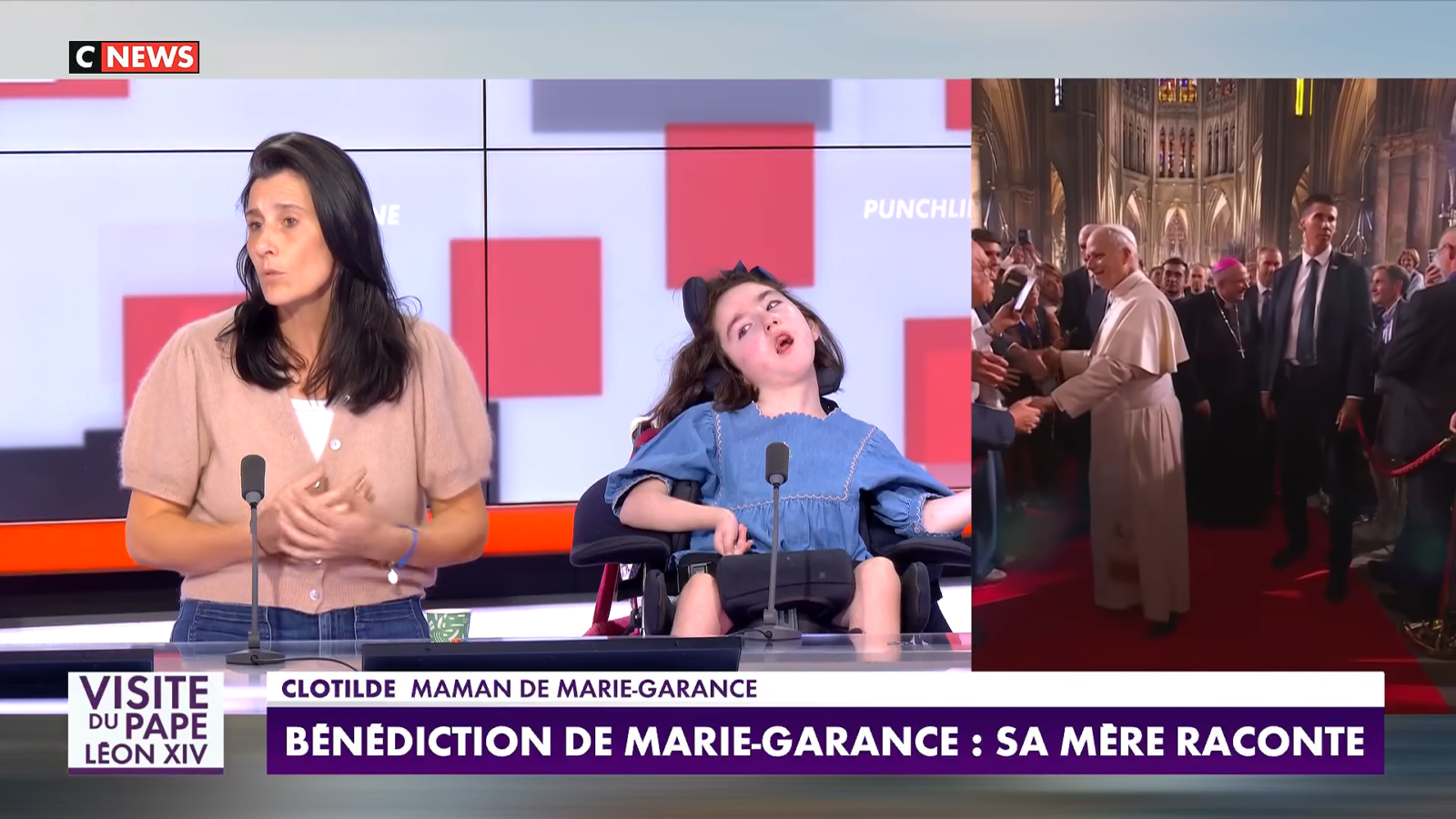
Pope Leo XIV’s recent apostolic journey to France was punctuated by an image that has since traveled far beyond the streets of Paris: the pontiff pausing his motorcade along the Champs-Élysées to bless a severely disabled young girl. According to reporting in The Federalist, the moment was more than a display of papal warmth — it was a pointed theological challenge to a continent that the outlet argues has increasingly embraced a utilitarian view of human life.
The girl, identified as Marie-Garance, was adopted at 16 months old by Clotilde and Nicolas Noël, a Catholic couple with six biological and three adopted children, all of whom have severe disabilities. The Federalist reports that she requires daily care, medication, and a gastrostomy tube. The outlet framed her presence at the heart of the papal visit as an indictment of secular European policies on abortion and euthanasia.
A Liturgical Message in Paris
The centerpiece of the pope’s message, according to The Federalist, came not only through the blessing of Marie-Garance but through his selection of altar servers at an open-air Mass in Paris. Leo XIV chose six men and boys with Down Syndrome to serve alongside him — a deliberate counterpoint, the outlet argues, to European nations where prenatal genetic testing and abortion have sharply reduced the number of people born with the condition.

The pope did not leave his criticism implicit. In an official address delivered at Macron’s residence, he directly challenged the French president’s support for the country’s newly passed “aid in dying” law. “It is impossible to regard causing death as something normal. What is legal is not necessarily moral,” the pope said, according to The Federalist. “The protection of the right to life constitutes the indispensable foundation of every other human right.”
Macron had championed the assisted suicide legislation and celebrated its passage last month, making the pope’s remarks — delivered in his own home — a striking public rebuke.
The Netherlands and the ‘False Compassion’ of Euthanasia
At Lourdes, speaking to a crowd of 150,000 pilgrims, Leo XIV returned to the theme. “Here, no one is turned away due to their frailty,” he said, as quoted by The Federalist. “Your crutches, your wheelchairs and your hidden tears are not obstacles; instead, they are the very place where you are fully respected and welcomed, and where you can experience a transforming encounter with the infinite love of God.”

The Federalist situates the pope’s words against a specific and alarming case: a two-year-old boy in the Netherlands who was euthanized last year under the country’s expanded law. The child was born with severe disabilities but was not terminally ill. The outlet describes the killing as a milestone — the first euthanasia of a child in the Netherlands since a 2024 rule change permitted doctors to euthanize children under 12.
The official body tasked with reviewing the case — the Assessment Committee for Late-Term Abortion and Termination of Life in Newborns and Children Ages 1 to 12 — released its assessment earlier this month. According to The Federalist, the committee wrote that “all facets of ‘being human’ — regarding motor skills, behavior, and personality — were severely impaired and were not going to improve.” The committee concluded that the doctor had “strictly adhered to all due-care requirements.”
The Federalist sharply critiques this reasoning, arguing that it reduces human dignity to a set of measurable metrics. Under such a framework, a child’s humanity becomes contingent on developmental capacity rather than inherent worth — a worldview the outlet ties to the de-Christianization of Europe. In its telling, the euthanasia of a toddler is a modern form of child sacrifice, a practice that Christianity and the doctrine of imago Dei — that every human is made in the image of God — had long since banished from the continent.

The Noël Family and a Countercultural Witness
The contrast The Federalist draws is personal as well as political. Clotilde Noël, a mother of nine, wrote a book titled *Tombée du Nid* (*Falling from the Nest*) about raising her large family and caring for her adopted disabled children. That book inspired an organization of the same name, founded by Clotilde and Nicolas, which supports adoptive parents raising children with disabilities.
In a 2023 interview with Aleteia, Noël described her family’s calling. “When we decided to go on the road to adoption, I understood the phrase: ‘I have called you by your name,'” she said, citing Isaiah 43:1. “It was as if God were saying to me, ‘I’m calling on you. You are the one I have chosen.’ I have accepted that I have to trust Him and I receive incredible graces. Once you say ‘yes’ to God, everything happens naturally. He never abandons us.”
For The Federalist, the Noël family embodies the alternative to the utilitarian logic it attributes to European policymakers: a recognition that impairments do not diminish human dignity, but rather reveal its deepest meaning. The outlet frames the pope’s visit as a defense of a distinctly Christian anthropology — one it argues is the foundation of Western civilization itself.
As the debate over assisted suicide and prenatal testing continues across Europe, the pope’s words and the image of Marie-Garance receiving a blessing on the Champs-Élysées now stand as the most contested symbols of his trip. Whether they will shift policy is unclear, but the Vatican’s intent was unmistakable: to present the Catholic vision of human dignity as a rebuke to the laws France and its neighbors are increasingly willing to pass.
Source: thefederalist.com — https://thefederalist.com/2026/09/30/pope-leos-embrace-of-disabled-people-in-france-is-a-rebuke-to-secular-europe/