
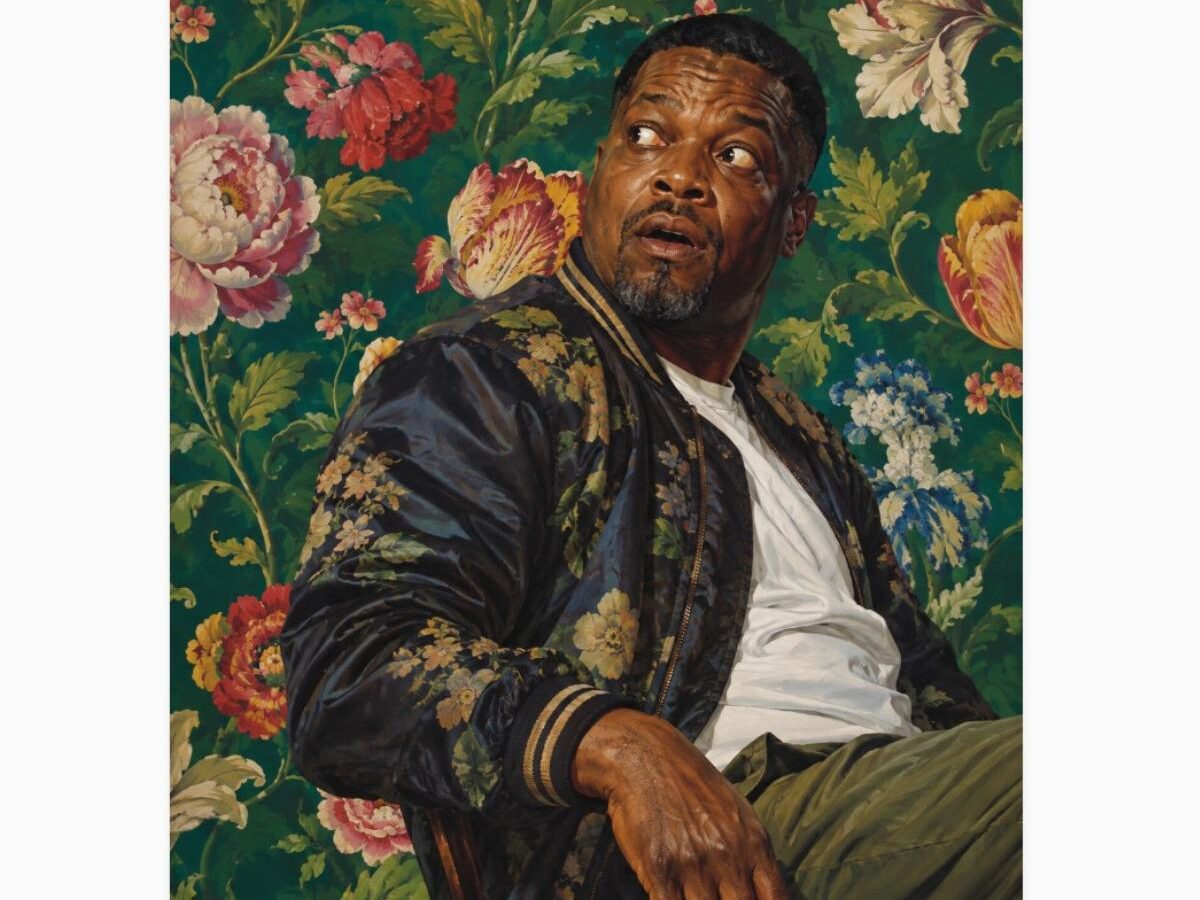
There’s a particular kind of whiplash that comes when an artist builds a career on political association and then discovers that political association cuts both ways. Kehinde Wiley — the painter who became a household name after the Obama administration commissioned him to produce the former president’s official portrait — is learning that lesson in real time, according to reporting in American Thinker.
Wiley has reportedly sent a letter to President Trump asking to buy back one of his paintings after administration officials removed it from the American Embassy in the Dominican Republic. As The New York Times first reported, the painting drew the ire of embassy staff, was mocked by officials as “aesthetically terrifying,” and was at one point falsely described as featuring a “lesbian picnic.” When government officials hinted they might sell the work, Wiley moved to reclaim it rather than see it liquidated or warehoused.
Speaking to The Times on Monday — his first public comments on the controversy — Wiley described the whole episode as the source of a “deep sadness.”
“If the administration is not particularly interested in the work, bring it home. Let me have it,” he told the paper. “It was a really successful painting and it is a shame it was so little understood.”
The Patronage Pipeline
The American Thinker piece, written by Monica Showalter, doesn’t pretend to be neutral about any of this. Her argument is essentially that Wiley built a career on the back of Obama-era cultural politics, and now he’s discovering what happens when the other side holds the levers of institutional power. The headline practically writes itself: a man who traffics in irony suddenly finds the irony pointed squarely at him.
There’s a substantive critique buried under the schadenfreude, though. Showalter acknowledges liking Wiley’s paintings personally — she saw a gallery exhibition at the La Jolla Museum of Contemporary Art (under whatever name it now carries) last Juneteenth and found his work more compelling than the other pieces on display, praising what she called “great character and interesting gestures” in his subjects. Her objections are less about the canvases themselves than about the political machinery that elevated them.
She notes that Wiley, like Robert Rauschenberg, premises much of his art on irony — most famously in his take on Caravaggio’s Judith Beheading Holofernes, which substituted a Black woman holding a white woman’s severed head, a version Showalter notes had little to do with the biblical source material. That single early move, she suggests, cemented his political credentials within a particular cultural orbit, and the Obama commission did the rest: The New York Times, in its own coverage, has noted the portrait made him famous, then wealthy.
Who Gets to Curate
The embassy controversy has pulled back the curtain on how federal art programming actually works. According to The Times, the dispute erupted after Leah Campos, the U.S. ambassador to the Dominican Republic, noticed the painting — reportedly one of the first things a visitor would see upon entering the embassy — and disliked it. She contacted Erin Scavino, who runs the State Department’s Art in Embassies program.
The Times casts Scavino as a political operative rather than an arts professional: a former contestant on “The Apprentice” married to White House aide Dan Scavino, who has, according to former State Department officials, used her position to push the government’s collection in a more ideologically congenial direction and to install personal friends in cultural leadership roles despite their lack of arts credentials.
Showalter’s response to that framing is essentially: so what? Embassies exist for messaging, and the sitting president gets to decide what that messaging is. She also raises a sharper point about consistency — the administration, she notes, cited sexual harassment allegations against Wiley, which he denies. Given the left’s own embrace of the MeToo movement, she writes, that particular irony is hard to miss.
The Critic’s Revenge
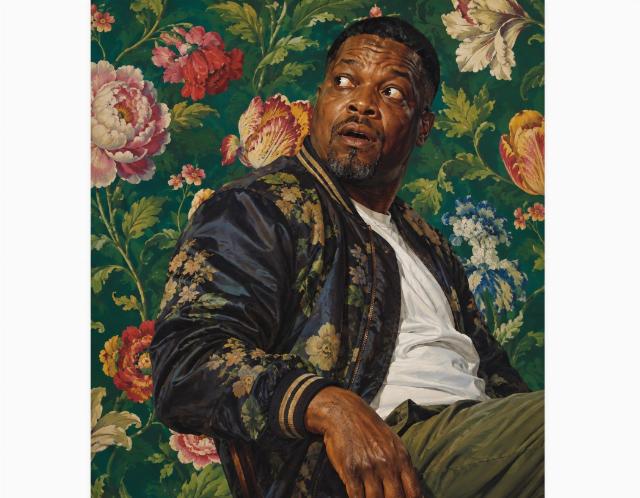
Then there’s the question of the work itself. Showalter argues that Wiley’s reputation has largely escaped the kind of scrutiny that would otherwise attend an artist of his commercial scale. His operation, she writes, functions more like an industrial studio than a traditional painter’s practice, with large workshops — one reportedly based in Beijing — where production assistants execute canvases on assembly lines. His formula, in this telling, is predictable and repetitive: white historical figures swapped out for Black subjects against floral wallpaper backdrops that function as branding more than artistic depth.
That critique isn’t coming exclusively from the right. Showalter cites art critic Jerry Saltz — hardly a conservative — as having expressed misgivings of his own. She also points out that formulaic, factory-style work is easy to knock off, a point she illustrates with an AI-generated image.
On the market side, ARTNews reports that comparable Wiley paintings have sold for around $845,000. Showalter notes, with some relish, that a series of Hunter Biden’s blow-pipe paintings reportedly fetched $875,000 — a bit more than an actual working artist. Both men, she argues, benefited from proximity to Obama-era political networks, and her framing treats the two as points on the same continuum.
“I just happen to be the guy who painted Obama,” Wiley told The Times. “That is the elephant in the living room.”
He’s not wrong about that. The Obama portrait brought him fame, fortune, and a devoted collector base — Showalter describes gallery crowds that felt like the Nikole Hannah-Jones set, with Alicia Keys among the top collectors. (It was Keys’s collection, she notes, that she viewed in La Jolla; Rep. Ilhan Omar reportedly visited the same show after it moved east.)
The Trap of Proximity
Wiley’s own phrasing — “bring it home. Let me have it” — carries a kind of pathos that’s hard to fake. He clearly cares about the painting. He clearly believes it deserved better than a hasty removal and a snide press rollout. And he’s right that the “lesbian picnic” detail was false, and that “aesthetically terrifying” is a matter of taste, not an objective verdict a government should be rendering about an American artist’s work.
But the American Thinker piece lands on something real underneath the irony: political patronage is a loan, not a gift. Wiley’s career benefited enormously from association with an administration whose cultural preferences aligned with his own, and he is now discovering that the flip side of institutional embrace is institutional rejection — that the same machinery that can make an artist can just as easily unmake one when the people operating it change.
Showalter, for her part, says she would have kept the painting, or at least moved it to the Smithsonian, characterizing it as the work of a significant American artist from an earlier political era whose fame came partly from his Obama association. That’s a more generous position than the administration she’s defending took — and it’s a reminder that there were middle paths available, none of which anyone chose.
Wiley’s letter to President Trump is, in a sense, an acknowledgment that the rules of the game are what they always were: whoever holds the building decides what hangs on its walls.
Whether he gets the painting back is a practical question. Whether he’s fully processed the irony is another matter entirely.
Source: www.americanthinker.com — https://www.americanthinker.com/blog/2026/10/obama-portrait-artist-kehinde-wiley-finds-out-the-hard-way-that-the-irony-is-now-on-him/