
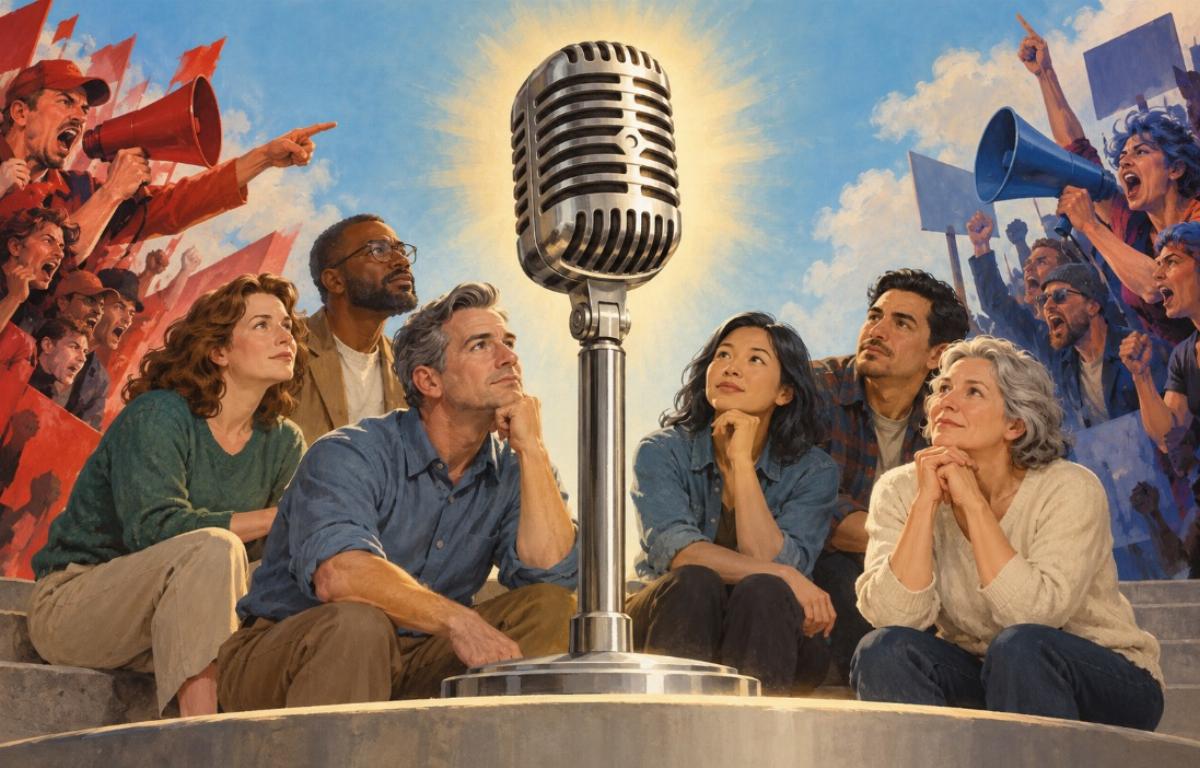
The question of why American politics feels so polarized usually comes with a built-in assumption: that the voters themselves drifted to the edges, leaving the middle behind. A new essay in American Thinker offers a different reading — one drawn from ecology, of all places — arguing that the center didn’t disappear, it simply lost its representation, and an unrepresented majority eventually stops looking like a majority at all.
The piece, by David DeMay, published October 1, 2026 in the outlet’s John Fetterman vertical, borrows a concept from the natural world: an empty niche is not the same thing as an unwanted one. Sometimes it just means nothing has managed to occupy it yet. Apply that to the American political center, DeMay suggests, and several pieces of conventional wisdom start to wobble.
Why the middle went quiet
The essay’s central claim is structural rather than moral. For years, the standard story has been that Americans themselves polarized — that with only rare exceptions, the electorate moved toward the ideological poles. DeMay proposes a competing explanation that deserves more attention than it gets: the political center didn’t vanish, its representation did. Without a voice, it became invisible, and once invisible, it gets treated as nonexistent.
What drives that disappearance, according to the essay, is the media engine. The old newsroom axiom — if it bleeds, it leads — has, in DeMay’s telling, accelerated in the social media era. Conflict produces headlines, viral clips and theatrical villains, which makes the ideological edges culturally fashionable. Moderation, by contrast, resists theater. There’s little emotional voltage in acknowledging that compromise is necessary, so the incentive structure rewards extremity while moderate positions are quietly pushed to the side.

The result is a kind of optical illusion. Because the most visible political impulses are also the most extreme, the center gradually appears vacant — not because people left it, DeMay writes, but because the microphones packed up and moved to the fringe.
To make the point land, the essay reaches for a children’s book. In Horton Hears a Who!, the title character detects a faint sound that everyone around him dismisses, and the lesson is that silence is not the same as absence. American politics makes the same error, DeMay argues, whenever it treats shouting volume as an accurate census of the population. The essay poses the question plainly: what if millions of Americans never evacuated the center at all? What if only much of their political class did? The voters, in this framing, are still waiting there — their representatives have simply fallen silent.
Fetterman as the test case
That’s where John Fetterman enters the argument, and where the essay gets its most concrete example. The Pennsylvania senator, per DeMay, appears to be one of the only figures paying attention to moderates. Fetterman offers a demonstration of something the essay considers more important than any single policy stance: by remaining inside his political coalition while publicly breaking with it on significant issues, he disrupts the binary assumption that every politician must conform to every position associated with his own side.
DeMay is careful to note that readers can think whatever they like about Fetterman’s individual positions. What matters for the argument is his visibility. Ideological independence, the essay contends, can still command attention — which means the space for it hasn’t been closed off, only left unoccupied.
And that distinction is the heart of the piece. DeMay writes that the individual politician matters less than the ecological opening. An empty niche, in nature, eventually invites occupation. If one voice from the silent center becomes two, and two become twenty, the essay predicts, American politics may discover the territory was never abandoned in the first place — it was just waiting for a microphone.
A familiar complaint, reframed
The complaint that the center lacks a champion is hardly new, and American Thinker’s own framing doesn’t pretend otherwise. What gives the essay its hook is the mechanism it proposes. Rather than blaming voters for drifting apart, DeMay points at an incentive system — conflict-driven coverage, viral incentives, the theatrical premium on outrage — that makes the middle look smaller than it is. Reclaiming that space, the essay argues, requires more than simply existing. It requires amplification, and amplification requires someone willing to be visible while refusing to be fully sorted into a partisan camp.
Whether Fetterman is the beginning of that occupation or an isolated exception is a question the essay raises without resolving. DeMay’s closing note is more modest than sweeping: the empty niche has been sitting there, unclaimed, and the only way to find out how many people are standing in it is for someone to start talking.
The piece appears in American Thinker, a conservative-leaning outlet, under its John Fetterman topic — a placement that itself says something about the cross-ideological interest the senator’s approach generates. For readers on either side, the essay’s underlying proposition is the harder one to dismiss: that the loudest voices in a debate are not necessarily the most numerous, and that a representation gap can masquerade as a consensus.
DeMay’s argument lands in a media environment where the incentives he describes are, if anything, intensifying. The essay doesn’t offer a blueprint for changing them. It offers a wager instead — that the audience for something other than conflict is still out there, waiting, and that the first politician willing to speak into that silence might find it far more crowded than it looks.
Source: www.americanthinker.com — https://www.americanthinker.com/blog/2026/10/there-s-a-middle-in-america-but-it-has-no-political-voice/