
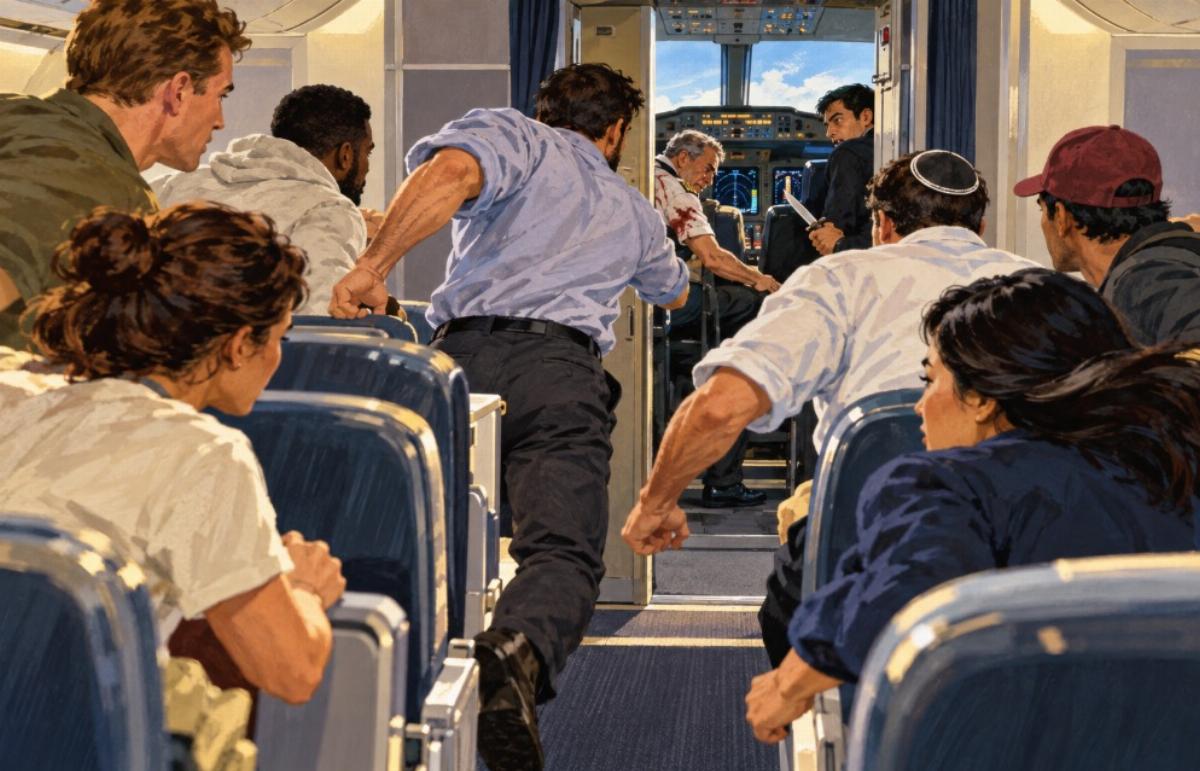
When the co-pilot of Flydubai Flight FZ1073 stabbed Captain Smit Machchhar and the aircraft dropped more than 14,000 feet in seconds, the wounded captain opened the cockpit door. Israeli passengers went in and subdued the attacker. Writing in American Thinker, Israeli-American IDF veteran and Krav Maga instructor Tsahi Shemesh says the headlines recorded what those passengers did, but skipped the harder question: would you have made that decision within seconds, knowing you might die trying, and knowing that doing nothing might kill everyone around you?
Shemesh, who has spent two decades teaching self-defense and founded Krav Maga Experts in New York City, argues that most people watching from a couch imagine they would move. His experience tells him otherwise. The gap between imagining courage and displaying it, he writes, comes down to a single moment that arrives before any punch is thrown and before any technique is applied: the decision that the information in front of you is already enough.
Waiting for Permission That Never Comes
The passengers on FZ1073, as Shemesh describes the scene, did not know the attacker’s plan or whether anyone else was involved. No one gave them instructions. What they knew was that the captain was bleeding and the plane was falling. That was the whole of their intelligence picture.
Most people, in his account, keep searching for one more piece of information. They wait for someone with authority to confirm what their own eyes are telling them. They wait for someone else to move first. Under extreme stress, the mind can keep hunting for an explanation while the danger continues to develop — which is why Shemesh says he teaches the freeze response as seriously as he teaches physical defense. Perfect technique, he notes, has no value if you cannot decide to use it.
The cost of that hesitation is measured in options. On a subway platform, delay means losing distance. In a crowd, it means losing an exit or the chance to shield someone standing beside you. On FZ1073, it meant losing altitude. Nobody outside that cockpit door was coming to help in time.
Why Israelis Moved
Shemesh writes that he was not surprised Israelis acted without hesitation, and he roots that reflex in history rather than temperament. Israel, he argues, has spent generations confronting terrorism aimed at civilians — people murdered on buses, in cafés, at weddings, in homes and at public events. The October 7 attacks added entire communities and a music festival to that list. The lesson Israeli society drew, over and over, is that ignoring a declared threat does not make the threat vanish.
He points to September 11 as the moment the rest of the world absorbed a similar lesson. The passengers aboard United Flight 93 knew hijacked aircraft had already struck the World Trade Center. They did not know the full plan for their own flight, but they understood enough to act. They fought back, and the hijackers never reached their intended target.
From there, Shemesh widens the lens from a single aisle to the conduct of nations — and his argument turns pointed. Radical Islamist movements, he writes, have been stating their intentions for decades. Hamas’s 1988 founding charter called for Israel’s elimination. After October 7, senior Hamas official Ghazi Hamad said the organization would repeat attacks like October 7 again and again. Jihadists have acted on that ideology in airplanes, concert halls, schools, hotels, restaurants and city streets from New York to Paris to Jerusalem.
Yet Western institutions, in his telling, keep reaching for softer language. Terrorists become “militants.” Explicit ideological commitments get recast as grievances to be analyzed. Clear threats are treated as mere rhetoric until someone acts on them. His line for this habit is blunt: a knife stays just as dangerous when you refuse to name the man holding it.
Awareness Is Only Half the Job
The constructive half of Shemesh’s essay is about what self-defense actually requires. He defines situational awareness as noticing behavior, distance, capability and environment — and, critically, how quickly the situation is changing. Awareness only becomes useful, he insists, when you can convert what you see into a decision.
That conversion is trainable, he writes. Training under pressure teaches people to function while afraid, to decide with incomplete information, and to act while useful options still exist. The goal is not certainty. It is recognizing when the evidence you already hold has crossed the threshold for action.
The passengers aboard FZ1073 had seconds. They went through the door.
Shemesh closes by extending the same standard to states. You will rarely have complete information when real danger arrives, he writes, and neither will a country. The question is whether you will recognize when you already know enough. His biography accompanies the piece: an Israeli-American IDF veteran, father and educator who writes about Jewish identity, resilience, moral courage and the ethics of strength amid rising antisemitism.
It is, in the end, a self-defense instructor’s argument applied to the largest possible frame — that the hardest part of protecting yourself, or your country, is not the fight but the instant you decide the fight has already begun.
Source: www.americanthinker.com — https://www.americanthinker.com/blog/2026/10/would-you-have-gone-through-the-cockpit-door/
Source: www.americanthinker.com
Related coverage
- IQM and Pasqal Head to Nasdaq as Europe’s Quantum Champions Head for the Exit
- AR-15 Ownership Surges as Rifle-Related Crimes Hit Record Lows
- American Thinker: Gemini Calls GOP Positions ‘Far-Right’ but Won’t Say the Same of Democrats
- Remembering the Prague Spring: When 200,000 Soviet Tanks Crushed a Nation’s Hope