
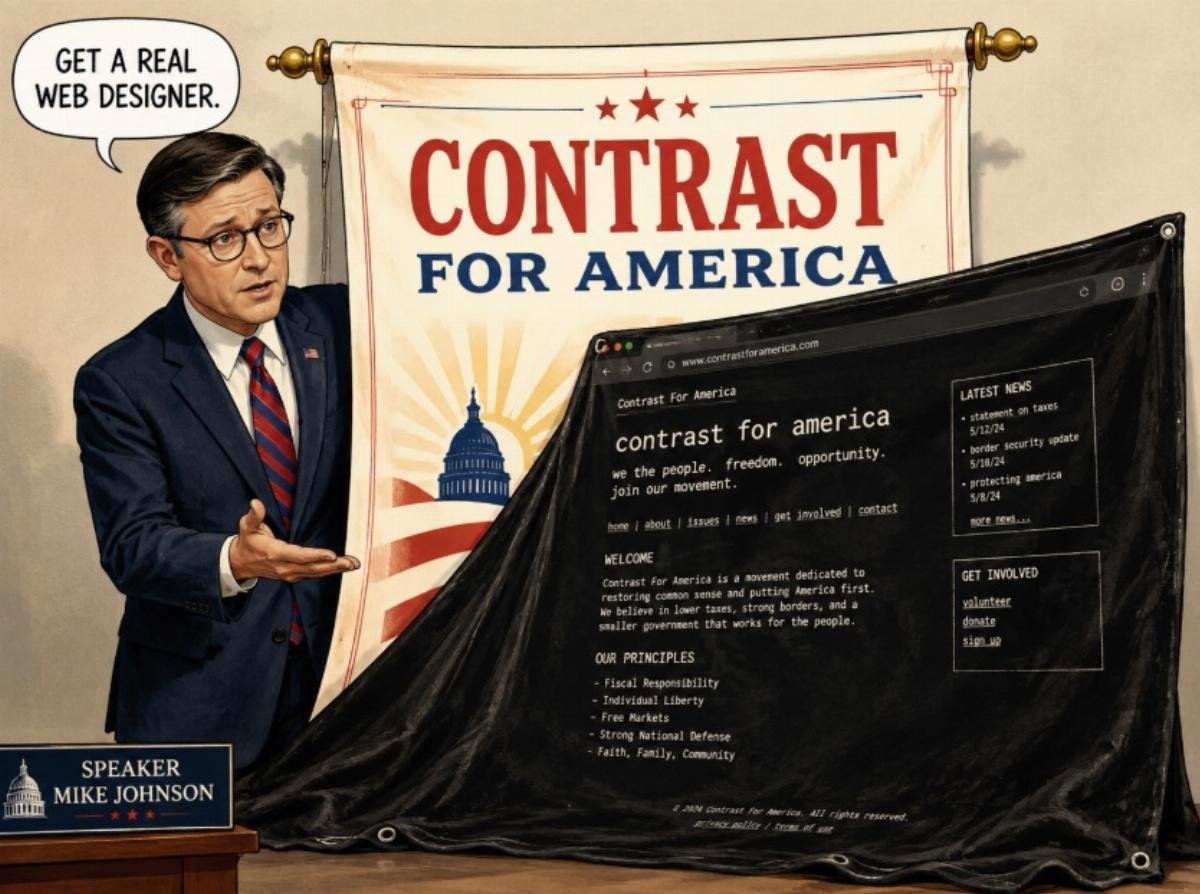
Former House Speaker Newt Gingrich sees real potential in Speaker Mike Johnson’s new “Contrast for America” initiative—potentially as transformative as the famous 1994 “Contract with America.” But according to a new analysis at American Thinker, the plan’s rollout is so poorly executed that it may never reach the voters it’s meant to persuade.
In an August 15 opinion piece, American Thinker contributor Andrea Widburg argues that while the Contrast for America has a solid core idea, it’s being undermined by a combination of weak promotion and a badly designed website. The piece highlights a broader problem: in 2026, getting a political message out requires more than just a good policy platform—it requires digital savvy that, so far, appears to be missing.
What is the ‘Contrast for America’?
The initiative is intended to update Gingrich’s 1994 “Contract with America,” the famous policy agenda that helped Republicans sweep the House that year. In a video that Widburg says she stumbled across while curating content for American Thinker’s new “Watch” section, Gingrich himself expresses optimism that the Contrast for America could be “every bit as successful” as its predecessor.
The timing, Widburg argues, is favorable for Republicans. She writes that Democrats are “daily revealing themselves to be pretty awful”—characterizing them as “communists, Islam-adjacent, and disconnected from reality.” Those are harsh partisan descriptions, but they reflect the piece’s core argument: the contrast should be easy to sell.
The problem, as Gingrich himself notes in the video, is that success depends on Republicans being “courageous and smart.” Widburg wryly observes that “courageous is almost never paired with Republicans” in her experience, and while individual Republicans may be smart, the collective’s campaign instincts can be “disheartening, to say the least.”
A media landscape that no longer exists
Widburg’s central point is that the 1994 “Contract with America” succeeded in part because of a media environment that no longer exists. Back then, she notes, there were just three major broadcast networks—ABC, NBC, and CBS—plus CNN. Fox News wouldn’t launch until October 1996. Local newspapers, along with the New York Times and Washington Post, were widely read, and global wire services like Reuters and the AP ensured stories reached every corner of the country.
That meant that even though the mainstream media largely disparaged the Contract with America, they still covered it. “They had to,” Widburg writes, because in a pre-internet age there wasn’t a constant stream of competing content to pick and choose from. Voters, she argues, at least had a chance to see the plan and decide for themselves.
Today, the information universe is fragmented. There are endless outlets, endless platforms, and endless ways for a message to get lost. Widburg, who describes herself as “incredibly well connected to the news,” admits she hadn’t heard of the Contrast for America until she watched the Gingrich video. That’s a damning sign for an initiative that’s supposed to shape the November elections.
The website problem
Even if the media weren’t ignoring the initiative, Widburg says the website itself is a disaster. She describes a single-page format that is “very poorly done,” with a black background and white text that she says is hard on the eyes. The type is tiny, the flow is “illogical,” and the overall feel is, in her words, “high school.”
She’s blunt about the consequences: “This will not go viral.”
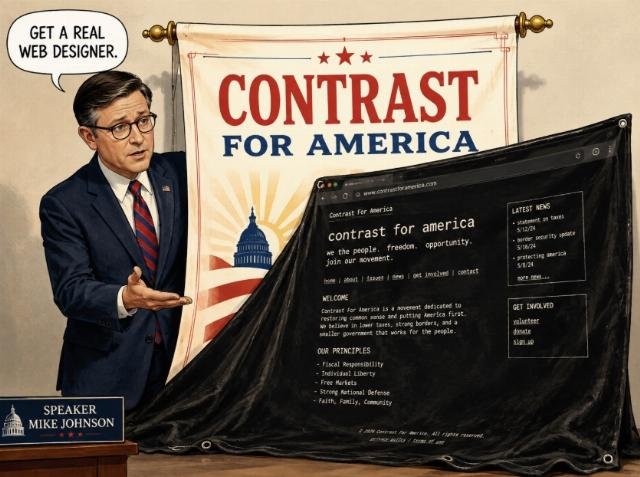
The piece suggests an obvious fix: bring in professional help. “You’d think that someone would have said, ‘Hey, Elon, we need help. You’re a design guy,'” Widburg writes, referring to Elon Musk. “Can you find someone to make a website for us that’s modern enough to attract young people, and visually friendly enough for the oldsters?”
Instead, she says, “it seems that nobody asked.” Her advice to Speaker Johnson is direct: “Stop having some House intern design a website that could be the difference between winning and losing an incredibly important election.”
A good idea at risk
The broader concern, Widburg argues, is that a sound political concept is being undermined by sloppy execution. The Democrats’ recent behavior should make them vulnerable, she says, but that only matters if Republicans can effectively communicate the contrast. A poorly designed website and a lack of promotion could squander what should be a winning hand.
“I hate seeing a smart concept brought down by poor technology and implementation,” she writes.
Whether the Contrast for America will ultimately succeed is an open question. But the piece makes a compelling case that it won’t matter how good the ideas are if voters can’t find them—or, when they do, can’t read them without straining their eyes.
For now, the initiative remains largely unknown. And in a political environment where every day brings new distractions, an unknown message is often an ignored one.
Source: www.americanthinker.com — https://www.americanthinker.com/blog/2026/08/the-contrast-for-america-a-good-idea-with-a-rotten-rollout/