
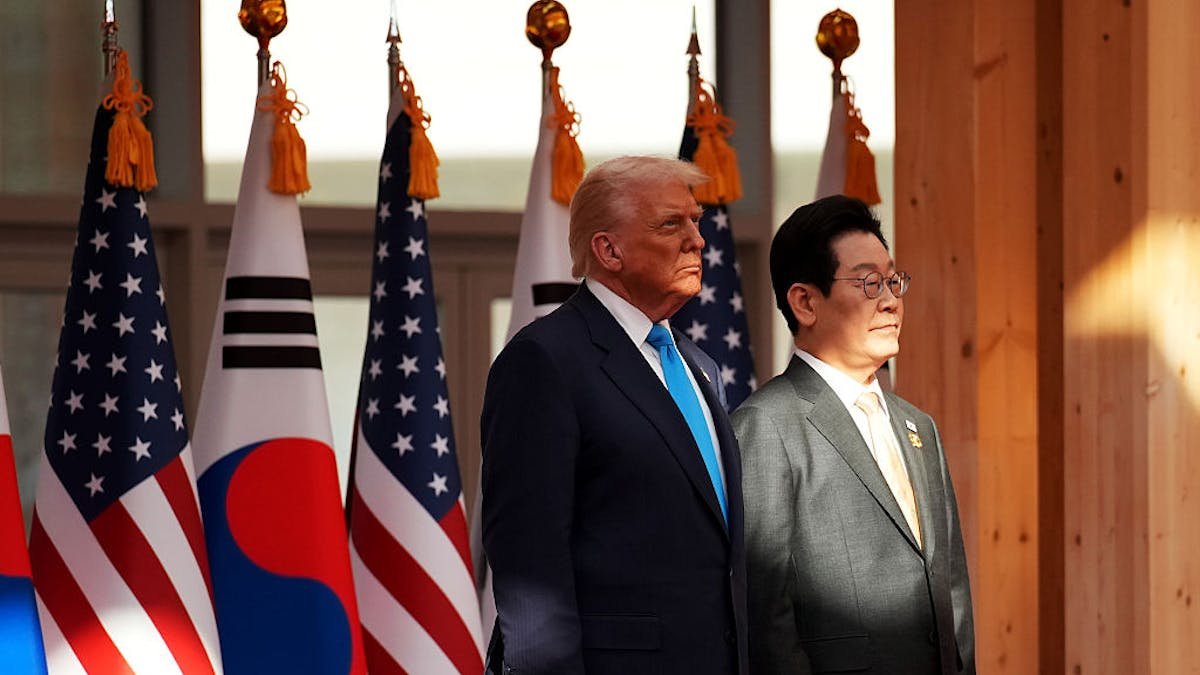
President Donald Trump’s announcement that he will order the Pentagon to “substantially reduce” joint military exercises with South Korea has sparked criticism that the move confuses allies with adversaries and risks empowering America’s enemies in the Pacific, according to a new analysis published by The Daily Wire.
In a social media post, Trump cited his “very good relationship” with North Korean leader Kim Jong-un and Seoul’s failure to assist Washington in its conflict with Tehran as justifications for scaling back the drills. The president’s explanation marks a sharp reversal from his own dismissal of Seoul’s help five months ago, when he insisted that “WE NEVER DID” need South Korea’s assistance to reopen the Strait of Hormuz.
The move mirrors a gambit Trump played during his first term, when he sought to use reductions in joint exercises as an olive branch to Pyongyang. Critics, however, argue the decision undermines deterrence on the Korean Peninsula at a time when the region is already facing a U.S. carrier gap and growing Chinese assertiveness.
Strategic Concerns and Ally Reliability
While Trump may have legitimate frustrations with South Korea—including Seoul’s history of engagement with China and its efforts to weaken sanctions on North Korea—analysts say the United States still benefits from keeping Pyongyang hemmed in and deterred from belligerence. The article notes that America’s interests demand North Korea never unify the peninsula under its own terms, making continued military exercises with Seoul essential.

The Daily Wire piece, authored by Hudson Institute senior fellow Michael Sobolik, argues that confusing allies with adversaries is a basic foreign policy error, and leveraging enemies to attack friends is a deeper failure. Trump’s idiosyncratic view of international relations, the piece contends, risks unwittingly empowering America’s enemies, particularly China.
Xi’s Assessment of Trump
The analysis highlights how Chinese President Xi Jinping has had ample opportunity to take measure of Trump. Their first interaction in 2017 saw Trump temporarily leave a dinner at Mar-a-Lago to order a strike on Syria—a move that signaled strength and resolve. However, Xi has also witnessed Trump’s fundamental rejection of traditional categories for friends and foes, including accusations that Ukrainian President Volodymyr Zelensky started the war with Russia, scolding Taiwan over tensions with China, and delaying arms sales to Taipei.

These actions, combined with the latest South Korea decision, present Xi with an easy response: follow Kim’s lead by appearing “unthreatening and respectful” and reap unilateral concessions from America. As a bonus, the administration may blame U.S. allies for being “hostile,” a pattern already seen with Taiwan earlier this summer.
Capability Shortfalls and Deterrence Gaps
The piece also points to a growing capability shortfall in East Asia. The Pentagon recently redeployed the USS George Washington from the Indo-Pacific to the Persian Gulf to relieve the USS Abraham Lincoln, leaving no carriers in or near East Asia. The drawdown of Tomahawk missiles and other standoff platforms needed in a China scenario compounds the problem. Trump, the article argues, is coupling a numbers problem with a judgment problem.
The article acknowledges that Trump deserves credit for calling on allies to contribute more to their own security, but argues that nixing readiness exercises on the Korean Peninsula—where nuclear stakes are high—smacks of poor judgment and misplaced optimism in his ability to untangle intractable challenges dating back to 1950.
Ultimately, the analysis concludes that Trump is unknowingly playing into a perverse pattern of oscillating between confrontation and conciliation, projecting weakness to Kim Jong-un’s northern neighbor and East Asia’s most powerful dictator. The day may come, the piece warns, when the president sees the wisdom of his former advisors who counseled against such a move.
Source: www.dailywire.com — https://www.dailywire.com/news/trumps-break-with-south-korea-projects-weakness-in-the-pacific