
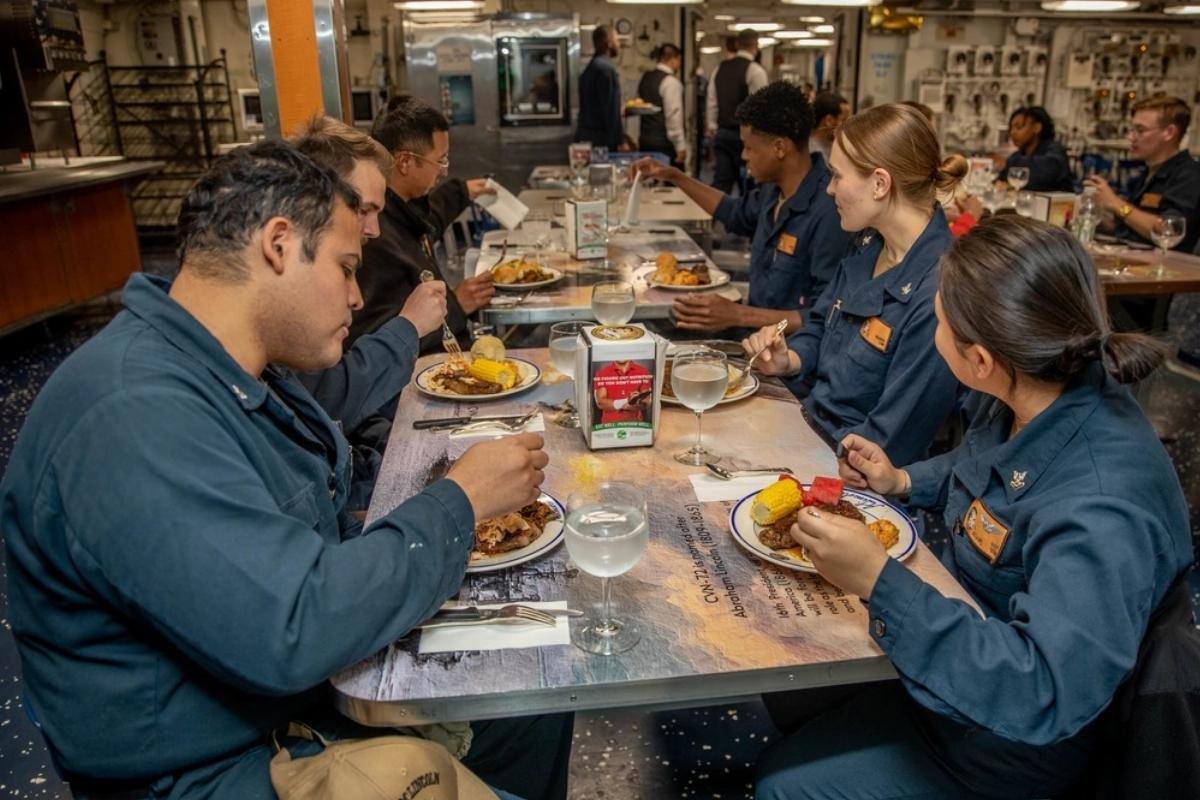
The internet loves a good military food fight — and this one isn’t about the MREs. Over the weekend, a brief clip from the USS Lincoln set off a heated exchange that has little to do with noodles and tuna and everything to do with how we honor those who serve.
It started, as these things often do, with a CNN reporter sticking a microphone in front of a sailor in the carrier’s mess hall and asking about the chow. The sailor — clearly exhausted, clearly not expecting an interview — mentioned that the rations were getting monotonous. Lots of noodles. Lots of tuna. Not exactly a gourmet spread.
Back in the Fox News studio, the segment sparked a reaction from Joey Jones, the network’s combat veteran commentator. Jones, a retired Marine who lost both legs in Afghanistan, essentially told the sailor to suck it up. His point, as summarized by American Thinker’s Noel S. Williams, was that the sailor’s complaints paled in comparison to what Jones endured during his own service. The sailor should be grateful for the protection of an impenetrable ship and the food he’s getting, no matter how repetitive.
A matter of respect
At first glance, it’s hard to argue with that. Jones is a bona fide hero. He lived through firefights, ate worse than tuna, and paid a physical price that most of us can’t fathom. His service commands respect — and Williams, a veteran himself, is quick to acknowledge that.
But Williams raises a question that cuts to the heart of military culture: where’s the camaraderie in that? Where’s the “we’re all in this together” spirit that’s supposed to bind service members across branches and ranks?
“It seems a bit churlish to make such unnecessary comparisons between service members whose duties are inherently tied to missions within their branch of service,” Williams writes. “Not to put words in his mouth, but my takeaway is that Jones was marginalizing the poor sailor.”
That’s a strong charge — and one that Williams doesn’t make lightly. He’s been in the military. He’s stood on color guards and funeral details. He knows the difference between a joke and a jab. And he knows that every sailor, soldier, airman, and Marine has a breaking point.
The reality of life at sea
Consider the context that the sailor was operating in. He’s trapped on a carrier with 5,000 other sailors. The supplies that would normally keep the mess hall varied may be running low because of attacks on allied supply depots in the region. There may be plumbing issues. There may be tensions that come with intense daily operations. All of that can wear on mental health.
That’s not speculation — it’s a point that CENTCOM’s top commander, Admiral Brad Cooper, has now acknowledged. During a visit to the USS Lincoln, Cooper said, “This doesn’t mean that all is perfect. Find any of the nearly four million Navy veterans in America today and they will likely tell you that service at sea for long periods isn’t for everyone.”
The admiral’s words are a far cry from Jones’ dismissive tone. They speak to a reality that military leaders understand: even the strongest warriors have moments of weakness, and complaining about bad food doesn’t make you a bad sailor.
Disagreement is part of the bond
Williams’ piece isn’t an attack on Jones. It’s an appeal for nuance. He argues that unless there are deeper issues — like violations of the Uniform Code of Military Justice — the sailor should be given the benefit of the doubt. A momentary gripe under duress doesn’t erase years of service.
“In light of his combat injuries and the way he overcame them, Joey Jones deserves our utmost respect,” Williams concludes. “So does the sailor who doesn’t enjoy noodles and tuna all the time.”
That’s the heart of the matter. Respect isn’t a zero-sum game. Honoring one service member’s sacrifice doesn’t require diminishing another’s struggle. And if the military is truly a team, then maybe the best way to honor Jones’ service is to do what he once suggested: lead a life of meaning — one that includes the occasional respectful disagreement.
Williams ends with a nod to the importance of free speech, noting that “the ability to speak our minds is crucial to the republic we cherish.” That applies to the sailor with the microphone in his face, to Jones in the Fox studio, and to all of us watching from the safety of our living rooms.
The debate over the sailor’s comments may fade, but the underlying question will linger: What does it really mean to respect those who serve? Perhaps it’s not about comparing sacrifices, but about recognizing that every single one of them is making one.
Source: www.americanthinker.com — https://www.americanthinker.com/blog/2026/08/fox-news-joey-jones-vs-admiral-brad-cooper/