
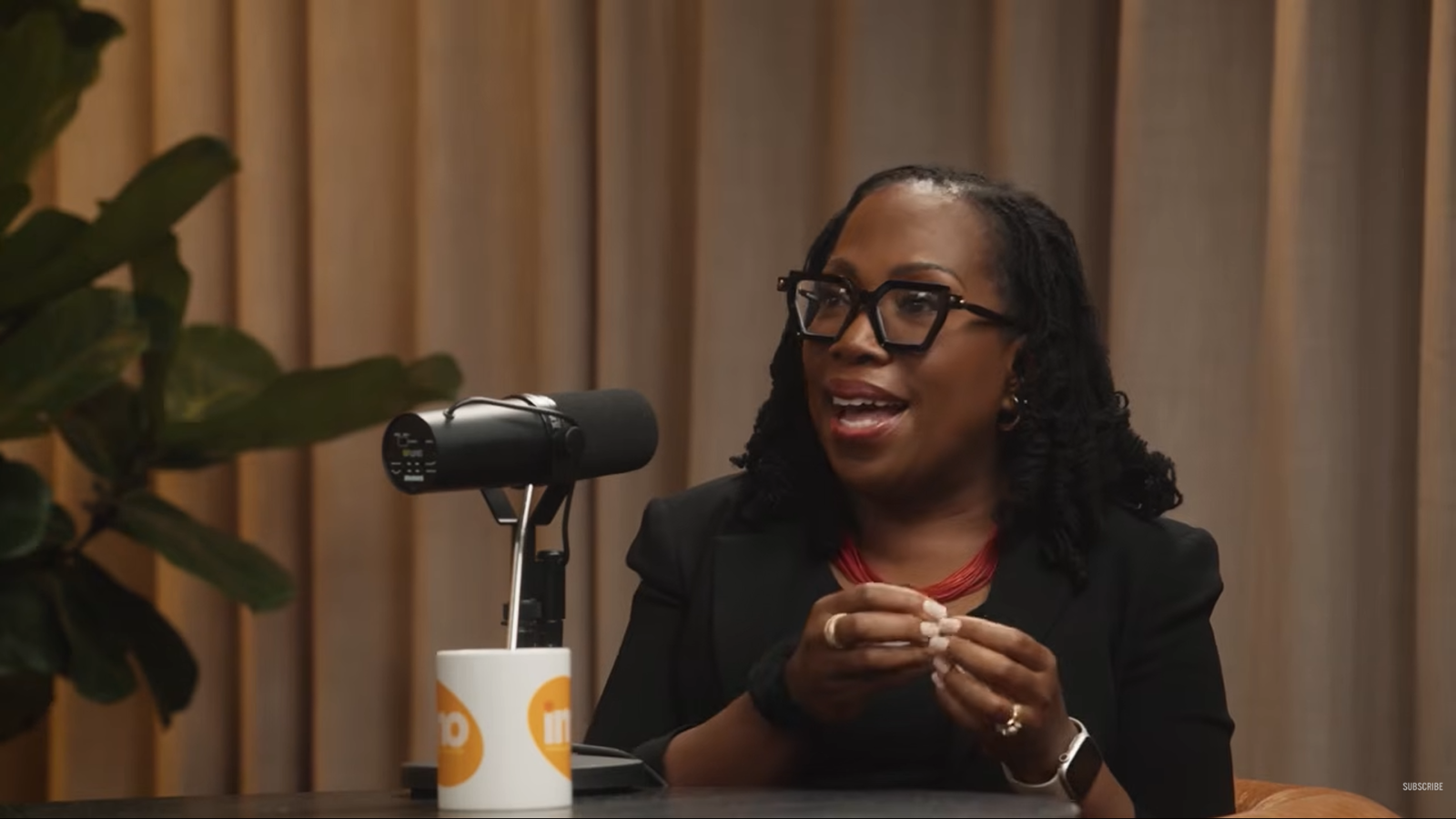
A new study reveals that Supreme Court Justice Ketanji Brown Jackson is, by a wide margin, the most talkative member of the bench, speaking more than twice as many words per case as the average justice over the past two decades.
The analysis, reported by The New York Times and covering October 2005 through April 2026, found that Jackson, who joined the Court in 2022, averages 1,263 words per case during oral arguments. The Times noted this figure is “more than double the justices’ average.” The study also shows that Jackson accounts for 23 percent of all words spoken by the justices.
Jackson’s closest rival in verbosity is retired Justice Stephen Breyer, for whom she once clerked, who averaged 818 words per case during his tenure. Among current justices, Sonia Sotomayor comes in second with 791 words per case.
Possible Explanations
The Times offered three theories for Jackson’s talkativeness. One is that, “understanding she will be on the losing end of many cases on a court where conservatives hold a supermajority,” Jackson may see her questioning as an opportunity to communicate directly with the public through live-streamed arguments, reaching beyond the courtroom.
Jackson has often used her time to advance progressive arguments, sometimes drawing criticism for what commentators describe as “nonsensical” or “unintelligible” reasoning during hearings.
Birthplace Citizenship Case
During the Trump v. Barbara hearing on birthplace citizenship earlier this year, Jackson mused about a hypothetical involving stealing a wallet in Japan, arguing that a U.S. citizen visiting the country would be bound by its laws.

“I was thinking, I, a U.S. citizen am visiting Japan. And what it means is that if I steal someone’s wallet in Japan, the Japanese authorities can arrest me and prosecute me,” Jackson said. “It’s allegiance meaning can they control you as a matter of law. I can also rely on them, if my wallet is stolen, to, you know, under Japanese law, go and prosecute the person who has stolen it.”
She added, “So there’s this relationship, even though I’m just a temporary traveler, I’m just on vacation in Japan, I’m still locally owing allegiance in that sense.”
Despite the criticism, Jackson’s approach ultimately prevailed in that case, with Chief Justice John Roberts and Justice Amy Coney Barrett joining her and the Court’s liberals in codifying birthplace citizenship into the 14th Amendment.

Other Notable Hearings
In the Louisiana v. Callais redistricting case last year, Jackson suggested that states should consider race in drawing district lines, arguing that black Americans are systemically “disabled” and lack legitimate access to voting systems.
She also defended the administrative state during Trump v. Slaughter, warning about the consequences of a president replacing “nonpartisan experts” with “loyalists and people who don’t know anything.”
The study’s findings have sparked debate about the role of oral arguments and whether Jackson’s extensive questioning is a deliberate strategy to shape public opinion or simply a reflection of her judicial philosophy.
Source: thefederalist.com — https://thefederalist.com/2026/08/14/study-ketanji-brown-jackson-speaks-more-than-twice-as-much-as-any-of-her-fellow-justices/