
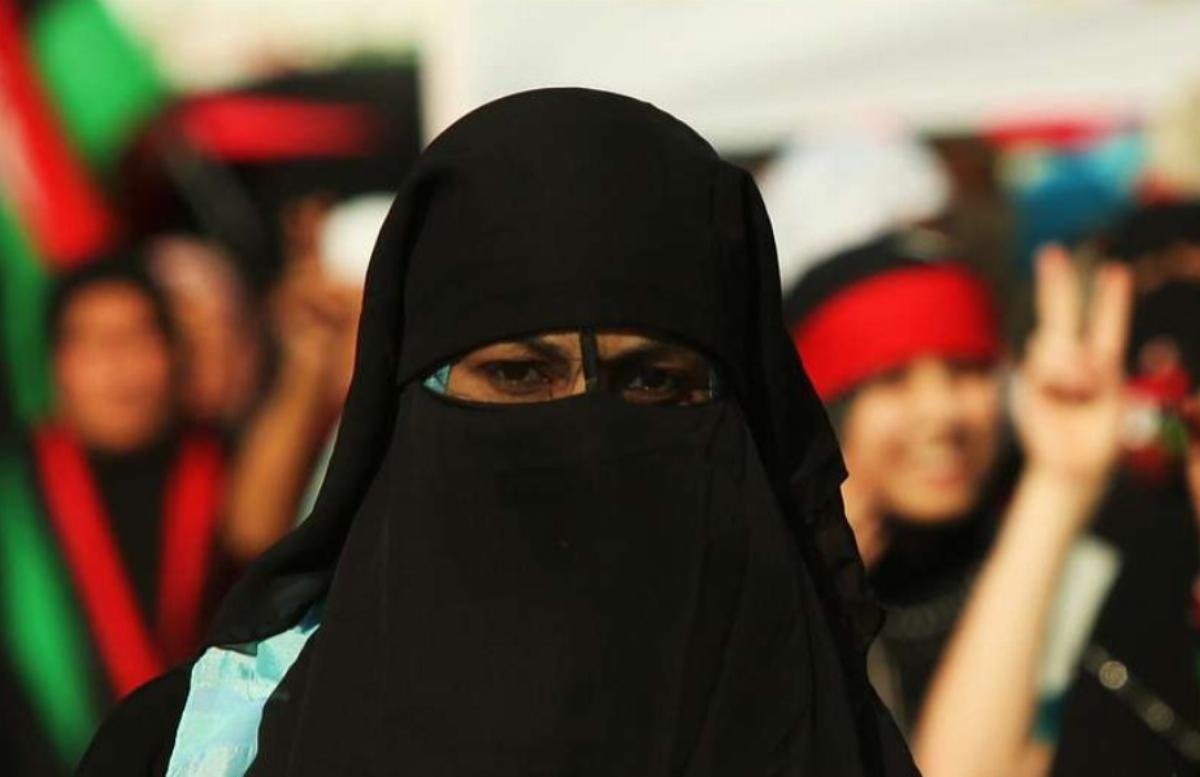
A routine visit to a post office in Northern Italy has become the latest flashpoint in Europe’s long-simmering debate over religious dress and national security. According to a report in American Thinker, a Muslim woman from Bangladesh arrived at the post office wearing a niqab—the face veil that leaves only the eyes visible. After she presented her identity card, a clerk asked her to lower the veil so he could confirm her identity. She complied, but later wrote to Italian newspapers claiming she had been discriminated against.
The post office rejected the complaint outright, stating that no discrimination occurred and that staff had simply enforced the law. The logic is straightforward: if a person cannot show their face, a clerk cannot reliably verify that they are who their identity card claims they are.
This incident, while small, touches on a broader and increasingly contentious question across Western democracies: does the right to religious expression extend to wearing garments that obscure one’s identity in situations where the state requires clear identification?
The legal landscape: What Western nations say
The American Thinker article is unambiguous in its view. “In a free and democratic society, you may not go around disguised,” the author writes. It argues that the niqab and the burka—the full-body covering worn by some Muslim women—both humiliate women and make identification impossible, and therefore should not be permitted.
The piece goes further: it argues that no concession should be granted even to women who request identification only by female clerks in private areas. To grant such a request, the author contends, would itself be discriminatory toward other customers, and would open the door to anyone demanding special treatment based on personal whim.
“In the West, to go around perfectly recognizable is not an opinion you may agree or disagree with. It’s a law—which is the same for everybody,” the article states.
This reflects a view that has gained traction in several European countries. France banned the full-face veil in public spaces in 2011. Belgium, Austria, and Denmark have followed with similar restrictions. Italy, while not having a nationwide ban, has local ordinances and relies on general laws requiring identification in certain contexts.
The Italian post office incident is far from isolated. The American Thinker piece notes that such incidents are “anything but unusual in the Western world nowadays,” pointing to a pattern of tension between Muslim dress codes and Western norms of public transparency.
The arguments on both sides
Proponents of face-veil restrictions argue that identification is a fundamental prerequisite for security and accountability. A masked person in an enclosed public space—whether a post office, bank, or government building—represents a potential risk. No clerk can tell if the person behind the veil is the one on the passport, and no official can rule out that the person is hiding intent to commit fraud or violence.
On the other side, defenders of the niqab argue that it is a deeply personal religious practice. Many Muslim women who wear it say it is a matter of modesty and devotion, not a challenge to state authority. For those who hold this view, forcing a woman to uncover her face violates her religious freedom and dignity—and singling out Muslim women for such treatment can feel like state-sanctioned humiliation.
The American Thinker article is not sympathetic to these arguments. While it does not deny that religious feelings are sincere, it insists that in the West, the rule of law must prevail. “If you don’t like our laws, you are quite free to go back to your own country,” the author writes—a sentiment that, while blunt, reflects a view many Europeans and Americans convey privately, if not always publicly.
A clash of values, not just cloth
The debate over the niqab and burka is never really about cloth. It is about competing visions of what a society demands of its members. The West, the article argues, has built its institutions on the principle of recognizable citizenship. In courtrooms, polling stations, banks, and public offices, a face is not incidental—it is the very basis of trust and accountability.
The article also tackles the argument, sometimes made by Western liberals, that accommodations such as female-only identification rooms are a reasonable compromise. The American Thinker piece rejects this out of hand. To allow a woman to be identified only by another woman, or only in private, would not be a neutral accommodation. It would effectively grant a religious exception to a universal law—and once you allow one exception, the door is open to countless others.
“Anyone might ask for a special identification by personal whim,” the author warns, suggesting that the slippery slope is real.
This is not just a European issue. In the United States, courts have repeatedly upheld the rights of states to require face-to-face identification in contexts such as voting and driver’s license issuance, even when religious objections are raised. The Supreme Court has never squarely ruled on the niqab in a general public space context, but lower courts have generally sided with state identification requirements.
What the clerk did right
The clerk in Northern Italy did what the law required. He asked to see the face behind the veil, and when the woman complied, he processed her transaction. The subsequent complaint, however, suggests that the tension is not going away.
The American Thinker piece’s conclusion is stark: “In the West, to go around perfectly recognizable is not an opinion you may agree or disagree with. It’s a law—which is the same for everybody.”
That is the crux of the matter. The woman from Bangladesh reportedly expressed feeling discriminated against. The post office said it was only following the law. In the article’s view, the law is correct, and no exception should be made—even if that means risking a complaint or accusations of bias.
What this incident makes clear is that the issue of religious veils in Western public spaces is not disappearing. Each time it surfaces—at a post office, an airport, a courthouse—the same fundamental questions arise: How far do religious freedoms extend when they conflict with public security and the equal application of law? And who gets to decide where the line is drawn?
For now, the Italian post office’s answer—show your face or don’t do business here—has the force of law behind it. But as the woman’s complaint shows, the cultural battle over that answer is far from settled.
Source: www.americanthinker.com — https://www.americanthinker.com/blog/2026/08/in-the-west-women-must-show-their-face/