
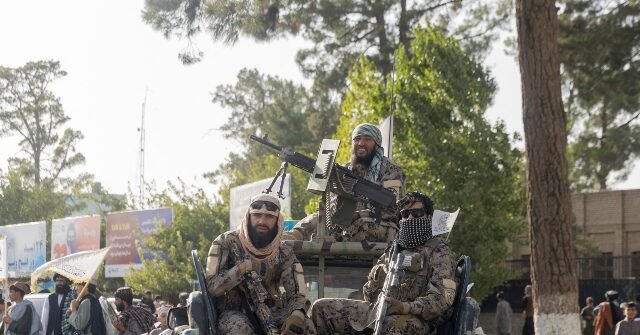
KABUL — Five years to the day after American forces withdrew and the Taliban swept back into the Afghan capital, the movement’s leadership used the anniversary to issue a pointed rebuke to the world: recognize us, or keep living with the consequences.
In statements and official commemorations reported by Breitbart News, Taliban officials condemned the international community for continuing to withhold formal diplomatic recognition of their government, describing the global refusal as both unjust and driven by political prejudice rather than by the reality on the ground.
A Milestone Marked With Grievance
The anniversary marks a half-decade of Taliban rule over Afghanistan, a period that has seen the country sealed off from much of the world, its economy crippled by sanctions, and its population — particularly women and girls — subject to some of the most severe restrictions anywhere on earth. Yet for the movement’s leaders, the defining feature of these five years has not been isolation but rather what they characterize as the international community’s stubborn refusal to accept the outcome of the 2021 power transfer.
Official Taliban spokespersons used the occasion to argue that their government has met the basic conditions for recognition, pointing to the absence of large-scale internal conflict and the functioning of state institutions under their control.
They have also repeated long-standing demands that foreign governments unfreeze billions of dollars in Afghan central bank assets held overseas, funds that remain inaccessible to the Taliban administration and that the movement says are critical to stabilizing the country’s economy.
Recognition as a Political Weapon
The Taliban’s central grievance is that recognition has been weaponized by Western capitals, particularly Washington, to extract concessions the movement is either unwilling or unable to make. Chief among those demands has been the restoration of women’s rights, including access to education and employment, which the Taliban has rolled back dramatically since 2021.
International human rights organizations and the United Nations have documented widespread abuses under Taliban rule, including bans on girls’ secondary education, restrictions on women’s freedom of movement, and public punishments that the UN has condemned as cruel and degrading. The Taliban’s response has been to dismiss such criticism as foreign interference and as evidence of the West’s ongoing hostility toward Afghanistan.
On the anniversary, Taliban leaders amplified this narrative, telling supporters that the international community’s rejection is not about human rights but about punishing a Muslim nation for defying Western military power. They framed their government’s survival over the past five years as a victory in itself, a point they drove home in public gatherings and through state-run media.
No Country Has Formally Recognized the Taliban
No nation has formally extended diplomatic recognition to the Taliban government since it took power in August 2021. Several countries, including China, Russia, and Pakistan, have maintained working-level contacts and hosted Taliban diplomats, but none have crossed the threshold of full recognition. Even Qatar, which served as the primary host for Taliban peace talks and continues to engage with the movement, has not formally recognized its government.
This diplomatic vacuum has had practical consequences. Afghan ambassadors and consulates abroad remain staffed by holdovers from the previous U.S.-backed government, leaving the Taliban without representation in most international forums. Afghanistan’s seat at the United Nations remains held by the deposed government’s envoy, a constant reminder of the Taliban’s pariah status.
The Taliban has repeatedly demanded that its representatives be allowed to take up Afghanistan’s UN seat, but those efforts have gone nowhere, with Security Council members citing the regime’s human rights record and its continued harboring of militant groups, including some with ties to al-Qaeda.
The Stakes of Non-Recognition
For ordinary Afghans, the recognition dispute is not an abstract diplomatic quarrel. The freezing of billions in central bank reserves, combined with sweeping international sanctions, has starved the Afghan economy of foreign currency and investment. The result has been a humanitarian catastrophe of staggering proportions: the UN has described Afghanistan as one of the world’s worst humanitarian crises, with the majority of the population requiring some form of food assistance.
The Taliban blames the international community for this suffering, arguing that its economic isolation is a deliberate punishment for the Afghan people rather than a consequence of its own policies. Western officials counter that the Taliban’s own governance choices — the bans on women working, the restrictions on civil society, the sheltering of terrorist networks — are what have kept sanctions in place and chilled any prospect of investment or aid.
A Question of Conditions
Whether the Taliban’s demands for recognition will ever be met remains unclear. The movement has shown little appetite for the kind of concessions that Western governments say would be prerequisites, and its internal decision-making structure offers no obvious mechanism for a policy reversal. While some Taliban figures have spoken of opening girls’ schools or moderating policies, such statements have rarely been followed by action, and the regime’s most repressive edicts have remained firmly in force.
At the same time, there are signs that meaningful engagement is not entirely off the table. Regional powers, particularly China and Russia, have deepened their ties with Kabul, viewing the Taliban as a stabilizing force in a volatile region. Beijing has invested heavily in infrastructure projects, and Moscow has hosted Taliban delegations for security talks. Whether these functional relationships will eventually translate into formal recognition remains a key question for the region and for the Taliban itself.
The Anniversary as a Message
For the Taliban, the fifth anniversary was both a celebration and a warning. In their telling, the movement is here to stay, and the international community’s refusal to accept that reality is costing Afghanistan and the world alike. They point to the absence of major insurgency within their borders — an absence they claim as proof of their legitimacy — and to the relative security that Afghans enjoy compared to the chaos of the two-decade war that preceded their rule.
Critics, however, note that the Taliban’s stability is built on suppression, not consent. There are no free elections, no independent judiciary, no free press, and women are effectively erased from public life. The Taliban’s version of peace, they argue, is the peace of the prison yard.
Still, five years on, the Taliban shows no sign of cracking. Its leadership remains unified, its security forces are intact, and its grip on power is as strong as ever. The question now is whether the international community will ever find a way to deal with that reality, or whether Afghanistan will remain frozen in the limbo between recognition and rejection — with the Taliban on one side of the divide, and the rest of the world on the other.
For the moment, the movement’s leadership has made clear that it will continue to press its case, using every anniversary and every international forum to insist that Afghanistan’s rulers deserve a place at the global table. Whether the world will eventually come around is anybody’s guess, but the Taliban has shown itself to be patient — and, by its own account, victorious.
Source: www.breitbart.com — https://www.breitbart.com/asia/2026/08/18/taliban-marks-five-years-in-power-condemning-the-world-for-not-recognizing-it/