
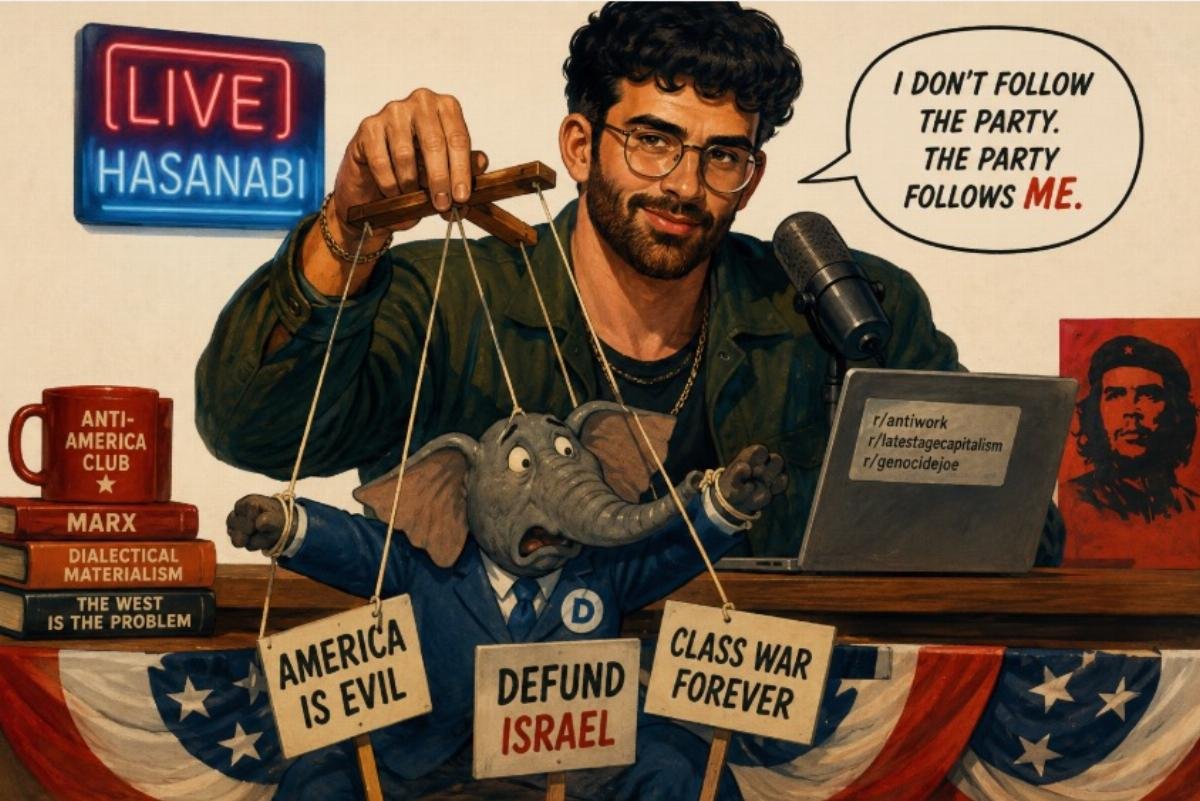
The old model of American politics went like this: Party → Candidates → Media → Voters. The party picked who ran, the media shaped the conversation, and voters chose within that frame. According to a new essay in American Thinker by Allan J. Feifer, that model is being replaced by something far less institutional—and far harder for the major parties to control.
Feifer’s argument, published August 19, 2026, centers on Hasan Piker, the Turkish-American Twitch streamer known online as HasanAbi. Piker is one of Twitch’s most-watched personalities, blending political commentary, news reactions, gaming, and live audience interaction. He’s a rising star on the left, particularly among digitally native young men who prefer interactive commentary to traditional media and are drawn to confrontational, anti-establishment rhetoric.
But Feifer says Piker’s significance isn’t just the millions who watch him. It’s what happens inside the community he’s built.
The New Power Flow
The new political model, as Feifer describes it, looks like this: Influencer → Community → Political Identity → Voters → Candidates. The influencer builds a community first. That community develops its own language, heroes, villains, and grievances. It forms a political identity. And then that identity dictates which candidates voters demand—leaving the political party scrambling to respond to a movement it didn’t create and can’t control.
This is a fundamental shift in where political power originates. For generations, parties helped shape candidates and messages. Today, Feifer argues, parties are increasingly downstream of political communities they had no hand in building.

The unsettling part, he writes, is not that a social media streamer has influence. It’s that he can build a political community outside the party apparatus and acquire enough clout to make the party accommodate it. That, Feifer says, is exactly what the new digital ecosystem has created.
Parties want these influencers inside the tent. Feifer suggests Democrats may believe they’re recruiting young political actors whom they can moderate once they become candidates. Instead, he argues, they’re discovering the opposite: the party is recruiting itself into someone else’s political movement.
Feifer invokes a cautionary tale about a young woman who “rides the tiger.” She enjoys the thrill and believes she’s in control—until the tiger turns and devours her. The lesson, he says, is simple: once you climb onto a tiger, control is an illusion.
True Believers vs. the Reality Triangle
Feifer’s essay introduces what he calls the Reality Triangle: three broad classes of people. Most of us fall into one of them. But there’s a fourth, much smaller and darker group: “True Believers.” These are people whose calculations of self-interest are subordinate to their emotional commitment, making them resistant to—or even activated by—evidence that contradicts their beliefs.
Societies function well, Feifer argues, when people remain responsive to reality. Outcomes, incentives, and consequences induce corrections. Societies become destabilized when people unresponsive to those mechanisms gain enough influence to shape everyone else’s behavior.
The key test, he says, isn’t whether a belief is extreme. An Idealist can hold deeply unpopular views and still change his mind when reality proves him wrong. The distinction is what happens when belief collides with evidence. Does contrary evidence cause reconsideration, or does it simply become another reason to attack whoever produced it?
That’s the test Feifer says we should apply to Piker—and to the broader class of political influencers emerging in American life.
Democrats’ Movement Left May Not Be Their Choice
Feifer argues this dynamic may help explain something otherwise puzzling about the modern Democratic Party: its movement to the left. That shift may not have been the party’s choice. Pressure came from political communities that developed outside the traditional structure, forcing the party to respond.
The party no longer creates the demand, Feifer writes. It may have no choice but to acquiesce.
That’s why Piker matters. The question isn’t whether he’s influential—clearly he is. Nor is it simply whether his politics are extreme. The larger question is whether America is entering an era where political identity is increasingly formed outside traditional institutions, and those institutions are then forced to accommodate the communities that form it.
If so, Feifer concludes, the Democratic Party’s problem is considerably larger than one streamer. The party may be discovering that it no longer shapes the movement. The movement is shaping the party.
This essay is an opinion piece based on Allan J. Feifer’s analysis as published in American Thinker.
Source: www.americanthinker.com — https://www.americanthinker.com/articles/2026/08/politically-we-all-live-in-piker-s-world-now/