
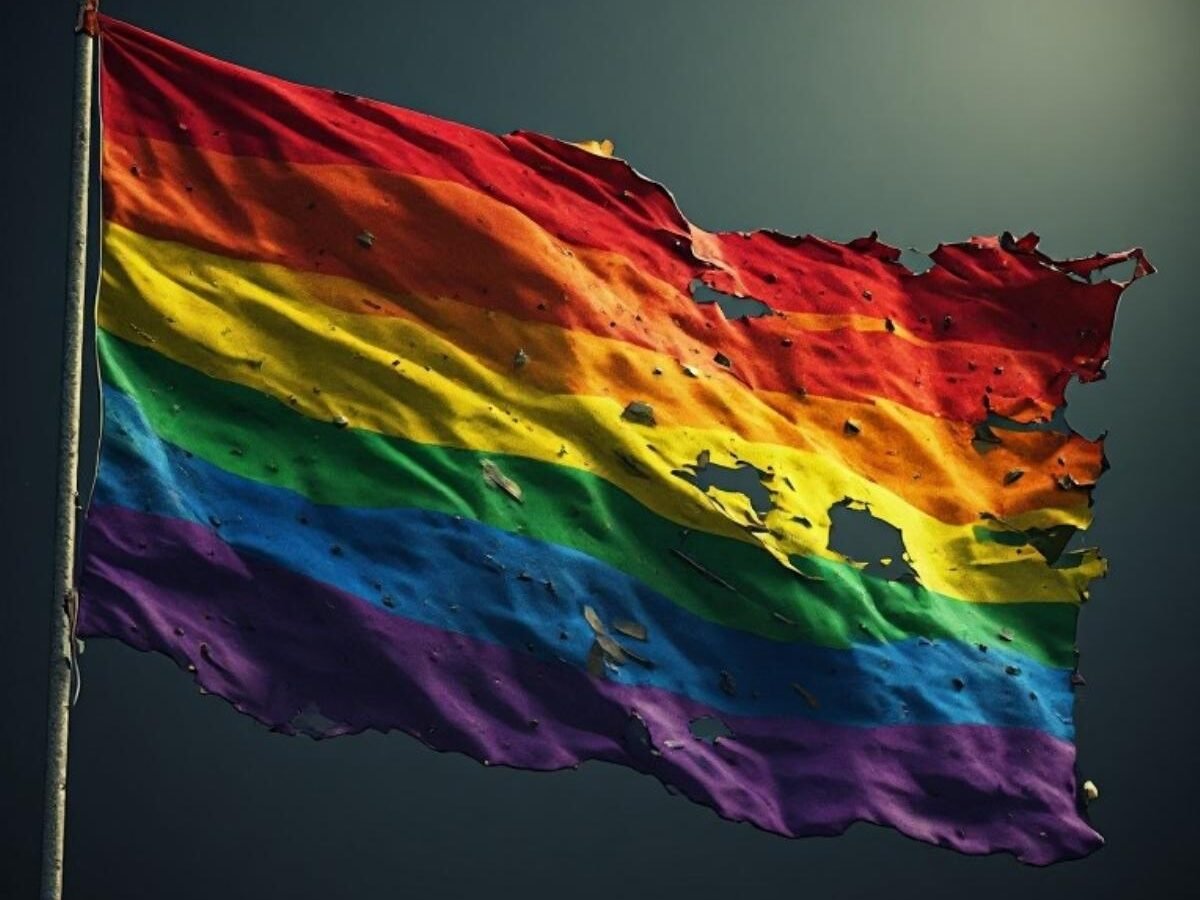
The Pride flag, once a symbol of LGBTQ visibility, now appears increasingly in Jewish communal spaces, and some observers are asking whether its presence signals something more troubling than inclusivity. Eileen F. Toplansky, writing for American Thinker, contends that the flag’s adoption by synagogues reflects a deeper, more insidious infiltration of radical left-wing ideology into Jewish life.
Toplansky identifies what she calls a “subtle camouflage” at work, arguing that Pride flags and DEI initiatives in temples serve as vehicles for anti-Jewish, anti-Israel, and anti-White messages. Her essay, titled “The Pride Flag and Jewish Self-Sabotage,” suggests that congregants may be “mesmerized by radical left-wing ideology without realizing the ulterior motives behind it.”
The piece takes particular issue with the evolution of the flag itself. Since its creation in 1978, the flag has been amended multiple times, with stripes representing ever-narrower sexual and gender designations. Toplansky notes the irony of “white” being relegated to represent only the trans community, thereby “erasing an entire group of people on the multi-color rainbow.” She also quotes the Lesbian Pride Flag as representing “independence from men,” which she sees as fundamentally at odds with traditional family structures.
The Shift from Social Justice to Progressive Politics
Central to Toplansky’s argument is the claim that “social justice,” as defined by leftist advocacy groups, has replaced biblical Judaism’s calls for righteousness. “Actual social justice in Judaism is rooted in biblical commands,” she writes, but the left demands “something that is much more insidious,” creating a persistent feeling that “something is not quite what it seems.”
The essay cites Pierre Rehov, who observes that “[d]iversity, equity, inclusion, anti-racism, and transgender affirmation have replaced the older revolutionary vocabulary” and that “[c]ertain opinions are no longer treated as debatable; they are treated as evidence of bigotry or harm.” Toplansky warns that congregants who voice concerns about gender-affirming medical procedures, particularly those affecting minors, risk being labeled bigots.

She also raises questions about the sudden rise in transgender identification, particularly among young white adults, asking whether such questions have become taboo—though she does not offer specific answers or data.
Anti-Zionism as the Latest Iteration of Antisemitism
Perhaps the most pointed section of the essay concerns Israel. Toplansky notes that LGBTQ rights in Israel are “already considered the most developed in the Middle East and Asia,” contrasting this with Arab nations where “the Arab world has no problem with throwing gays off the tops of roofs.” Yet, she argues, progressive advocacy groups remain hostile toward the Jewish state.
She recounts an exchange at one temple where congregants challenged their rabbi after he said upcoming speakers would “represent a range of perspectives on Israel, but all of them identify as Zionists.” The congregants responded: “How can you claim to be a pluralist if you don’t invite the anti-Zionist perspective to the table?”
For Toplansky, this exchange illustrates how “hostility toward Israel is nuanced into the discussion.” She frames anti-Zionism as “the latest iteration of antisemitism,” a position echoed by activist Phyllis Chesler, who argues that anti-Zionism is “a plot to kill a nation.” Chesler urges Jews to “reclaim” the term Zionist “unapologetically,” warning that abandoning the word leaves “Jewish self-determination unnamed, and therefore undefended.”
Symbols, Power, and the Question of Self-Sabotage
Toplansky also points to the Human Rights Campaign (HRC), a major LGBTQ+ advocacy group, which faced intense pressure from pro-Palestinian groups and, she claims, “accepted the falsehood about genocide against Palestinians.” She sees this as evidence that the progressive agenda, now “permeating so many Jewish houses of worship,” is “largely defined by anti-Zionism and pro-Palestinian solidarity.”
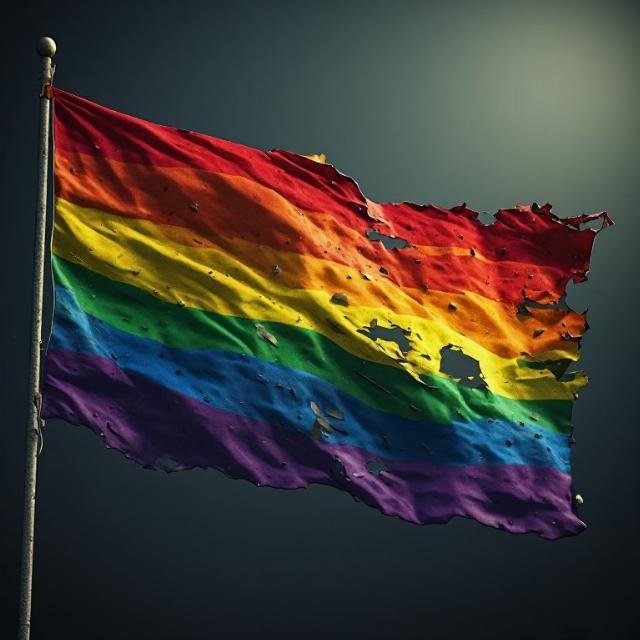
“Symbols are powerful tools,” she writes. “The Pride flag is a subtle camouflage for anti-Jewish, anti-Israel, and anti-White messages that the Left promotes.”
Her conclusion is stark: “As Jews accept more and more leftist ideology are they engaging in self-sabotage? Under the guise of relentless progressive pluralism, are Jews undermining their own well-being and Jewish identity? It may only begin with a Pride flag, but it metastasizes.”
The essay is unapologetically polemical, and it raises valid questions about the co-opting of religious spaces by political movements. However, critics are likely to push back on several fronts. First, equating the Pride flag—a symbol of civil rights for a marginalized community—with a stealth assault on Jewish identity conflates distinct issues. Second, the claim that LGBTQ inclusion inherently conflicts with Jewish values overlooks the significant number of Jewish LGBTQ individuals who find a spiritual home in inclusive congregations.
Moreover, Toplansky’s framing of anti-Zionism as equivalent to antisemitism is a subject of fierce debate within the Jewish community itself. While many Jewish organizations share her concern, others argue that criticizing Israeli government policies—even to the point of opposing Zionism as a political ideology—does not necessarily constitute anti-Jewish hatred. The essay offers no evidence that the Pride flag leads congregations toward anti-Israel positions, beyond anecdotal observations about one temple’s speaker series.
“Since we are all created in the image of G-d, no one should be denied fundamental rights,” Toplansky writes, affirming that the issue is not with LGBTQ individuals per se, but with what she perceives as the left’s subversion of Jewish tradition. “It is inimical to American and Jewish values,” she adds.
The essay ultimately asks whether the embrace of progressive symbols in synagogues is a form of cultural capitulation—a question that will resonate with some readers, while others will see the flag as a testament to the community’s growth and openness. What is clear is that the conversation about identity, inclusion, and religious values in American Jewish life is far from settled.
At its core, Toplansky’s argument is a cautionary tale about the power of symbols and the ease with which good intentions can be manipulated. Whether that warning is prophetic or paranoid remains a matter of perspective. As she puts it, “Substituting the beauty of Jewish values for the far-left ideology represented, in part, by a Pride flag is suicidal compassion.” It is a dramatic charge, one that reflects a deep anxiety about the future of Jewish communal identity in an era of intense political polarization.
Source: www.americanthinker.com — https://www.americanthinker.com/articles/2026/08/the-pride-flag-and-jewish-self-sabotage/