
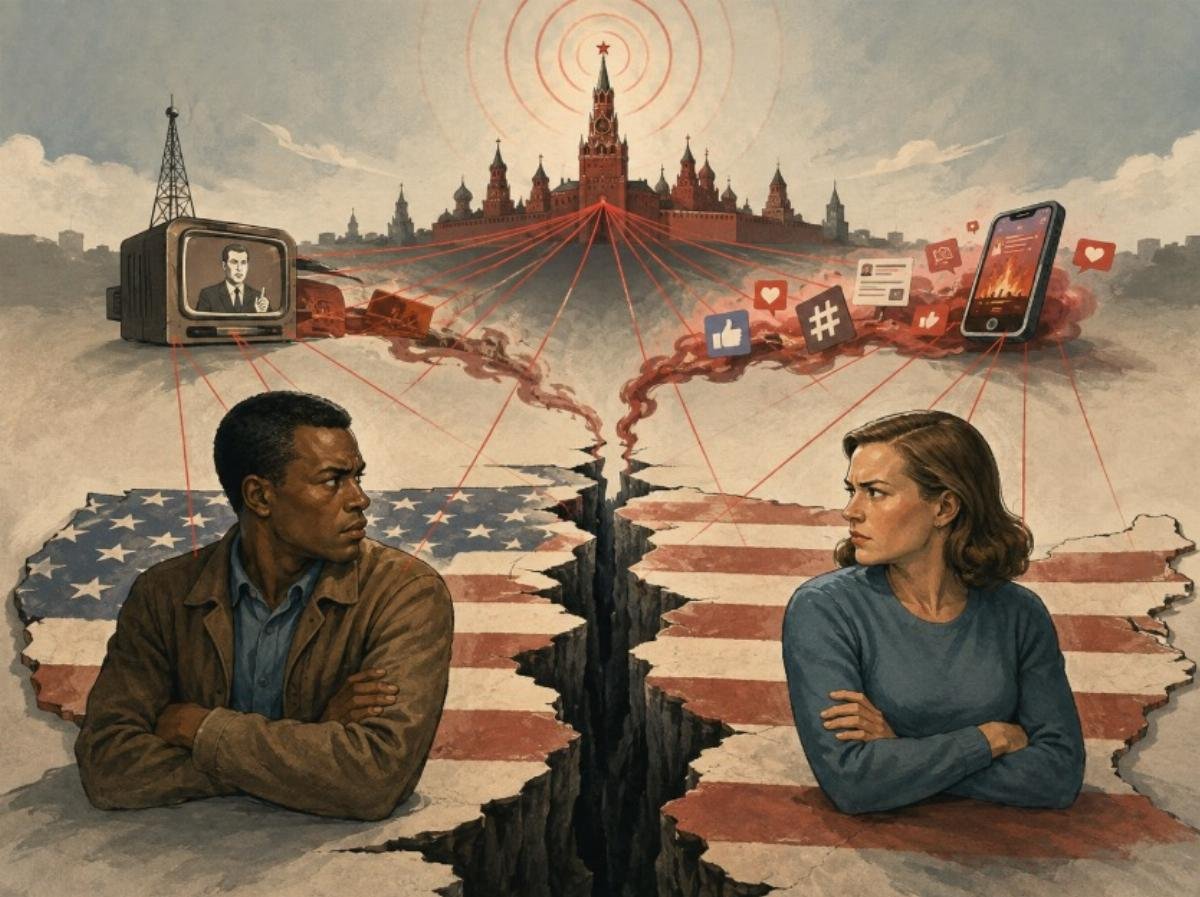
American racism has long been framed as a domestic moral failure, a stain on the nation’s conscience. But according to a new analysis, it is also something else entirely: a national-security vulnerability that foreign adversaries, above all Russia, have exploited for over a century.
The argument, laid out by Kathleen Brush in the American Thinker, contends that the Soviet Union—and later Russia—deliberately and systematically amplified racial divisions in the United States as a low-cost geopolitical weapon. The goal, writes Brush, was never to help Black Americans achieve equality. Instead, Moscow sought to keep America weak, distracted, and morally compromised on the world stage.
Lenin’s Gamble: Propaganda as a Weapon of the Weak
The strategy dates back to the aftermath of World War I, when Vladimir Lenin recognized that Soviet Russia lacked the military and economic might to confront the rising global power across the Atlantic. Direct confrontation was impossible; propaganda was cheap. The Soviets needed a wedge issue, and they found one in America’s most visible internal fracture: racism.
But the Soviets knew little about American racism firsthand, Brush notes. To succeed, they needed boots on the ground. Through the Communist International (Comintern), Soviet agents cultivated African American intellectuals and activists—figures like Cyril Briggs, Langston Hughes, and Paul Robeson—who were brought to the USSR, given privileged treatment, and taught a specific narrative of American “whiteness.”
The message was simple and potent: White American capitalists would never permit genuine Black equality because a permanent underclass was essential to capitalism. Racism, they argued, was not a flaw but a feature of the capitalist system—in stark contrast to the supposedly racist-free, egalitarian Soviet communism. Peaceful reform was impossible; only violent upheaval could bring change.
The appeal was obvious. Black Americans were justifiably angry about inequality and racism. The Soviet framing offered a ready explanation for their suffering and a seemingly noble path forward. It was, Brush argues, a brilliant strategy.
From Robeson to We Charge Genocide: Amplifying Travesties
The “race travelers” used their platforms to advance Soviet framing. Briggs formed the African Blood Brotherhood, an Afro-Marxist organization that instructed members in violent protest. Robeson, sponsored by a Communist Party of America (CPUSA) front organization, co-authored the 1951 UN petition We Charge Genocide with W.E.B. Du Bois—a document that echoed Soviet talking points and was amplified by Soviet media as evidence of American hypocrisy.
Hughes wrote poems and pamphlets contrasting racist America with praise for the racist-free Soviet Union, even though, as Brush notes, he personally knew this was untrue.
The Red Scare and McCarthyism pushed the Soviet Union to work through the CPUSA to identify and promote racial travesties of justice. The Scottsboro Boys case and the murder of Emmett Till were turned into durable, global propaganda events. For domestic American audiences, the theme was whiteness; for the world, it was capitalism and worker repression. Communists were painted as champions of Black civil rights—even as the Soviets relied on Black Americans remaining a subordinated, segregated population.
The Geopolitics of Guilt and Whataboutism
There was more at stake than just weakening America, Brush argues. The Soviet Union needed to cast America as an immoral, racist capitalist to glorify communism’s superiority—and to deflect attention from its own genocides, ethnic cleansings, and torture. When America raised human rights abuses, Moscow’s response was classic whataboutism: “And you lynch negroes.”
The Soviets understood the guilt Americans felt over slavery and Jim Crow and knew that inflaming white remorse could deflect from Soviet atrocities. It was a devastatingly effective tactic.
Martin Luther King Jr. was uniquely dangerous to this strategy. His peaceful approach and calls for integration with whites directly contradicted the Soviet narrative that capitalism made America irredeemably racist. According to Brush, MLK was a target of both the KGB and the CIA. After his death, the Soviets attempted to foment a full-blown race war, amplifying tensions between Jews and Blacks—a tactic that also served another geopolitical goal: making the world reject Israel as a racist state. Both strategies required casting Jews as racists, fascists, and imperialists.
The Civil Rights Milestones: Co-opted, Not Celebrated
The Civil Rights Movement, the Civil Rights Act of 1964, and the Voting Rights Act of 1965 directly challenged the whiteness narrative by showing that American institutions could change and that a majority of Americans were willing to confront the country’s racial past. This was deadly to the Soviet claim that capitalism made America irredeemably racist.
So the Soviets adapted. Legislation was mocked as window dressing, a sop to placate Blacks, while propaganda highlighted continuing racism as “proof” that America was immutable. The Soviets also modified their strategy along partisan lines, framing Democrats as the anti-racist party and Republicans as the party of the racist capitalist bourgeoisie—amplifying racial and partisan divisions simultaneously along two mutually reinforcing fault lines.
From Soviet Collapse to Modern Troll Farms
When the Soviet Union collapsed, Brush writes, the whiteness narrative had already been widely accepted by many Americans—the result of 70 years of Soviet and CPUSA propaganda, amplified by media coverage of discriminatory hiring, rising Black incarceration, and police brutality. Reports of Black progress were dismissed as white noise.
Academics picked up the baton. Marxist professor Noel Ignatiev presented white people as committed to maintaining racial and economic hegemony. Harvard professor Derrick Bell co-authored Critical Race Theory, which sees everything through a lens of whiteness. Figures like Ibram Kendi, Robyn DiAngelo, and Ben Crump parlayed these ideas into bestsellers. Crump’s book Open Season, like Robeson and Du Bois’ We Charge Genocide, accused America of genocide against Blacks. Alternative views could get you publicly discredited.
The Russian “whiteness siesta” after the Soviet collapse ended in the 2010s, Brush argues. Moscow awoke to find its legacy alive and well—visible in the protests and riots surrounding the deaths of Trayvon Martin, Michael Brown, and George Floyd. Americans themselves were building campaigns to reinforce whiteness, repackaged as “systemic racism,” revising history, and framing left-wing violence as legitimate political expression.
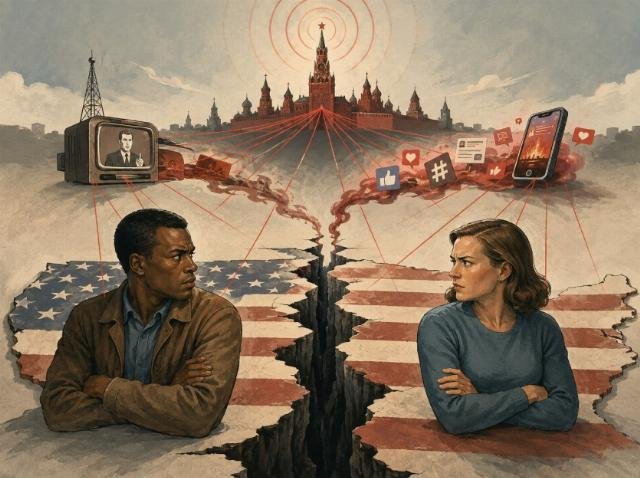
Russia adapted again, using troll farms to supercharge divisions by playing both sides—black and white, Democrat and Republican.
Progress Denied, Strategy Endures
Brush acknowledges that Black Americans in the 2020s are the most educated and wealthy Black population in the world. Yet despite undeniable progress, large shares of the public continue to believe racism is as pervasive as ever.
Did Russian and foreign interference influence this perception? Brush says yes—but cautions that America’s racist history, along with activists, politicians, and media downplaying Black progress, have also played significant roles. The foreign role, she argues, is not about denying real injustices or principled civil rights activism. It’s about recognizing the fingerprints of sustained external influence designed to prevent healing and keep racial conflict salient.
“The ghosts of Soviet strategy have haunted American race relations long enough,” she writes.
Source: www.americanthinker.com — https://www.americanthinker.com/articles/2026/08/dividing-america-on-race-russia-s-enduring-geopolitical-strategy/