
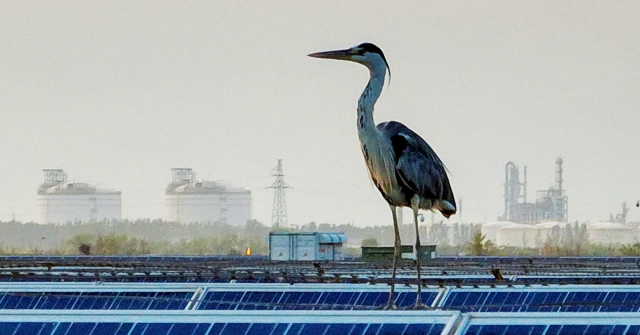
China’s breakneck build-out of solar panels has come at a measurable cost to its birds, according to a new international study published Friday in the journal Science. The research, led by Huiming Zhang of the Nanjing University of Information Science and Technology, found that counties with the most photovoltaic development saw significant reductions in bird diversity, driven largely by the conversion of agricultural and natural lands into vast solar fields.
The study, produced by researchers from China, Vietnam, and the United States, examined more than 2,000 Chinese counties and concluded that those with the most solar panels experienced “reductions in bird diversity, primarily due to land conversion.” The phrase “land conversion” refers to the transformation of former farmland or ecological preserves into ground-mounted solar arrays—a trade-off that the authors acknowledge sits uneasily alongside the environmental benefits of renewable energy.
“Clean energy also will have a large footprint on nature,” the researchers wrote, acknowledging the tension in their own field.
Inferior Greening and Habitat Loss
One of the paper’s more striking findings is what the authors call “inferior greening.” Solar panels, they found, tend to produce “dense but ecologically homogenous vegetation” in the areas around them. That uniformity is a problem for birds and other wildlife that depend on a mix of plant species for food and shelter. The result, the researchers say, is a landscape that looks greener but supports far less biodiversity.
Beyond vegetation changes, the study documented that solar farms “fragment landscapes,” “create visual and thermal disturbances,” and destroy bird habitats. Species that nest in specific vegetation, as well as those with carnivorous or omnivorous diets, were hit hardest. Flocking birds, meanwhile, were found to be confused by the glare reflected off solar panels, mistaking it for sunlight on water—leading to fatal midair collisions and futile searches for ponds that aren’t there.
The scale of the problem in China is particularly large. China’s solar footprint now covers an area “equivalent in size to the U.S. state of Rhode Island,” according to the study. And because China has been building solar capacity faster than any other nation, the biodiversity losses have become evident more quickly there.
A “Green Dilemma” and Its Proposed Solution
The researchers were blunt about the policy implications, describing their findings as highlighting “a critical green dilemma: Without meticulous spatial planning, policy-driven solar expansion can inadvertently compromise local biodiversity.”
Their recommended fix, however, is not to slow down the renewable transition. Instead, they call for a “data-driven, scientific basis for refining photovoltaic deployment.” Concretely, that means moving large-scale solar projects to “arid and semiarid regions, particularly the desert and Gobi areas of northern China.”
The other proposals were more administrative: transitioning from “abrupt policy shocks to phased, well-integrated rollouts,” monitoring solar facilities to address the inferior greening problem, and creating “financial incentives for biodiversity-positive solar farm management.”
In commentary accompanying the paper, Liang Yuanning, an assistant professor at Peking University, criticized the Chinese government for prioritizing political needs, “engineering feasibility,” and “issues like poverty alleviation and economic development” over ecological concerns when siting solar farms. Liang noted that while early large-scale development was concentrated in deserts and tundra, construction has since spread across the country as those areas reached their limits.
Zhang, the lead author, told Agence France-Presse that his “main message” was “not to slow the renewable energy transition, but to make solar development more ecologically informed.”
“Clean energy development and biodiversity conservation do not have to come at each other’s expense, but careful siting and biodiversity safeguards are essential,” Zhang said.
Agrivoltaics vs. Reality
The study also casts doubt on the promise of “agrivoltaics,” a concept promoted by the U.S. Department of Energy that envisions crops, livestock, and pollinator habitats coexisting beneath solar panels. While the researchers noted that the shaded, cooler microclimates under panels could theoretically “foster vegetation growth” and create “habitat islands” in degraded areas, they found no evidence that such benefits materialized for birds affected by China’s solar expansion. On the contrary, the study found that solar development led to major reductions in crop yields.
The paper’s publication is likely to reignite debates about the environmental trade-offs of renewable energy, even as countries worldwide race to expand their solar capacity. For now, the authors’ advice to China—and by extension, other nations—is to look to the deserts and avoid repeating the mistakes of the past.
Source: www.breitbart.com — https://www.breitbart.com/environment/2026/08/21/international-study-links-bird-deaths-to-chinese-solar-panels/