
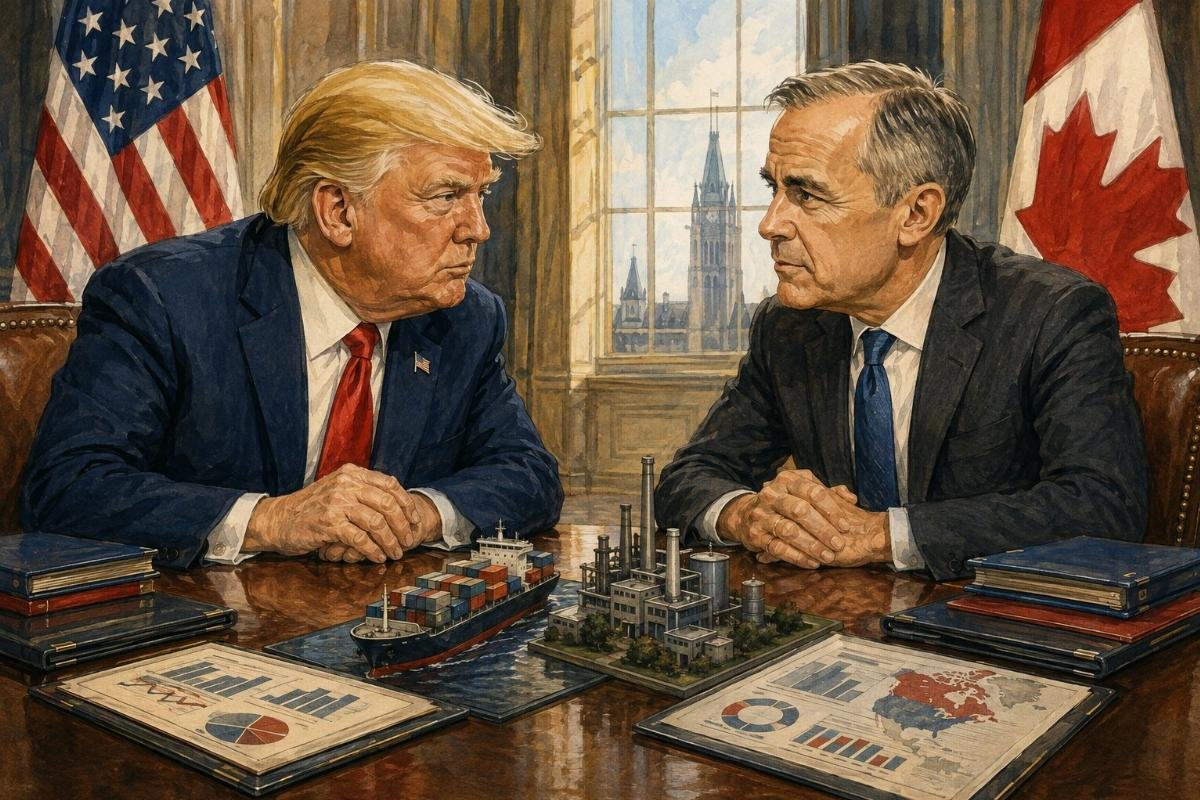
The latest round of Canada-U.S. trade negotiations has ended in failure, and the gap between political rhetoric and economic reality has never been wider. Canadian officials, including Prime Minister Mark Carney, continue to insist that Canada holds real leverage in the talks. The country’s businesses, however, are behaving as if they know better — and the data suggests they’re right.
The structural imbalance is stark and impossible to spin. About 75% of Canada’s exports go to the United States, while only a fraction of American exports head north. That single fact defines the bargaining relationship: one country depends on the other’s market far more than the reverse. The United States can absorb trade tensions with relative ease. Canada cannot — and Canadian companies understand this far better than the politicians representing them, according to a new analysis by American Thinker.
Political posturing vs. business reality
Prime Minister Carney and his trade negotiators have struck a firm tone, vowing to resist pressure and negotiate from a position of strength. That message may play well domestically, but it ignores the incentives driving the people who actually produce Canada’s economic output. Politicians — and career negotiators — have no personal financial stake in the outcome. A botched trade deal might cost them an election years down the road. For a manufacturer, it can mean immediate lost contracts, shuttered plants, and insolvency.
That disconnect between political risk and financial risk is not abstract. It’s showing up in the decisions companies are making right now. A recent survey by KPMG, reported by The Globe and Mail, found that nearly 20% of Canadian manufacturers have already moved some production to the United States, and more than 30% say they intend to do so in the coming years.
The reasons are practical, not ideological. Companies are relocating to avoid tariffs, to gain access to a larger and more stable consumer market, to take advantage of more favorable U.S. tax and regulatory conditions, and to secure long-term competitiveness. These are rational responses to the environment politicians have created. When the United States offers more profit, more stability, and more opportunity, capital follows — regardless of what officials say in press conferences.
Leverage is behavior, not rhetoric
Every factory that moves south reduces Canada’s manufacturing capacity, its job base, its tax revenue, and its future negotiating position. Meanwhile, the United States gains jobs, investment, and greater control over its own supply chains. The more Canadian leaders emphasize toughness, the faster this trend accelerates, the analysis argues. Businesses that conclude their government is detached from economic reality will act to protect themselves, moving to jurisdictions where incentives align with survival.
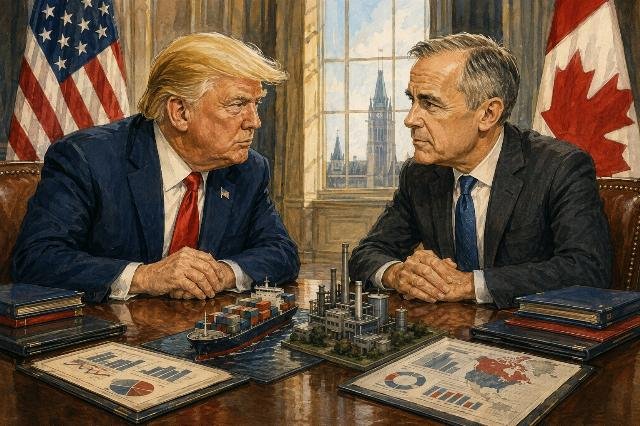
Leverage in trade negotiations is not determined by talking points — it is determined by behavior. While Canadian negotiators assert they can set terms, their own companies are voting with their feet. They are cutting capital spending, revising investment plans, and shifting production south in ways that reveal where the real power lies. The market, American Thinker argues, has always known the truth: the United States holds the stronger hand, and Canada’s insistence on projecting strength is becoming actively harmful.
Negotiate from reality, not hope
This is not to say Canada has no influence at all. It does. But meaningful influence must be grounded in reality, not in a fantasy of parity. A mutually beneficial agreement is still possible — indeed, it remains desirable — but only if Canadian leadership finally acknowledges the structural dependence that defines the relationship.
Trying to dictate terms to a trading partner roughly ten times Canada’s economic size is not a sign of strength. It is self-inflicted damage. The companies moving production to the United States are not being disloyal to their country; they are responding to incentives created by a government unwilling to confront the limits of its own power.
As the American Thinker piece concludes, politicians can afford to hold illusions. Businesses cannot. And until Canada’s leadership adjusts its strategy to match the economic realities its companies already live with, the country will keep losing investment, jobs, and negotiating clout — one factory relocation at a time.
Source: www.americanthinker.com — https://www.americanthinker.com/blog/2026/08/the-illusion-of-leverage-in-canada-us-trade-negotiations/