
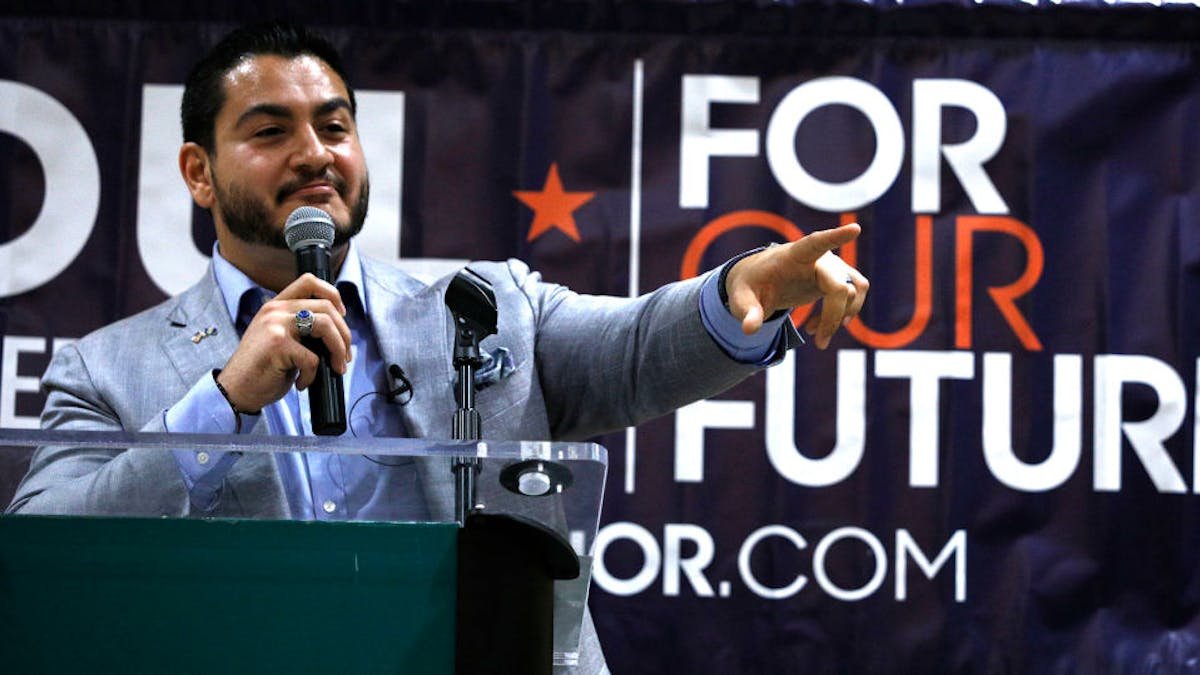
In the wake of a close Michigan Democratic Senate primary that saw progressive candidate Abdul El-Sayed edge out moderate Haley Stevens, a University of Michigan senior is sounding the alarm about how socialist ideals have taken root on campus. Writing for The Daily Wire, Addison Stone describes a movement that, in her view, repackages socialism as a form of idealism tailor-made for impressionable college students—and warns that this “rebranded poison” could have dire consequences for the country.
El-Sayed, who has denied holding socialist views but has been described as a “longtime friend of Detroit DSA” by organizers at his fundraising events, won over 60% of the vote in Washtenaw County, home to Ann Arbor and the University of Michigan’s main campus. Stone argues that his success in her college town was no accident, pointing to a campus culture where far-left progressivism is “encouraged as the norm by both professors and students.”
Stone, a senior majoring in War and Conflict Studies, says the only path to winning in a college town is through young voters “flirting with Marxism.” She notes that El-Sayed campaigned on campus last semester alongside Hasan Piker, a popular Twitch streamer who has made controversial statements, including justifying 9/11, mourning Stalin, and downplaying the October 7 atrocities committed by Hamas. During their campus appearance, El-Sayed and Piker promoted what Stone calls the “unsubstantiated, anti-Israel genocide accusation” and described a prominent Jewish American lobbying group as using “dark money.”

The Appeal of Idealism
Stone acknowledges the allure of socialist ideas for young people. “We arrive at college bright-eyed idealists ready to charge ahead and change the world,” she writes. But she argues that this idealism can be easily exploited. “Idealism is attractive because it’s easy and seems righteous,” she says, noting that students often lack real-world experience to temper their expectations.
Instead of adapting their worldview to what actually creates effective change, Stone observes, some students cling to “collective” control over government and the economy as a universal solution. “While DSA’s socialism may seem innocuous in theory,” she writes, “all arguments fall apart when confronted with the horrors produced by these systems.”
Stone describes the basic socialist pitch as offering a “cure-all for accountability.” Individuals are told they are victims of a rigged system, and that things will improve once that system is torn down. She draws parallels to the experiences of North Korean asylum seekers, Refusnik Jews, and Cuban refugees who risked their lives to escape such systems.

Grassroots Influence on Campus
The Democratic Socialists of America has been expanding its presence through campus and community chapters. At the University of Michigan, the DSA chapter boasts over 1,000 followers on Instagram, while College Democrats has roughly 2,600—a gap that Stone suggests shows the DSA’s growing influence even if it hasn’t yet surpassed traditional political groups.
Stone, who was born and raised in Miami, says many of her friends come from families that fled Cuba and Venezuela. She points to those countries as cautionary tales of what happens after socialist revolutions. “These countries were doing very well—especially in the context of the region—before their respective 20th-century socialist revolutions,” she writes, noting that government takeovers of their economies led to their current impoverished states.
A Refugee’s Account
At a Young America’s Foundation conference, Stone heard from Daniel Di Martino, a Venezuelan refugee and economist. Di Martino described how the lack of a profit motive led to absurdities like government bean rations “literally had rocks inside that you had to clean up.” Even with dismal quality, shoppers had to bring piles of cash due to extreme inflation, and without real market prices, grocery stores couldn’t respond to shortages effectively. Shelves stayed empty even when demand was obvious.

“DSA leaders have yet to produce any viable solutions to these problems,” Stone asserts.
A Generational Divide
Stone argues that while the DSA hasn’t yet committed “crimes against humanity,” the movement is following a path similar to that of the Castro and Chavez regimes. The difference, she says, is the medium: instead of armbands and pamphlets, today’s socialists use “beaded bracelets and TikTok.”
She urges students to look past political popularity and examine what the systems they support actually do. “A movement should earn our support because its ideas survive scrutiny,” she writes, “not because its language appeals to our good intentions.”
Stone’s piece, published in The Daily Wire, reflects a growing debate on college campuses about the rise of socialist ideas and their appeal to young voters. As the DSA celebrates victories across the country, the question of how to counter its influence remains a pressing one for those who oppose its agenda.
Source: www.dailywire.com — https://www.dailywire.com/news/i-saw-how-socialists-won-over-the-university-of-michigan-with-my-own-eyes