
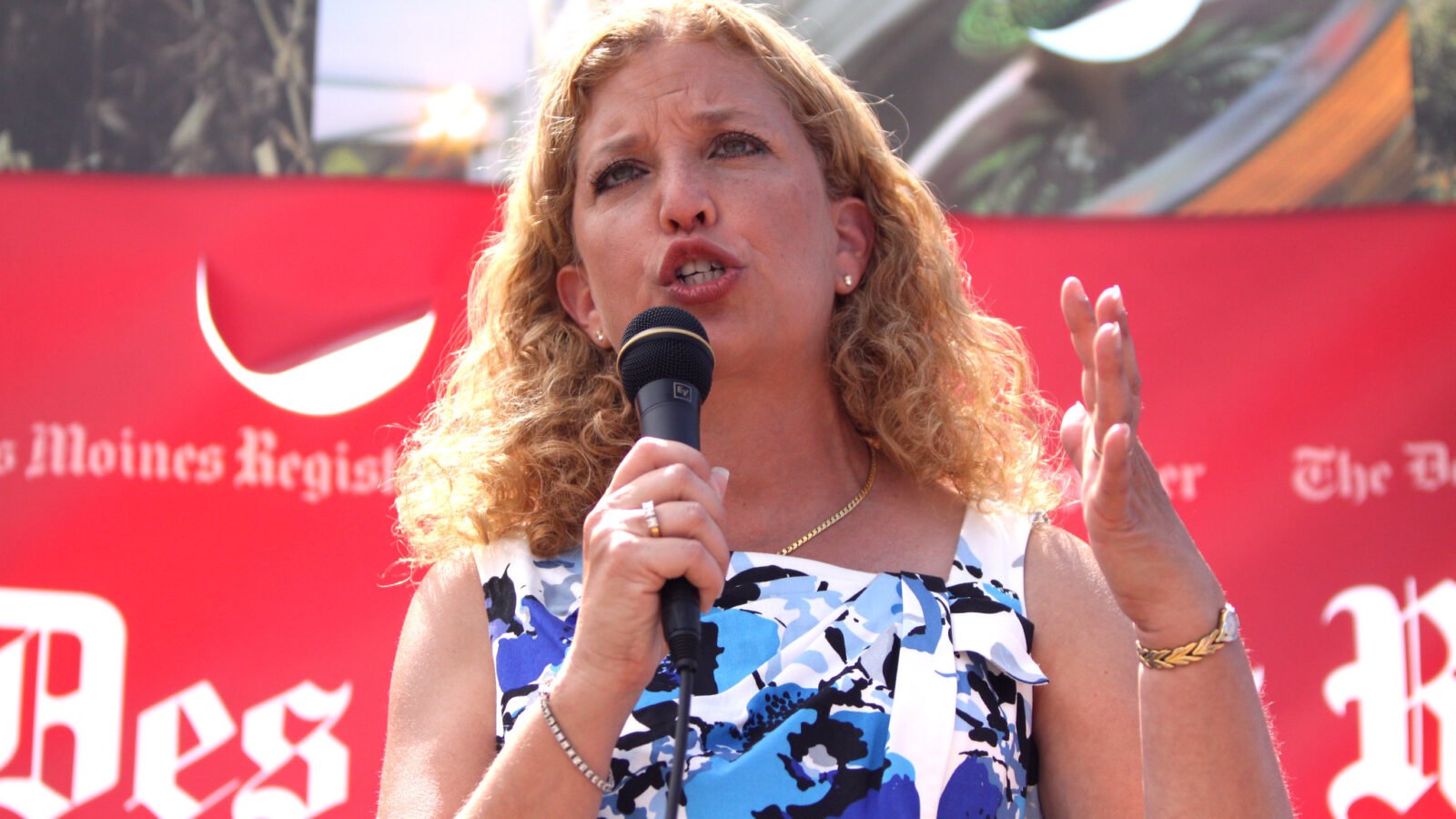
Debbie Wasserman Schultz’s decision to run in a neighboring Florida district after redistricting shifted her own has sparked a firestorm among Black Democrats, who see the former DNC chair’s move as a textbook case of racial hypocrisy. The Florida congresswoman, who once touted her party’s diversity, is now accused of undermining Black political power to save her own career.
In November 2012, Wasserman Schultz, then chair of the Democratic National Committee, boasted about the newly elected Congress: “They [Republicans] got whiter and more male, and we now have a majority minority and female caucus for the first time in history.” Fourteen years later, she is campaigning in Florida’s 20th Congressional District, a seat with a 49 percent Black population that has been represented by Black Democrats since the 1990s.
Wasserman Schultz, who currently represents Florida’s 25th District, made the switch after redistricting altered her own district’s boundaries earlier this year. She soundly defeated scandal-ridden Rep. Sheila Cherfilus-McCormick in the August 18 primary, and is expected to win the heavily Democratic seat in November against Republican Brent Anderson, who has raised significantly less money.
The move has drawn sharp criticism from Black Democrats in the district, who see it as a betrayal of the party’s stated commitment to racial representation. “She’s been an ally, but suddenly it’s feeling more like she’s using the familiarity she’s built against us,” Corey Shearer, president of Broward County’s Black Democratic Caucus, told the Washington Post.
Ten of Florida’s fifteen elected DNC members signed a statement accusing Wasserman Schultz of “treating one of Florida’s few remaining majority-Black districts as a political opportunity.” The statement added: “We cannot claim to defend voting rights, racial justice, and representation while undermining Black political power when it becomes politically convenient.”
The backlash has extended to national party leaders. House Majority Leader Hakeem Jeffries refused to endorse Wasserman Schultz, citing “the sensitivities of the moment in terms of an unprecedented Jim Crow-like assault on Black political representation.” Congressional Black Caucus Chair Yvette D. Clarke said of their conversation: “Encouragement was not a part of that conversation.”

The liberal American Prospect magazine described Wasserman Schultz as “lily-white” and accused her of “parachuting into a race alongside four viable Black candidates.”
Wasserman Schultz’s likely victory would directly contradict her own past remarks about diversifying Congress, underscoring what critics call a cynical use of racial rhetoric to secure political power. During the 2020 campaign, President Biden promised to “dismantle systemic racism,” and Vice President Harris condemned “structural racism.” In 2022, Jeffries called on the nation to “address the poison of white supremacy.” And earlier this year, Rep. Alexandria Ocasio-Cortez said that “if you are in this country and you are not Black, you benefit from a system of white supremacy.”
But critics argue that such rhetoric is abandoned when it conflicts with political advancement. Wasserman Schultz told the Washington Post: “You want to make sure that you have someone who knows the communities and knows their values, who has delivered for them and knows how to fight for them.” Yet her own record and her current actions suggest that racial solidarity is secondary to personal ambition.

The situation illustrates a broader pattern of what critics call “grievance grifting,” where racial and gender narratives are exploited for profit or power. Figures like Robin DiAngelo, author of White Fragility, and Ibram X. Kendi, who reportedly charges $25,000 for a single-hour presentation, have built lucrative careers on such narratives. Black Lives Matter co-founder Patrice Cullors purchased a $6 million home in Los Angeles with funds raised for the organization.
The DEI consultancy industry alone generates an estimated $5 billion annually. Wasserman Schultz herself praised DEI initiatives in 2024, saying they “play a crucial role in uplifting historically persecuted or marginalized communities.” Yet her actions suggest that when faced with a choice between political survival and upholding those principles, self-preservation wins out.
In the current Congress, women make up only 42 percent of Democratic representatives, and non-whites constitute 45 percent. For all the party’s talk of structural racism and the patriarchy, Democrats have shown they are willing to “perpetuate” both when it serves their interests.
As Floridians in FL-20 prepare to send Wasserman Schultz to Congress, the irony is not lost on observers. Her victory will ensure a “whiter” Congress, even as she campaigns on behalf of “marginalized communities.” The contradiction is a stark reminder that for many in the left’s leadership, racial justice is a means to an end, not an end in itself.
Former Minneapolis Mayor Jacob Frey, who won a third term despite complaints about “400 years worth of institutionalized racism,” offers another example of this dynamic. The grievance narratives that define leftist politics, critics argue, are a cynical con designed to empower and enrich at the expense of social cohesion.
Wasserman Schultz’s district switch may be the most blatant example yet of the disconnect between rhetoric and reality in Democratic politics.
Source: thefederalist.com — https://thefederalist.com/2026/08/27/democrats-racial-grievances-are-just-a-cynical-grift/