
A conversation with a Venezuelan neighbor over the new U.S.–Venezuela oil deal produced what might be the most sensible two-sentence summary of the arrangement yet: “The US is the best country to do business with.” That, according to columnist Silvio Canto Jr. writing for American Thinker, is likely how most Venezuelans feel after nearly 30 years of Chávez and his successors systematically wrecking the country’s oil industry and broader economy.
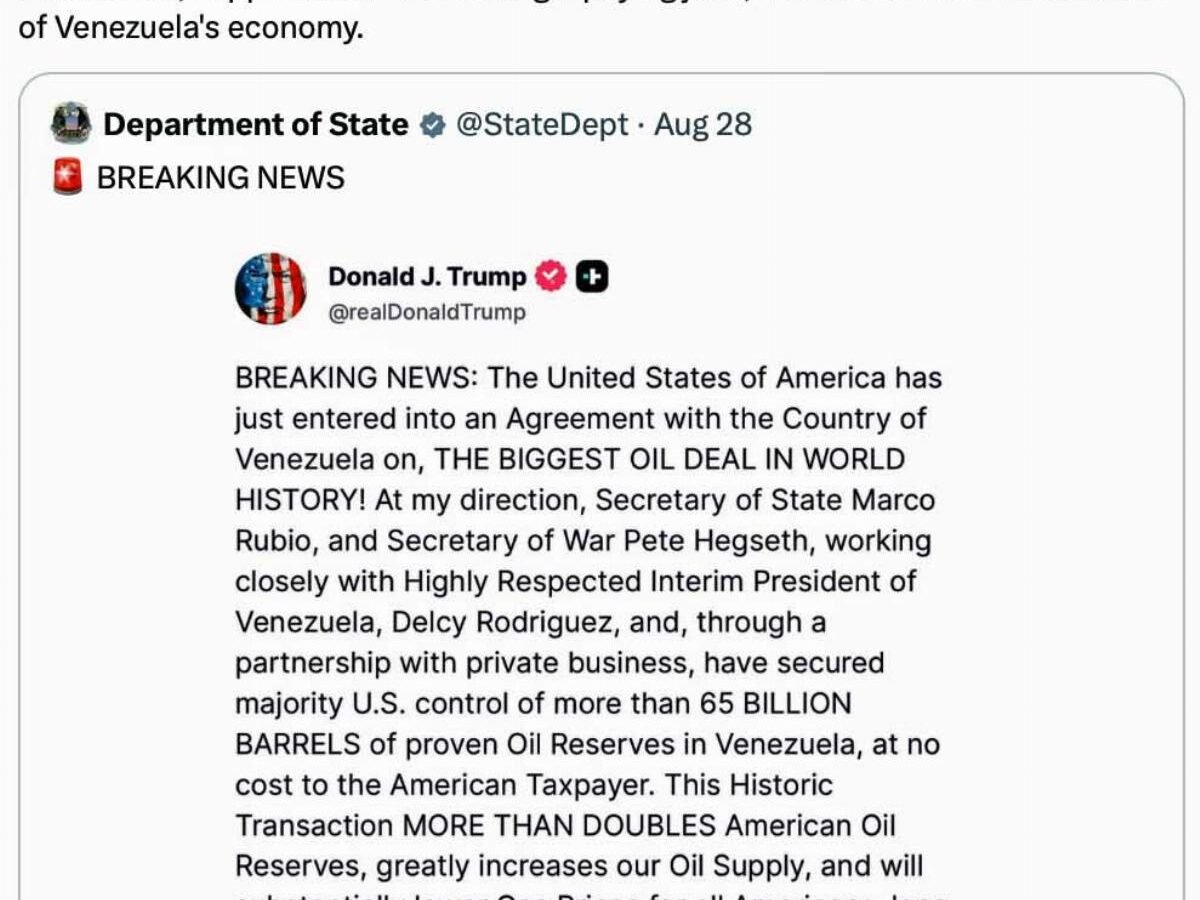
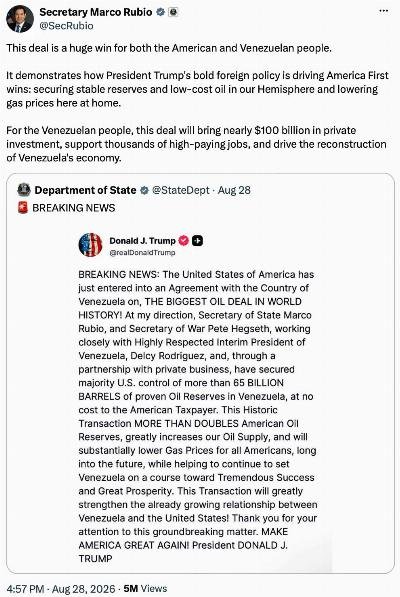
The deal in question — announced last week by President Trump and negotiated by Secretary of State Marco Rubio and Secretary of War Pete Hegseth — is a historic partnership with Venezuela’s interim government. Interim President Delcy Rodríguez confirmed the core terms: 17 strategic oil fields holding more than 65 billion barrels, a production target above 1.5 million barrels per day, more than $100 billion in private investment, and large fiscal flows to Venezuela. Whether the final U.S. stake lasts a generation or a century, the meaning is the same: the United States has secured an interest in the very resource that once financed communist Cuba and subversion throughout Latin America.
American Thinker’s commentary, echoing analyst Yuri Perez, frames the deal as a clear win for both nations — and a long-overdue correction to a quarter-century of disaster. “For more than a quarter-century, Venezuela was not merely poorly governed,” Perez wrote. “It was captured by Cuban communist intelligence services. Russian arms entrenched it.” Chinese loans stripped the country of sovereignty while the Chávez–Maduro regime looted the nation, wrecked the currency, and filled the prisons. The result was a failed state marked by mass exile, political prisoners, electrical blackouts, and a platform for America’s enemies in the Western Hemisphere.
Critics of the new agreement, the column argues, prefer to forget that history. The left is calling the deal “colonialism” — a charge Canto dismisses as reflexive anti-Trump sentiment. “It’s all about Trump with these people,” he writes. His own unscientific survey — conversations with Venezuelan friends — convinces him that Venezuelans trust capitalism more than the Democrats do.
A Sovereignty That Was Never Real
The deeper point, as both Canto and Perez emphasize, is that Venezuela’s oil was always “sovereign” on paper but enslaved in practice. In theory, the people owned the oil. In reality, it was Chávez and his inner circle who used the resource to enrich themselves, finance failed socialist projects, send money to left-wing candidates in Latin American elections, and align the country with the world’s worst actors. Sovereignty without property rights, honest courts, and a state that cannot be flipped by the Cuban communist regime, Perez argues, is an empty word.
The new deal changes that calculus by giving the United States a secured interest in the resource — a kind of ownership stake that makes foreign exploitation harder rather than easier. The terms are staggering by any measure: more than 65 billion barrels across 17 strategic fields, a production target above 1.5 million barrels a day, and over $100 billion in private investment. Those numbers represent not just an economic lifeline but a strategic repositioning of the hemisphere’s energy map.
What the Critics Miss
The column acknowledges that critics will see the deal as American overreach. But it argues that such criticism ignores the actual history. For more than 25 years, Venezuela wasn’t poorly governed — it was captured. Cuban intelligence services ran the regime. Russian arms fortified it. Chinese loans hollowed it out. The Venezuelan people fled by the millions. The electrical grid collapsed. Prisons filled with political opponents. And all the while, the country’s oil wealth funded communist projects and subversion across the region.
Seen through that lens, the deal is less a colonial power grab and more a rescue operation. A prosperous Venezuela pumping oil, Canto writes, is the best thing that could happen to a future government down there. Keeping China out of the country is a nice dividend as well.
Time will tell whether the agreement delivers on its promise. But for Venezuelans who have lived through the Chávez–Maduro nightmare, the choice between a U.S. partnership and continued socialist ruin may not be much of a choice at all. As Canto’s Venezuelan friend put it, “The US is the best country to do business with.” After 30 years of Chávez, that might be the highest praise available.
Source: www.americanthinker.com — https://www.americanthinker.com/blog/2026/09/a-good-deal-for-venezuela-and-the-us/