
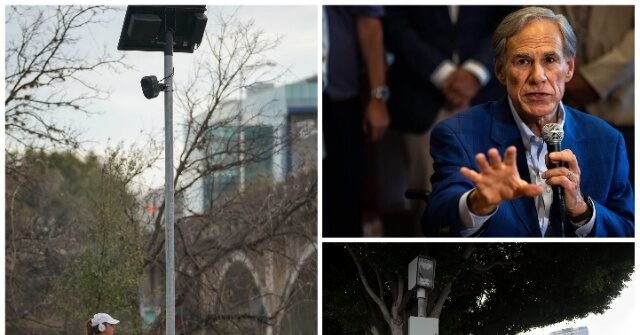
Texas Governor Greg Abbott has ordered all state agencies to stop funneling money toward local law enforcement’s purchase and operation of Flock surveillance cameras, a dramatic reversal that comes on the heels of a new investigation into how those systems were funded, according to the Breitbart Texas-Border team.
The directive arrived Thursday, shortly after the Texas Tribune published its investigation into roughly $30 million in state money that flowed to local police departments for the AI-powered license plate readers. The Tribune found that the state of Texas had quietly added a $1 fee to car insurance policies, with the proceeds distributed to local law enforcement agencies to combat catalytic converter thefts.
That funding stream, administered by the Motor Vehicle Crime Prevention Board, led to the purchase of about 2,000 Flock cameras, the Tribune reported. An additional $15.9 million went to the Texas Department of Public Safety to buy another 1,200 cameras.
Andrew Mahaleris, Abbott’s communications director, told the Tribune that to the extent cities receive any funding for the cameras, most of it comes from the federal government. “To the extent any funding comes from Texas agencies, those agencies are clarifying that those funds cannot be used for Flock cameras,” Mahaleris said.
The move marks a sharp turn for a technology that police agencies have credited with solving serious crimes, including child kidnappings, but which has come under mounting scrutiny from both civil liberties advocates and lawmakers concerned about government overreach.
A Funding Pipeline Under the Microscope
The Tribune’s investigation indicated that the actual number of Flock cameras purchased through the insurance-policy fee may be even higher than reported, as agencies were not always forthcoming with complete records. That opacity has only deepened concerns among Texas legislators about the scale of electronic surveillance enabled by the AI-driven system.
State Representative Mitch Little, a Republican from Lewisville, told the Tribune that the sheer volume of information collected by Flock cameras is not something he believes the Fourth Amendment can accommodate.
“The sheer volume of information captured is not something that is entertained, in my view, by the Fourth Amendment,” Little said.
Senator Ted Cruz, also a Texas Republican, voiced even stronger disapproval during an interview on Bloomberg’s “Balance of Power.” Cruz said he dislikes Flock cameras and government surveillance generally, arguing that law enforcement should focus on going after criminals rather than monitoring innocent citizens.
“We have a presumption of innocence,” Cruz said. “And I think the surveillance state—China has built an espionage and surveillance state. I don’t want to see America the same way. I think these Flock cameras really invite abuse, and I’m hopeful the political process will constrain it.”
Law Enforcement Defends the Technology
Despite the political pushback, state and local law enforcement agencies have praised the cameras for their impact on solving and reducing crime.
Dallas Police Department’s Major Felony and Vehicle Recovery Division said it uses hundreds of cameras to track suspects involved in violent offenses, hit-and-runs, and auto thefts. The department reported that clearance times for many of these crimes dropped from days to hours.
Texas DPS also reported using automatic pings from the cameras to intercept stolen vehicles, apprehend fleeing felons, and disrupt human smuggling operations along major highway corridors.
A Collision Between Technology and Privacy
Abbott’s abrupt freeze on state funding highlights a growing collision between law enforcement technology and constitutional privacy rights in Texas, a state that has otherwise been a strong proponent of expansive police powers and border security measures.
The revelation that millions in state grants—derived from mandatory auto insurance fees—had bankrolled the surveillance network has catalyzed bipartisan pushback, with lawmakers on both sides of the aisle questioning the program’s Fourth Amendment boundaries.
As the state spigot now appears shut off, local departments will face increased scrutiny and potentially tighter legislative guardrails if they choose to continue funding these automated tracking networks through local or federal dollars.
The development follows a broader national debate over the proliferation of automated license plate readers, which capture and store data on every vehicle that passes within range, including those belonging to people not suspected of any wrongdoing. Proponents note the systems have been instrumental in recovering stolen vehicles and locating missing children, while critics argue the mass data collection amounts to a form of unwarranted surveillance.
With Abbott’s order now in place, the near-term fate of Flock camera expansions in Texas appears uncertain. Agencies that already purchased the hardware may still operate it, but without state support, future acquisitions could slow considerably—or shift entirely to federal grants, which Mahaleris indicated are the primary source of local funding.
The Texas Tribune’s investigation, which prompted the governor’s move, underscores how a small, seemingly innocuous fee can quietly underwrite a vast surveillance apparatus. The $1 charge on car insurance policies was framed as a tool to curb catalytic converter theft, a crime that spiked nationwide in recent years, but the resulting camera network has raised far broader questions about who is being watched and why.
As lawmakers prepare for the next legislative session, the debate over Flock cameras is likely to heat up. With both Republican and Democratic figures expressing discomfort, the political process that Cruz hopes will constrain the surveillance state may have already begun.
Source: www.breitbart.com — https://www.breitbart.com/border/2026/08/29/texas-governor-orders-halt-to-state-funding-of-flock-cameras/