
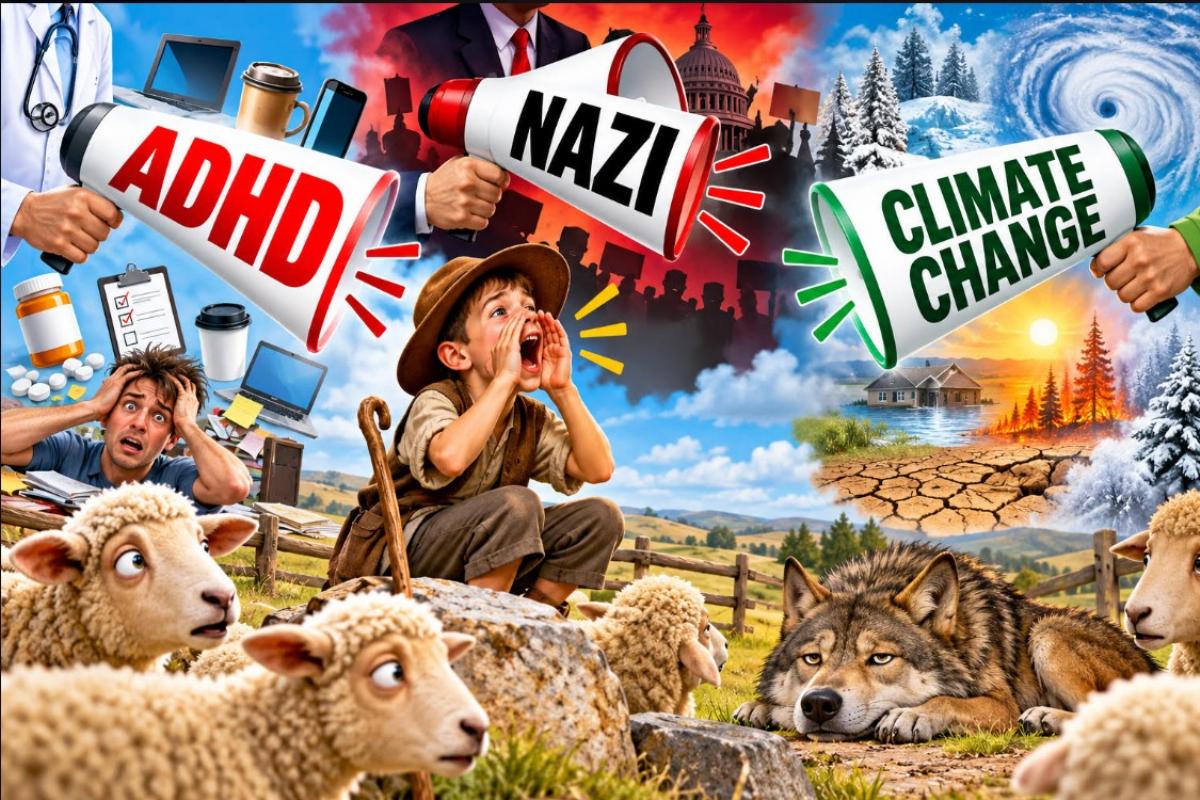
What do adult ADHD, Nazi comparisons, and climate change have in common? For Brian C. Joondeph, M.D., writing in American Thinker, the answer is a single fill-in-the-blank sentence: When everything is ___, nothing is ___.
Joondeph, a Colorado-based ophthalmologist who writes on medicine, science, and public policy, uses that formula to argue that three of the most charged terms in contemporary life are being stretched so far beyond their useful boundaries that they are losing the precision that gave them force in the first place. He frames the problem through a concept psychologists already have a name for — “concept creep” — and warns that the casualty isn’t just vocabulary but the ability to identify genuine harms.
The ADHD case: seven in ten GPs say it’s overdiagnosed
Joondeph opens with adult ADHD, citing reporting in The Telegraph that seven in ten British general practitioners believe the condition is overdiagnosed in adults. In his account, the diagnostic pathway has become something closer to a default: once a patient is referred to a specialist for evaluation, nearly everyone walks away with the diagnosis. From there, he writes, the machinery shifts to treatment — stimulant medications, behavioral therapy, counseling — consuming both public and patient resources. He calls it another facet of what he terms the medical-industrial complex.
He notes that on the American side of the Atlantic, the Association of American Medical Colleges has acknowledged that ADHD “can be overhyped” and that few physicians are prepared to treat a condition long regarded as an issue confined to children.
None of this, in Joondeph’s telling, means adult ADHD is fictional. He concedes it is a genuine neurodevelopmental disorder with recognizable symptoms — inattention, hyperactivity, impulsivity. The question he poses is different: where is the line between a diagnosable condition and the ordinary static of modern life? Too much coffee, too little sleep, job stress, an hours-long relationship with a smartphone — all of these can mimic the checklist. “When does the spectrum of normal human behavior veer into mental-health pathology?” he asks. His answer, in the space of one line: when everything is ADHD, nothing is ADHD.
Hitler as a political adjective
The second term is the one with the heaviest historical freight. Joondeph acknowledges that the Nazi era was among the darkest chapters of modern history — and then points to how casually the vocabulary is now deployed against political opponents. Prominent Republicans including Donald Trump and George W. Bush have been depicted as Hitler, he writes, and he adds, in a nod toward even-handedness, that similar imagery has been aimed at Barack Obama.
His argument is not that political disagreement is off-limits, but that routinely applying Hitler and Nazi to electoral rivals transforms extraordinarily grave historical terms into ordinary insults. Once any elected official can be tagged a Nazi, the word stops pointing at anything in particular and becomes just another jeer — its historical specificity gradually worn away. As he puts it: if everyone is a Nazi, then no one is a Nazi.
The practical concern lurking beneath the wordplay is what happens later, when something genuinely resembling that ideology appears. If the vocabulary has already been spent on a disliked policymaker, what remains?
From global cooling to climate change
Joondeph’s third example is climate change, and he traces a shift in framing: first the warnings about global cooling — pointing to a widely read 1975 Newsweek piece, “The Cooling World,” that described dramatic changes in weather patterns and declining food production — then global warming, and today the broader umbrella of climate change.
His core distinction is between climate and weather, which he notes are not synonymous. Hurricane, drought, flooding, wildfire, heat wave — all are attributed to climate change, he writes, and even unusual cold and snow can find their way under the same heading.
Joondeph is careful here, and the caveat matters. He does not deny that a changing climate can influence the probability or severity of certain kinds of weather, and he acknowledges that Earth’s climate has been shifting throughout its history. His objection is to labeling as the explanation what is really a category: simply stamping every unusual or destructive weather event “climate change” is not an analysis, and it can short-circuit the scientific work that would otherwise follow. When everything is climate change, nothing is climate change.
What ‘concept creep’ actually means
The unifying idea, Joondeph writes, was named by psychologist Nick Haslam: concept creep, the process by which the boundaries of a concept gradually expand until a term once reserved for something relatively specific swallows more behaviors, events, and circumstances. Haslam, according to Joondeph’s summary, describes two directions of expansion — outward, to include qualitatively different phenomena, and downward, to include progressively less extreme ones.
The irony Joondeph emphasizes is that this expansion can end up undermining the causes the terminology was meant to advance. If every distracted, restless, overworked, underslept adult is folded into ADHD, distinguishing a disabling disorder from everyday frustration becomes harder. If every objectionable policy becomes Nazism, the word loses the capacity to signal anything exceptional. And if every hurricane, drought, flood, wildfire, blizzard, or heat wave is stamped “climate change,” the explanation risks explaining very little.
Joondeph is explicit that the point is not whether ADHD exists, whether Nazis existed, or whether the climate changes. The point is what happens when terminology expands past its useful boundaries: medicine depends on diagnostic criteria, history depends on distinctions, and science depends on testable propositions — and all three depend on words that still separate one thing from another.
He sees the same linguistic inflation across the culture. A disagreement becomes “hate.” An unpleasant experience becomes “trauma.” Criticism becomes “bullying.” A disputed opinion becomes “misinformation.” Each of these terms, he argues, once described something relatively specific and now functions as a catchall.
Crying wolf, with real wolves
Joondeph lands on Aesop. The boy who cried wolf, he notes, was not wrong because wolves don’t exist — quite the opposite; the wolves were entirely real. The boy’s error was sounding the alarm so indiscriminately that no one responded when it mattered.
That, for Joondeph, is the real hazard of linguistic inflation. The more powerful a word, the stronger the temptation to use it. But every indiscriminate use spends a little of the word’s power, and the account eventually runs dry. His closing image is a world where ADHD means distraction, Hitler means someone you didn’t vote for, and climate change means bad weather.
“When everything means everything,” he writes, “eventually words mean nothing.”
Source: www.americanthinker.com — https://www.americanthinker.com/articles/2026/09/adhd-nazis-and-climate-change/