
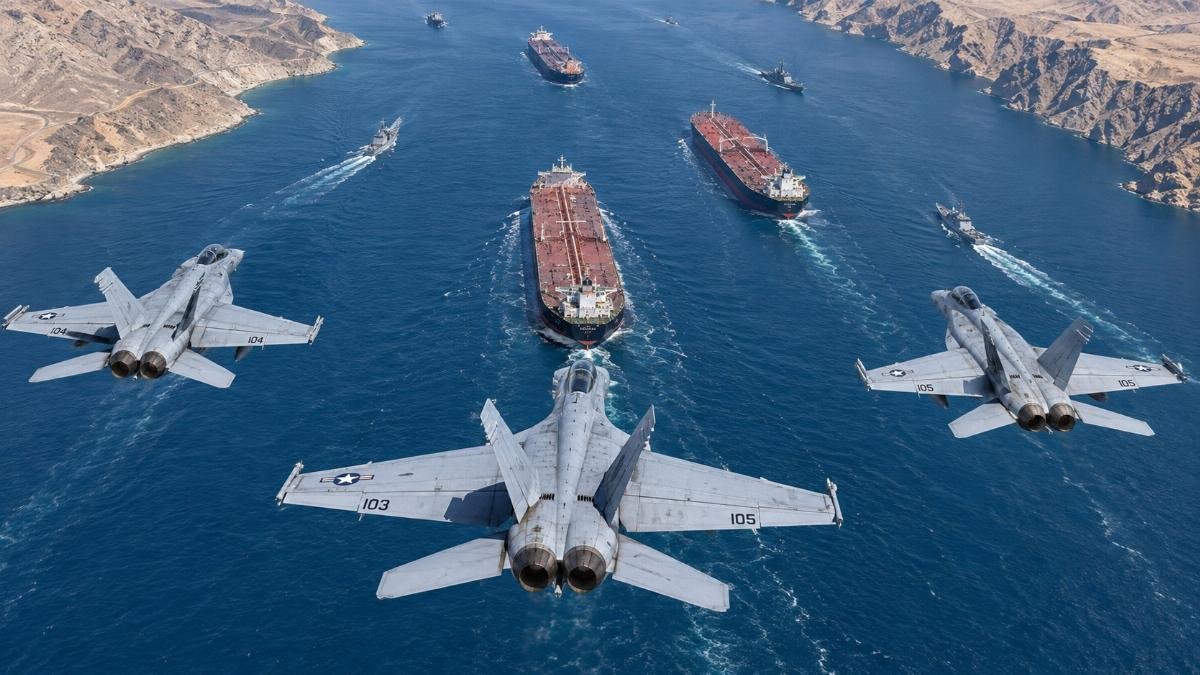
The Strait of Hormuz remains a pressure point in the ongoing confrontation between U.S. forces and Iran’s Islamic Revolutionary Guard Corps, with a recent incident report highlighting the unconventional tactics being employed in one of the world’s most critical waterways.
According to the UK Maritime Trade Operations, a tanker departing the Strait approximately 25 nautical miles northeast of Khasab, Oman, was approached by a small vessel that attached two explosive devices to its hull above the waterline. These limpet mines—magnetic explosive charges designed to breach ship hulls—represent the kind of asymmetric warfare the IRGC has long threatened to deploy against commercial shipping.
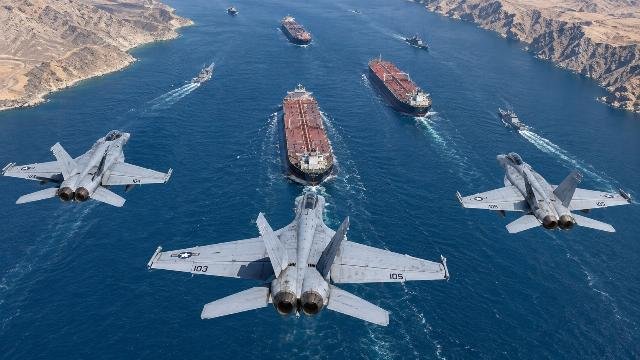
The incident comes as CENTCOM commander Admiral Brad Cooper conducted an aerial survey of the region earlier this week, showcasing U.S. military assets patrolling international shipping channels. During his tour, Cooper presented footage of American helicopters, fighter jets, and sea drones maintaining security in the Persian Gulf.
Competing Narratives Over Mine Threats
Admiral Cooper directly contradicted Iranian claims that the Strait has been seeded with mines, stating that U.S. forces have “successfully cleared” all sea mines from international shipping lanes, which “remain free and clear.” He characterized Iranian reports of ships striking IRGC mines as deliberate misinformation aimed at driving up insurance costs and pressuring shippers into paying what amounts to a protection racket for safe passage through Iranian territorial waters.
Since summer, Cooper said, 1.5 billion barrels of crude oil have safely transited the Gulf under U.S. protection. Notably, he claimed zero barrels of Iranian crude have made it through during that same period, suggesting American economic warfare has effectively choked off Tehran’s oil exports.
“What I didn’t see,” Cooper reportedly said during his briefing, “I didn’t see the IRGC out there at all… They were not out there because Iran’s navy is all at the bottom of the sea.”
Yet the limpet mine incident suggests the picture is more complicated than that assessment implies.
The Mosquito Fleet Problem
While U.S. forces may have neutralized Iran’s larger surface combatants, the IRGC maintains thousands of small, fast-attack boats—the so-called “mosquito fleet”—that can deploy explosives, conduct harassment operations, and generally make life difficult for commercial shipping. These vessels are nearly impossible to fully eliminate given their numbers and the ease with which they can be replaced or hidden among legitimate fishing traffic.
The strategic question isn’t whether the U.S. can sink every speedboat in the Persian Gulf—it can’t and won’t—but rather how to convince IRGC commanders that deploying them carries unacceptable risks. That calculation involves more than raw military force.
Kenneth R. Timmerman, writing in American Thinker, argues that breaking Iran’s will to fight requires a two-pronged approach: demonstrating the regime’s economic bankruptcy through continued financial pressure, and empowering religious figures who reject the ideological foundation of the Islamic Republic—the concept of velayat-e faghih, or absolute clerical rule.
Timmerman recounts meeting a dissident mullah in Paris during the 1980s who later briefed Defense Intelligence Agency leaders at Bolling Air Force Base in 1997. The core insight: only a mullah can credibly call another mullah a heretic, and since Iran’s government is built on religious ideology, theological challenges pose a unique threat.
Washington Tensions and Leaked War Plans
Back in Washington, political tensions over Iran policy surfaced this week when Senator Chris Murphy, a Connecticut Democrat, characterized classified CENTCOM briefings on U.S. war plans as “insane,” warning they would “lead to devastating escalation and the likely destruction of our commitment to the rule of law.”
While Murphy’s public comments didn’t reveal specific operational details, they signaled that military action may be imminent—significant enough that Pentagon officials felt compelled to brief senators beyond the traditional “Gang of Eight” intelligence committee leadership.
The timing of Murphy’s remarks coincided with reports that Defense Secretary Pete Hegseth fired Lieutenant General Brett Sylvia, the three-star general responsible for military planning (the J5 position). According to unauthorized sources, Sylvia failed three polygraph examinations regarding his communications with Washington reporters, raising serious operational security concerns about whether America’s top war planner was leaking classified information to outlets including the Wall Street Journal and Axios.
The Uprising Question
A persistent question surrounding the Iran confrontation is whether economic pressure will trigger a popular uprising that topples the regime from within. Timmerman’s assessment, based on three decades of observing Iranian protest movements, is blunt: not without outside help.
Mass demonstrations have erupted repeatedly—in 2009, 2018, 2019, and 2021—only to be crushed by security forces once the initial momentum faded. The pattern has been consistent: protests swell, the regime strikes back with overwhelming force, and people retreat into survival mode.
However, Timmerman speculates that a particularly brutal crackdown in January of this year may have represented a turning point, hardening public sentiment in ways previous repressions did not. He draws parallels to historic breaking points like the Boston Tea Party or the fall of the Berlin Wall—moments when accumulated grievances and state brutality crystallize into irreversible demands for change.
Whether economic strangulation, military pressure, theological challenges, or popular resistance will prove decisive remains an open question. For now, the Halloween image Timmerman invokes—IRGC “ghouls” lurking between the swells—captures an uneasy status quo: shipping continues under armed protection, explosive devices occasionally appear on hulls, and both sides maneuver for advantage in a conflict with no clear endgame in sight.
The UK Maritime Trade Operations continues to advise vessels transiting the region to maintain heightened vigilance, report suspicious activity immediately, and implement security measures appropriate to the threat environment. For the ships that carry a fifth of the world’s oil through these contested waters, Halloween in the Strait is more than a metaphor—it’s an operational reality.
Source: www.americanthinker.com — https://www.americanthinker.com/articles/2026/10/halloween-in-the-strait/