
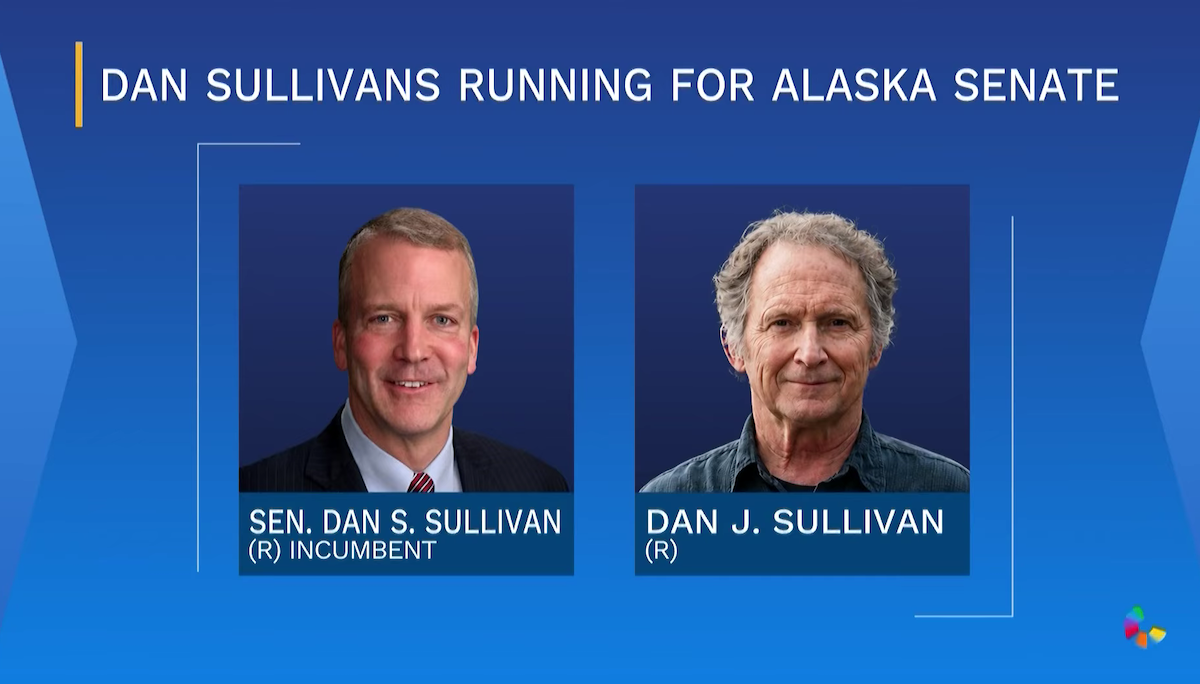
ANCHORAGE, Alaska — If you want a textbook example of what a rigged election looks like, the U.S. Senate primary still unfolding in Alaska is a strong candidate. Republican incumbent Sen. Dan Sullivan trails Democrat Mary Peltola by roughly 5 points with about 30,000 votes yet uncounted, but the fundamentals heading into November won’t change much — thanks, critics say, to the state’s ranked-choice voting regime.
Ranked-choice voting, or RCV, replaced Alaska’s traditional party primaries with an open ‘jungle primary’ that lets any state resident file as a candidate. After the primary, the top four finishers advance to the general election, where voters rank candidates instead of picking just one. The system, supporters argue, encourages consensus. But its opponents — including a number of Alaska conservatives — say it’s engineered to keep Republicans out of statewide office and protect Sen. Lisa Murkowski.
This year, the system has produced what looks like an outright spoiler scheme. A retired teacher named Daniel J. Sullivan — no relation to the incumbent — secured a spot on the general election ballot by finishing third in the primary with about 2.4 percent of the vote. He has never before run for office, and he wasn’t a registered Republican until two days before filing his candidate declaration. His campaign, according to The New York Times, has been quietly aided by veteran Democrat consultant Amber Lee.
The fake Sullivan initially tried to register as ‘Dan S. Sullivan’ — adopting the incumbent’s middle initial so the names would appear all but identical on the ballot. He also built a campaign website that closely mimics Sen. Sullivan’s official reelection site in format, color scheme, and branding. The obvious intent, critics charge, is to confuse voters into casting a ballot for the wrong Sullivan, siphoning votes away from the actual Republican incumbent.
‘Make no mistake, the entire purpose of this man’s candidacy is to siphon votes away from Sen. Sullivan by confusing voters,’ wrote The Federalist’s contributor, who grew up in Alaska and lives there now. ‘It’s allowing the Democrats to cheat — and in the most blatant, low-IQ way imaginable.’
The ‘Decoy Dan’ tactic is not new to Alaska politics, but RCV makes it especially potent. In a normal primary, a lookalike candidate would be an annoyance — a footnote. Under RCV, finishing in the top four guarantees a general election slot, and with two Sullivans on the ballot, the GOP vote could split just enough to hand the seat to Peltola, the former U.S. House member who has already proven she can win statewide contests in Alaska.

Peltola’s 2022 election was itself a product of RCV dynamics. She won the special election to replace the late Rep. Don Young, a Republican who held Alaska’s sole House seat for 49 years, after the GOP vote split between Sarah Palin and Nick Begich. Under ranked-choice tabulation, Peltola eked out a victory in the second round of counting — a result that became a rallying cry for RCV opponents.
RCV has also produced stranger outcomes. In the November 2024 election, a convicted felon serving a 20-year prison sentence in New Jersey was allowed to appear on Alaska’s ballot after finishing sixth in the open primary. That’s the system Alaska has, and it’s the system that’s now threatening to give Democrats a Senate seat in a state Donald Trump won by double digits.
The intellectual and political origins of Alaska’s RCV system trace back, critics say, not to good-government ideals but to one goal: insulating Sen. Lisa Murkowski from a conservative primary challenge.
Murkowski lost the 2010 GOP primary to Tea Party candidate Joe Miller, a loss she spent years trying to overcome. She won that November as a write-in candidate, largely on name recognition — her father, Frank Murkowski, served in the Senate for 21 years and resigned to become governor, famously appointing his own daughter to fill the vacancy. In 2020, Alaska voters — by a narrow margin — approved RCV after a $15 million campaign bankrolled largely by out-of-state donors, outspending grassroots opposition by 12 to one.
The connection is hard to miss, as Theo Wold, an Alaska attorney and former Trump administration official, noted on X this week. ‘Her former campaign staffer, Scott Kendall, wrote the ballot initiative to create RCV, and her former Chief of Staff left his perch in DC to run the RCV campaign when it passed in 2020,’ Wold wrote. ‘RCV in Alaska exists so Murkowski can be unbeatable in a Red State while governing as a Democrat who likes oil.’
Efforts to repeal RCV have so far failed. A 2024 ballot measure to end it lost by just 743 votes, with proponents raising more than $12 million compared to the repeal campaign’s paltry $120,000. This year, Elon Musk has donated $1 million toward a new repeal effort, but history suggests the pro-RCV side will again be flooded with outside cash between now and November.
The result, critics say, is a voting system that rewards deception and punishes clarity. A candidate with no real campaign, no platform, and no party loyalty can single-handedly flip a U.S. Senate seat — not because Alaskans wanted it, but because the gimmick of ranked-choice voting made it possible.
For now, the Senate primary remains too close to call, and the ‘Decoy Dan’ saga is far from over. If the fake Sullivan pulls enough votes in the general election to hand the seat to Peltola, Alaska will have a new senator — and a new cautionary tale about what happens when election rules are written to protect the powerful, not the voters.
Source: thefederalist.com — https://thefederalist.com/2026/08/24/the-senate-race-in-alaska-is-what-a-rigged-election-looks-like/