
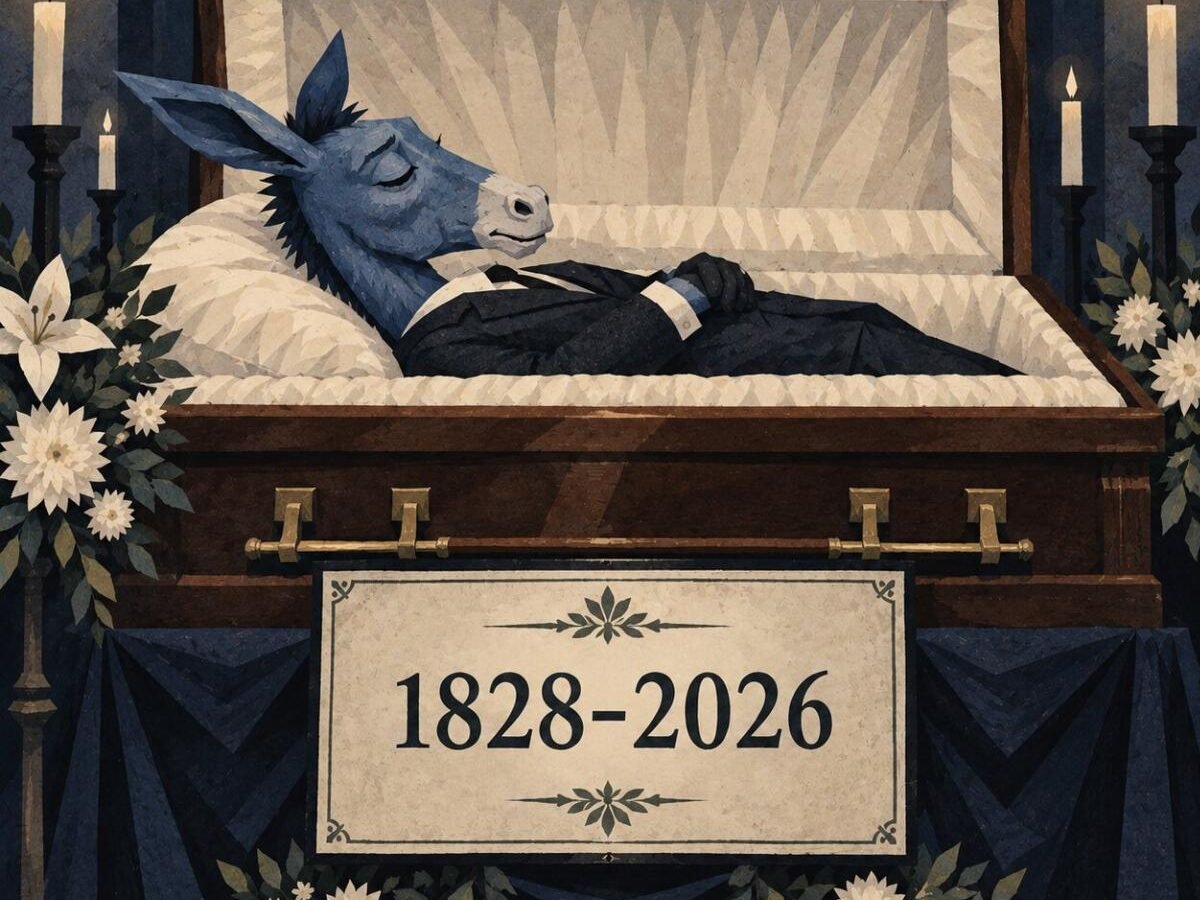
Political parties rarely get to declare mission accomplished. According to a September commentary in American Thinker, that is exactly the trap the Democratic Party now finds itself in — and it is the party’s past victories, not its defeats, that have left it grasping for a coherent message.
Written by Robert Weissberg, the piece opens with a structural observation: successful American parties cannot survive on narrowly tailored, closely argued platforms. Because they must assemble majorities from a heterogeneous electorate, they are built for broad coalitions, not ideological purity. European parties organized around a single doctrine play a different game.
But Weissberg argues that the Democrats have gone well beyond the normal messy coalition-building that American politics demands. His test is coherence: what, he asks, connects facilitating sex-change operations for minors with raising taxes on billionaires? What thread runs from “Medicare for All” to defunding the police? How does a message of affordability square with the Green New Deal, a program he says inevitably raises energy costs? He also questions the internal logic of promising to lower prices while simultaneously pushing wages higher across the board.
Other items on his list of what he calls bumper-sticker slogans: defending open borders and sanctuary cities even though, in his framing, cheap labor pushes down wages for American workers; allowing men to compete on women’s sports teams; legalizing addictive drugs; and condemning Israeli “genocide” in Gaza. These, he writes, are not a platform so much as an incoherent collection of one-liners.
Part of the problem, in his telling, is that many of these positions are simply unpopular — and have no realistic path to becoming law anyway. He asks whether Americans genuinely want to pack the Supreme Court or abolish it outright, and whether they want a party that shows what he describes as lukewarm enthusiasm for the flag and American history. American parties, he concedes, have always acted like budget-busting Santas. The difference now, he writes, is that the Democratic version promises toys few people want, that will not work as advertised, and that carry real risks.
Word games and outreach that misfire
Weissberg also takes aim at what he sees as a cheap substitute for substance: changing the language. Swapping “sex workers” for “hooker,” or “birthing person” for “mother,” may be easy to accomplish, he writes, but it wins no elections. Such wordplay, in his view, confuses terminology with reality and fools no one.
He reserves particular scorn for the party’s flirtation with socialism — or at least with the label. He acknowledges that few Americans have a precise understanding of what socialism entails, beyond the promise of “free stuff.” His deeper point is that actually implementing it would require deeply unpopular measures: public ownership of key industries, government-controlled media, the elimination of private banks, and similar controls over private life. Whatever voters think they are endorsing, he suggests, is not that.
Further from the party’s traditional identity, in his account, is its engagement with Muslim extremism, and he singles out Michigan’s Abdul El-Sayed as an example, citing what he calls anti-American and anti-Israeli baggage. Michigan matters here, Weissberg notes, because it is home to the United Auto Workers, a core Democratic constituency he describes as hardly disposed toward Islam. His conclusion is that the party’s “Big Tent” is currently shutting out the old faithful in favor of a religious tradition he considers deeply at odds with American values.
The March of Dimes parallel
The article’s central analogy is organizational, not ideological. Weissberg reaches for the March of Dimes, founded in 1938 to fight polio, a disease that paralyzed millions of children and that the charity raised millions to combat through research and healthcare facilities. When the Salk and Sabin vaccines conquered polio in 1955, the organization had effectively put itself out of business.
Rather than disband its sizable fundraising apparatus, it pressed on. After some initial misfires, it reinvented itself around birth defects, arthritis, and virus diseases, with premature birth added in 2005. In 1976 the shift was formalized with a new name: the March of Dimes Birth Defects Foundation.
Weissberg applies that template to the Democratic Party. On civil rights, he credits Democrats with enacting dozens of anti-discrimination laws, making huge investments in black-run neighborhoods and cities, electing countless black officials including a president, and creating economic set-asides, among other advances. He calls it a stunning record of accomplishment — and then asks what remains.
His answer is: not much, at least of the kind government can deliver and that actually works. Without a fresh agenda, he argues, the civil rights movement drifts toward what he terms ephemeral issues like toxic white racism or reparations. At most, he writes, Democrats can denounce Republican efforts to roll back racial preferences through DEI, but such rhetoric will not mobilize millions.

He sees the same dynamic with liberal women, whose far-ranging progress makes further demands awkward. It is hard to campaign for one more anti-discrimination law when women college graduates outnumber men, hold many top corporate positions, enjoy ample political success, and even fly fighter jets. He cites a striking data point: women accounted for 98% of all jobs added to the economy in August 2026. Crafting a message of greater sexual equality against that backdrop, he writes, is not easy work for a Democratic strategist.
Economic equality presents a parallel predicament. More than half a century of “wars on poverty” have poured massive sums into education, subsidized housing, job training, and food and medical subsidies. In Weissberg’s assessment, hundreds of billions have barely moved the needle, and no magic bullet exists. Faced with that, he says, Democrats fall back on slogans — demanding billionaires pay their “fair share,” or pushing what he calls business-killing, unrealistic minimum wage increases, as though such nostrums could lift millions into the middle class.
The Green New Deal gets similar treatment. Once a voter-mobilizing scheme to eliminate fossil fuels while creating millions of good-paying jobs, it has lost its magic in his view. Doomsday scenarios no longer persuade, and few voters want more huge wind farms or a ban on gas stoves.
The pattern, he argues, extends across the Democratic coalition: decades-old wish lists are now law, or the promised outcomes never materialized. Gays enjoy same-sex marriage and adoption rights; the disabled have ample legal protection. With hardly any disadvantaged group lacking government assistance, he writes, Democrats search almost desperately for new “victims” — the transgendered being his example.
Adapt or disappear
None of this is unique, Weissberg notes. He invokes the once-popular Prohibition Party, which banned alcohol nationally until Americans changed their minds, and the powerful Whig Party, which did not survive quarrels over slavery. The Republican Party, by contrast, was built on an anti-slavery appeal and successfully reinvented itself as the pro-business party once slavery was abolished.
Political survival, he concludes, demands constant adaptation. The roster of defunct American parties is long, and the shape of the Democrats’ next iteration is hard to predict — but endless facile sloganeering, in his view, is not the answer. A party built on helping ordinary wage earners needs something more substantive than “Orange Man Bad” or “prices are too high.”
He grants that Democrats will keep winning elections for now, buoyed by millions of loyal followers. But at some point, he predicts, today’s stalwarts will grow apathetic or die off, and new voters will look elsewhere for champions. The long-run verdict he delivers is blunt: a party that stumbles from one vacuous trendy issue to another for its core identity is doomed to collapse.
Source: www.americanthinker.com — https://www.americanthinker.com/articles/2026/09/democrats-in-disarray-the-cost-of-success/