
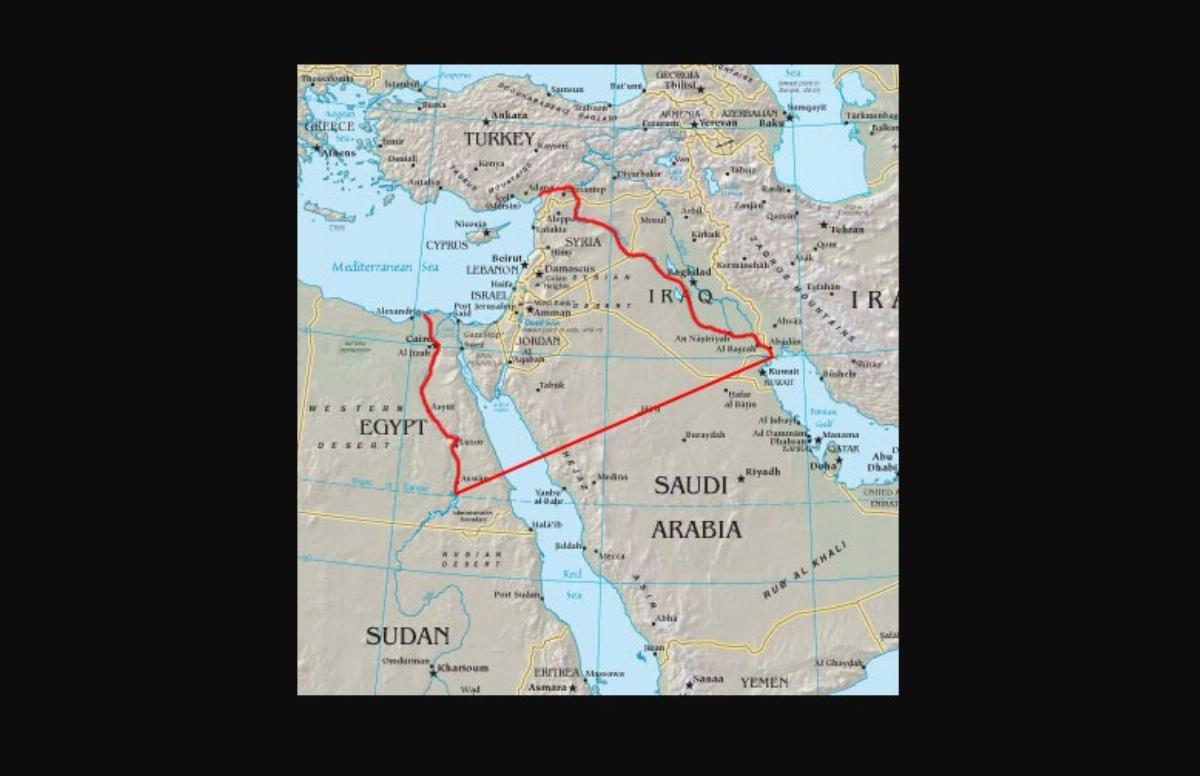
In an October 2 commentary for American Thinker, aerospace professional and former CEO Matthew G. Andersson takes aim at what he calls the dominant framing of Middle East conflict in progressive and alternative media — the idea that U.S. and Israeli policy is driven by a so-called “Greater Israel Project” (GIP). That interpretation, he argues, is not just wrong but a distraction from something more consequential: a contest over how regions will be organized in an age of technically linked infrastructure.
Andersson’s piece is less a defense of any particular government than an argument about categories. He contends that Israel and the United States are not simply pursuing territorial expansion or oil appropriation, but are engaged in “human systems growth” and “civilizational technical change,” in partnership with other countries that share similar ambitions.
From Reservation to Outward Pressure
To explain Israeli motivation, Andersson reaches for an analogy that will strike some readers as jarring: the postwar settlement, he writes, amounted to a kind of reservation in the Middle East, comparable to a Native American reservation in the United States. Drawing on a general theory of history, he suggests that small, locked-in territories dominated by a single culture tend toward eventual instability, because a confluence of factors can produce political will to expand beyond a confined area — sometimes after decades, sometimes after centuries.
What makes Israel distinctive in his account is how it responded to those constraints. He contrasts Israel’s modern economy and society with Arab nations he characterizes as a patchwork of oil and gas fields surrounded by desert, punctuated by a city or two of modern appearance whose inhabitants, including many guest workers, are often kept separate from the broader indigenous culture. Andersson writes that he got a taste of this arrangement when he was recruited to work for Aramco.
He also argues that the Arab tradition preserved an artificial global choke point by relying on the Strait of Hormuz — and predicts, flatly, that the choke point will be bypassed.
The ambition to advance through stages of economic growth, in his telling, is not primarily about land mass or colonial conquest. It is driven by a natural desire for resources and for an economic architecture that lets a country coexist with advanced nations, compete with them, and change the terms of that competition. Replacing old trading and transportation routes is one of the first markers of that change, he writes, but there is now much more: intelligent, linked infrastructure spanning communication, computing, and finance, forming the basis of regional organization — and, with it, a transformation of social governance “from a state to a technology.”
A Rostow-Era Lens on the Middle East
Andersson grounds his argument partly in personal history. He says he worked with economist and White House advisor Walt Rostow at the University of Texas at Austin, examining how countries move in “stages” from agrarian and pre-modern economies to basic manufacturing and eventually to advanced production and export. In that process, countries build wealth and the capital to reinvest and expand further.
China, he writes, is a primary example of a country that grew well beyond earlier predictions — largely, in his assessment, through appropriation of technology. Russia is another, particularly over the past two decades. The Middle East, by contrast, was always a curious outlier in growth theory because it settled into a strict oil cartel with little significant diversification, with Israel positioned as an effective cultural colony.
What interests Andersson is how Israel defied the stages-of-growth framework given its limited access to traditional means of production and natural resources. Its growth, especially in technology, turned that limitation into an outward pressure — a drive to create and join a larger system of economic activity, but one that changes the underlying nature of the economic system itself.
The Corridor That Isn’t a Borders Story
This is where the “Greater Israel Project” framing, in his view, fails to capture what is actually happening. He points to the India-Middle East-Europe Economic Corridor (IMEEC), quoting Prime Minister Benjamin Netanyahu’s description of a corridor stretching across the Arabian Peninsula and Israel, connecting India to Europe through maritime links, rail links, energy pipelines, and fiber-optic cables — bypassing maritime choke points including the Strait of Hormuz and the Suez Canal. In Netanyahu’s telling, Israel sits at the crossroads between Africa, Asia, and Europe, and the corridor represents “another pivot of history.”
Andersson says the corridor tells only part of the story. Tying the picture together, in his account, are developments in advanced technology and AI, modeled in part on the “smart city” concept and linked to networks of other smart cities and technical nodes such as AI centers — built on public-private partnership and commercially privatized state entities.
China, he notes, pioneered the smart-city model, but its version rests almost entirely on state control and ownership. That, he suggests, is part of why China is perceived as a heightened technology and smart-systems threat.
He also reads shifting alignments into the picture: India’s movement away from the earlier International North-South Transport Corridor — a multimodal network linking India, Central Asia, and Russia — toward a new commitment to the IMEEC helps explain some of the contention over Iran’s role, and why Russia and China together are seen as fundamental competitors over regional dominance and over the future of what he calls “technical network states” that replace traditionally bordered nations.
That shift, Andersson argues, fundamentally alters political scientist John Mearsheimer’s well-known “great powers” model of competition, replacing it with “great networks.” The stakes currently under contest, in his telling, are future, technically networked regions — even as, in the meantime, the oil still has to flow.
What the Argument Does and Doesn’t Claim
It is worth being precise about the boundaries of Andersson’s case. He is not claiming that territorial ambition or resource competition has vanished from the region. His claim is narrower and more structural: that interpreting national motivation solely through the lens of regional rivalry misreads the larger format of Middle East technical change, and that this misreading in turn fuels political party opportunism that exploits ignorance.
Whether one finds the networked-regions thesis persuasive or not, the piece is a reminder that arguments about the Middle East often proceed on assumptions about motive — conquest, security, resources, ideology — that competing camps never bother to reconcile. Andersson’s wager is that the more useful unit of analysis is no longer the border but the network, and that the countries positioning themselves along the IMEEC understand the game differently than their critics do.
Source: www.americanthinker.com — https://www.americanthinker.com/blog/2026/10/misinterpreting-the-greater-israel-project/
Source: www.americanthinker.com
Related coverage
- Spartan grit vs. the smartphone: What ‘maximum effort’ means for today’s military
- Conservative Writer Proposes Prenups Forbidding Abortion of Male Babies
- A $15 Billion Steel Mill in Iowa: How One Project Became the Case for Trump’s Tariffs
- American Thinker Argues Europe’s Welfare States Face a ‘FIGES Trap’ as Social Spending Hits €4.93 Trillion