
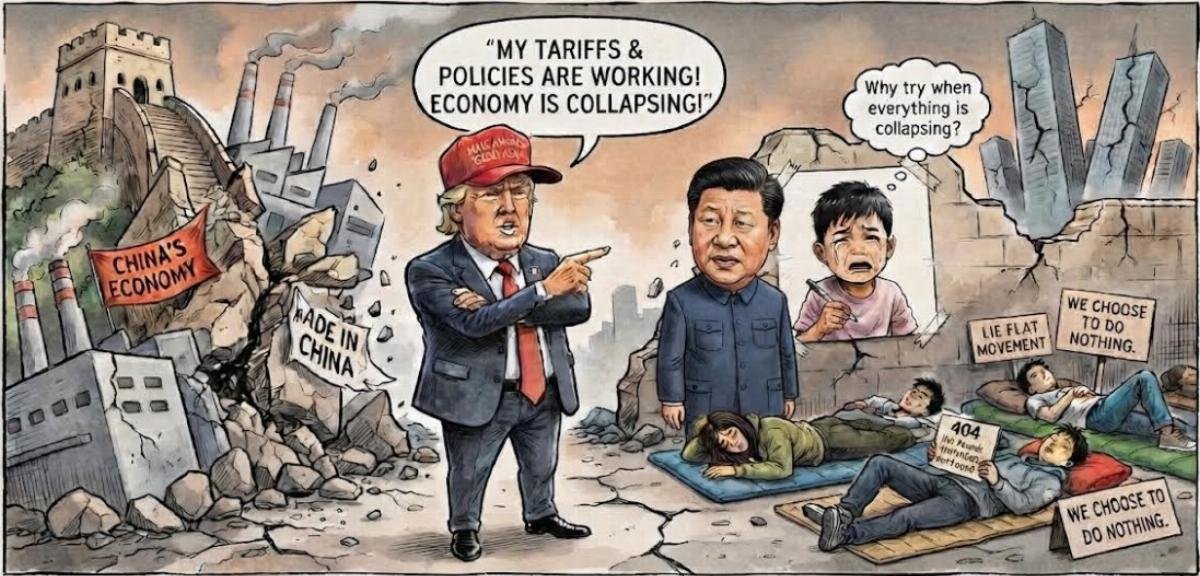
For years, a familiar chorus in Western commentary has warned that China is winning — economically, culturally, geopolitically — while the United States stumbles. In a new column for American Thinker, writer Arthur Schaper argues that this narrative gets the picture exactly backwards, and that two very different pieces of evidence prove it: a presidential reception in Washington and a viral video of a crying schoolboy in Tianjin.
Schaper’s piece, published October 5, 2026, takes direct aim at outlets and analysts he says are peddling a defeatist story about American decline. He names The Economist, economist Paul Krugman, and the Center for Strategic and International Studies as purveyors of the idea that China is ascendant. In his telling, President Trump’s handling of Chinese President Xi Jinping during a September 23–25, 2026 visit did more to puncture that narrative than any white paper could.
A Summit as Statement
According to the column, Trump’s reception of Xi amounted to a deliberate piece of political theater — a way of mocking the previous administration, which Schaper characterizes as having served Chinese interests at America’s expense. He writes that if Xi hoped to exploit American divisions through friendly leaders in Washington, the September summit should have disabused him of the idea.
The visuals, in Schaper’s account, were part of the message: a B-2 Spirit bomber and four F-22 Raptors flew over the red-carpet reception, a display of military strength staged in front of the leader of what he calls America’s main international rival. More consequentially, he writes, China left the summit without extracting any major concessions from Trump that would ease its own economic difficulties.
Readers can take or leave the symbolism. The substantive claim is that Trump gave up nothing — and that this matters because China came to the table needing relief.
The Kids Are Not Alright
Schaper’s second line of argument turns on a phenomenon that has been building inside China since around 2021: burnout, economic frustration, and a widening retreat from the relentless competition of Chinese life. He points to the difficulty of college entrance exams, shrinking opportunities to study in the United States — which he credits to Trump’s America-first posture — and a forbidding job market with little prospect of upward mobility.
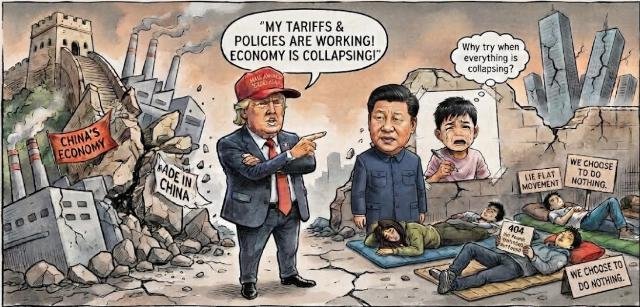
The movement has a name: Tang Ping, or “Lying Flat.” Schaper describes it as a non-Confucian, passive-aggressive rebellion aimed at employers, parents, and political leaders alike. Young Chinese, he writes, have concluded that corporate demands yield diminishing returns and that available jobs simply aren’t good. Rather than fight for a better life that feels out of reach, they have opted out.
Beijing, in his telling, is scrambling to reverse the trend. The government craves a striving workforce to compete with the United States, so it has deleted social media posts — including anything carrying the Tang Ping hashtag — cracked down on the notorious “996” culture of 9 a.m. to 9 p.m., six days a week, and pushed large employers to impose mandatory clock-off times and shorter workweeks. Officials have even branded the push to do as little as possible a Western conspiracy designed to hobble Chinese productivity.
None of it, Schaper argues, can force the proverbial ox to drink. The state can’t make young people embrace the party’s formula of hard work, advancement, children, and national pride when the payoff looks increasingly unlikely.
One Boy’s Tears, Millions of Echoes
The column’s most vivid passage concerns a video circulating on social media: a third-grade boy in Tianjin, a major northern port city, sobbing over a homework assignment while his mother films him. Schaper stresses that the child wasn’t crying because the work was too hard. He was crying, in this reading, out of a growing certainty that all his effort would amount to nothing — that he would end up a wage slave, or worse, in manual labor just to get by.
What struck Schaper most was the boy’s willingness to argue with his mother, contradict her, and talk over her attempts to calm him. In a culture that places heavy emphasis on filial respect and obedience, that defiance registers as something closer to despair than mere childhood stubbornness.
He also questions the mother’s decision to record the moment at all — and to leave her son’s face unblurred. Perhaps, he allows, she was trying to alert the public to the pressures Chinese children face. His prescription is simpler: she should have told him to stop working, hugged him, and assured him things would be okay. If reassurance failed, she should have let him be angry and release what he was feeling.
The clip drew coverage from Asian news outlets including Gutzy Asian, The Online Citizen, and Singapore-based Mothership, some of which, Schaper notes, treated the meltdown lightly. He suggests Chinese officials should watch it too, because it signals that efforts to stamp out Lying Flat are failing.
What the Column Is Really Arguing
Strip away the rhetorical flourishes and Schaper’s case rests on a straightforward proposition: China’s younger generations are not faring as well as Xi would like the world to believe. Rapacious business practices, protectionism, and aggressive anti-American chauvinism, he writes, are taking a toll, forcing young people into harsher competition for education and jobs that are no longer plentiful. A large cohort of educated but unemployed or underemployed Chinese, in his account, is simply dropping out in the face of surveillance-state pressure, economic decline, and cultural malaise.
From there, he connects the domestic picture to Trump’s ongoing trade war and pressure tactics, arguing that American policy is exploiting China’s weak spots. He calls the boy’s breakdown the best proof available of China’s troubles and asks whether that single cry, multiplied by millions, could become a collective shout or even a national protest against authoritarian rule.
He doesn’t claim to know. His conclusion is narrower: the Lying Flat movement shows no sign of stopping, and in his view it exposes Chinese weakness — at home and abroad — in the face of Trump’s continued MAGA agenda.
Whether readers find that convincing depends on how much weight they assign to a viral video and a summit’s optics. What’s clear from the column is the argument it wants to make: that the conventional wisdom about Chinese momentum is due for a second look, and that the evidence for it may be coming from China’s own young people — not from Washington’s think tanks.
Source: www.americanthinker.com — https://www.americanthinker.com/articles/2026/10/trump-trolls-china-and-the-chinese-youth-are-lying-flat/