

Two courtroom dramas have captured the country’s attention at the same moment, and the American Thinker columnist Whitson G. Waldo, III argues in an October 12 piece that they raise a question far larger than either case: do women bear responsibility for their own choices?
The essay, titled “Mountains Or Molehills?”, pairs the mistrial of Lindsay Clancy with the ongoing saga of the so-called Cornell 7 plus one, treating both as test cases for whether American law still holds women to the same standards it applies to men — or whether it has quietly embraced the premise that women cannot control themselves.
The Clancy mistrial
The piece takes direct aim at defense attorney Kevin Reddington, whom Waldo calls an “execrable” lawyer whose strategy in the Clancy case rests on a novel legal theory, and on whether that theory can withstand scrutiny. Waldo describes that theory in plain terms: for the sake of the case, a woman is not responsible for her thoughts and actions because her hormones are in charge.
In the essay’s framing, the Clancy prosecution represents a collision point between a legal theory about postpartum depression and a broader social argument about female culpability. Waldo hopes it is a passing anomaly. “For the sake of a constitutional republic and the rule of law,” he writes, an outcome that treats women as beyond accountability would be a departure from the legal tradition.
Waldo contends that Clancy’s own conduct undercuts the defense. She confessed to killing her three young children, he notes: those killings were planned, she sent her husband away on an errand so she would have the time to carry them out, and the methods she used took several minutes each.
The author believes the likeliest legal outcome is commitment to a psychiatric institution, followed by what he predicts will be a comparatively short stay before release back into society, and warns — in openly contemptuous terms — that she has not been sterilized, so a repeat might be possible down the line.
The Cornell 7 and the question of consent
The second thread of the essay concerns the Cornell 7 — a group of men, plus one woman, whose case has become a flashpoint in the national argument over campus sexual assault, consent, and prosecutorial discretion.
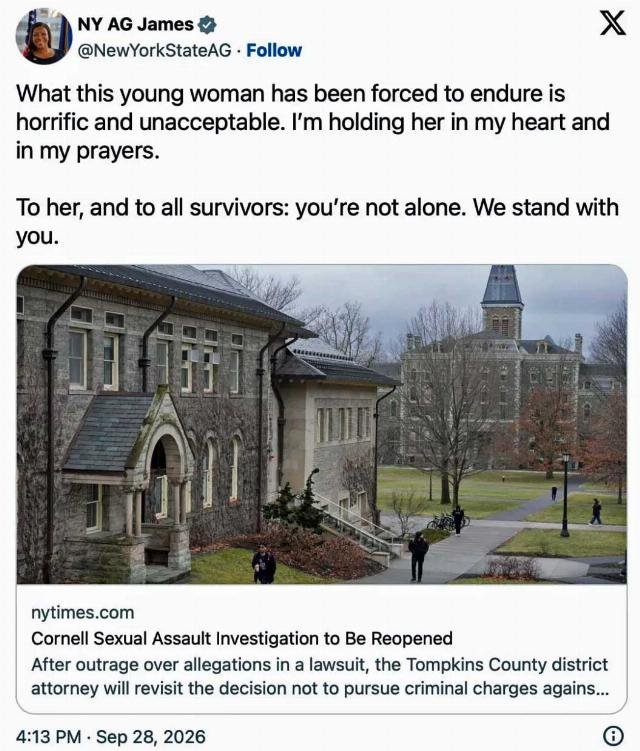
Waldo describes New York Attorney General Letitia James in sharply critical terms, calling her a political appointee of “the tyrannical New York governor Kathy Hochul,” and objects that the process is itself the punishment, even before any courtroom fight is resolved. He points to a recent attorney general debate in which James, according to the essay, said the facts and the law matter less than the conduct at issue: “You don’t have to study the facts and the law. All you have to do is study what they do.”
Turning to the woman at the center of the case, Waldo observes that she has not been doxxed, which he attributes to what he describes as the alt-media’s reticence to name her, while he complains that the mainstream press, which he calls the “Lugenpress,” has adopted critical theory’s premise about male hegemonic power over a helpless woman. He stresses that her sworn testimony has changed multiple times, and raises — without resolving — whether she might face indictment for obstruction of justice or submitting false reports.
The men involved, by contrast, have been doxxed, and Waldo notes an uncomfortable wrinkle for the case: one of them is Black, which, he says, complicates the standard critical-theory reading of who is victim and who is oppressor. He predicts that all of the men will nevertheless bear the charge of being male oppressors, which he thinks will be treated as sufficient.
The essay’s account of the night in question is unsentimental: the woman drank at her sorority, went to a bar for a period of hours, and then chose to go to a fraternity house — in Waldo’s telling, a place full of men who want to accommodate a young woman. He argues that she had absorbed a view of sexuality as pure pleasure, in which women can pursue sex as freely as men, followed that path, and later regretted it.
What troubles Waldo is the change in her story: where she initially testified one way, he writes, she later reversed herself and said she was raped. In his reading, that reversal amounts to a refusal to accept the consequences of what she knowingly did — a claim he frames as a test of whether a woman can change her account and expect to be believed. He leaves open the question of whether she lied to authorities then or is lying now, though he makes clear which possibility he considers more plausible.
From the specific to the sweeping
It is at this point that the essay widens into a series of questions that go well beyond either case. Waldo asks whether women are as intellectually and morally strong as men, whether they mean what they say, and whether what a woman says can ever be treated as having fixed meaning.
He pushes the thought to deliberately provocative extremes — asking whether unmarried women should be escorted in public by a brother or father, whether women should travel only in groups, and whether they should be chaperoned. He invokes the treatment of women under fundamentalist regimes — the image of a woman in a potato sack peering through a slit — as a possible shape the future could take if the premise of female incapacity is carried to its end, noting that such restrictions are traditionally justified as protection.
The comparison he reaches for is children. Parents must take responsibility for small children, because children cannot be trusted to make sound decisions and will dodge accountability when they can. The question, as Waldo frames it, is whether women should be treated the same way — or respected and taken seriously for what they say and do. Do women have agency, or not?
About the two cases themselves, he offers no verdict. “It is too soon to know whether these two events are mountains or molehills,” he writes — the source of the essay’s title, and its reminder that the answer may depend less on what happens in any single courtroom than on what the society decides to believe about women in general.
Waldo closes with a line that has become a refrain on American Thinker’s opinion pages, treating the ability to speak one’s mind as central to the republic’s survival, and pairing the essay with the site’s standing appeal for reader donations.
Source: www.americanthinker.com — https://www.americanthinker.com/articles/2026/10/mountains-or-molehills/