
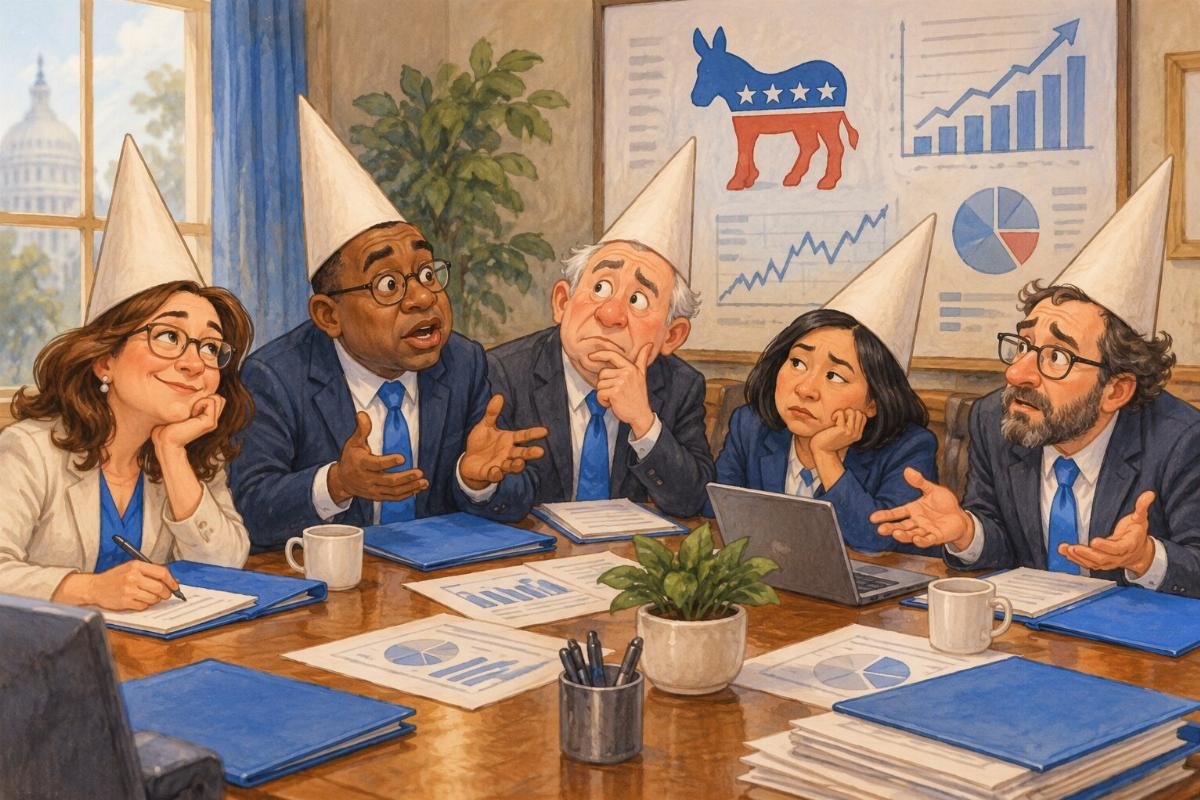
A column published this week at American Thinker makes a case that President Trump’s team should embrace export restrictions on diesel — even if only temporarily — as a way to bring down costs for American consumers before the midterm elections, and it does so while openly mocking the economists who warn the move could backfire.
The piece, written by Noel S. Williams and dated September 24, 2026, opens with a familiar gripe: economists and their track record. Williams trots out Adam Smith and Milton Friedman as thinkers who understood free markets and individual liberty, contrasts them with Marx, whose prescriptions, in the author’s telling, ran afoul of human nature and history, and then asks flatly, “what’s the point of economists these days?”
The answer, from the column’s perspective, is not much. Williams concedes that Stephen Moore and Larry Kudlow “provide some wisdom,” but argues that “more often than not, economists have wavering hands and are full of hot air.” He singles out the Federal Reserve — many of whose officials, he notes, have economics backgrounds — with the rhetorical jab “look what good that has done us.”
CFOs, tax consultants, investors, bankers, accountants, actuaries and budget analysts all have clearly defined roles, in the author’s accounting. Economists, he suggests, are the odd ones out.
A pattern of bad forecasts
The column’s immediate evidence for that claim is the labor market. Williams writes that economists’ predictions on jobs data are “usually woeful” — not occasionally — and points to what he calls wildly wrong estimates for the August jobs report as the latest in a series of “ignominious calls.” A jobs report, he notes pointedly, ought to be the profession’s bread and butter.

From there the piece turns to energy policy. According to Williams, President Trump’s staff briefly floated the idea of putting export controls on diesel. Now, he writes, Energy Secretary Chris Wright is hinting at a voluntary cap on diesel exports. Industry participants, unsurprisingly, are not fans of the idea.
The economic critique of such a move isn’t complicated. As Williams describes it, even the “experts” acknowledge a full ban could initially divert more diesel into the domestic market and temporarily lower prices — the very outcome the column is after. But some prominent economists warn it could backfire over the longer run, for what the author dismissively calls “various boring reasons.”
The case for short-term politics over long-term caution
Williams’s rebuttal is not an economic one. It’s a political and imaginative one. “Where’s the imagination?” he asks, and then lays out a sequence: a temporary reprieve is all that’s needed with the midterms looming; the “socialists” will do whatever it takes to win; so lower costs first, with an eye on the “trajectory,” then win the elections, then reopen the spigots for allies if they start getting “cozier with our diesel-producing enemies” because of American supply constraints.
That approach, the column argues, is better election maneuvering than “forking over $5,000 to everyone” — an apparent reference to a direct-payment alternative the author treats as inferior.
A temporary dip in gas and diesel prices, in this telling, is better than nothing. As the midterms approach, it could undercut what Williams calls the “Dems-cum-socialist affordability narrative.” At a minimum, it shows action. And because the controls — especially a voluntary version — could be reversed once the “national emergency that a potential socialist takeover entails” has been dealt with, the author frames the policy as flexible rather than permanent. President Trump and his team, Williams writes, are “nothing if not flexible.”
As for the economists who warn about the downside, the column’s closing line is not subtle: “AI can’t replace them soon enough.”
What the argument actually rests on
Strip away the rhetorical flourishes and the column is making a straightforward trade-off argument that has been a recurring feature of energy policy debates: short-run consumer relief versus long-run market consequences. Williams is candid about the trade-off. He isn’t claiming the economists are wrong about the backfire risk; he’s arguing that the risk is worth accepting because the political clock is short and the controls can be undone.
Whether a voluntary export cap would achieve the price effect the column hopes for is a separate question — one the piece doesn’t attempt to answer, beyond noting that industry is unenthusiastic and that even the “experts” grant a full ban would move supply and prices in the desired direction, at least initially. The mechanics of a voluntary cap, and how the diesel market would respond, go unexamined.
The column also leans heavily on a caricature of the economics profession, built around a single bad jobs forecast and a general sense that experts have been wrong before. That’s a broader complaint about credentialed expertise that runs through a lot of populist-adjacent commentary on the right, and Williams doesn’t bother to distinguish between macro forecasters, Fed officials, and the trade economists who study export controls — they’re all lumped together as “bloviating pinheads” and “pessimistic” naysayers.
What the piece does capture, fairly directly, is a mood. It’s a mood that treats policy as a tool to be deployed and retracted around an election calendar, that regards affordability as the central political battlefield heading into the midterms, and that has little patience for arguments about what happens after the votes are counted. The author says so plainly: lower costs, win elections, then deal with the rest.
American Thinker frames the column as a defense of speaking freely — the standard closing appeal on the outlet’s pages, asking readers to support its work so “our ideas be heard and our voices strong.” But the substance here is a policy argument, and it’s one that will be tested in real time if the administration moves from hints toward an actual cap. The economists Williams dismisses will keep publishing their “boring reasons.” The question the column poses — and answers in the affirmative — is whether anyone in power should care before November.
Source: www.americanthinker.com — https://www.americanthinker.com/blog/2026/09/banning-diesel-exports-and-what-s-the-point-of-economists/