
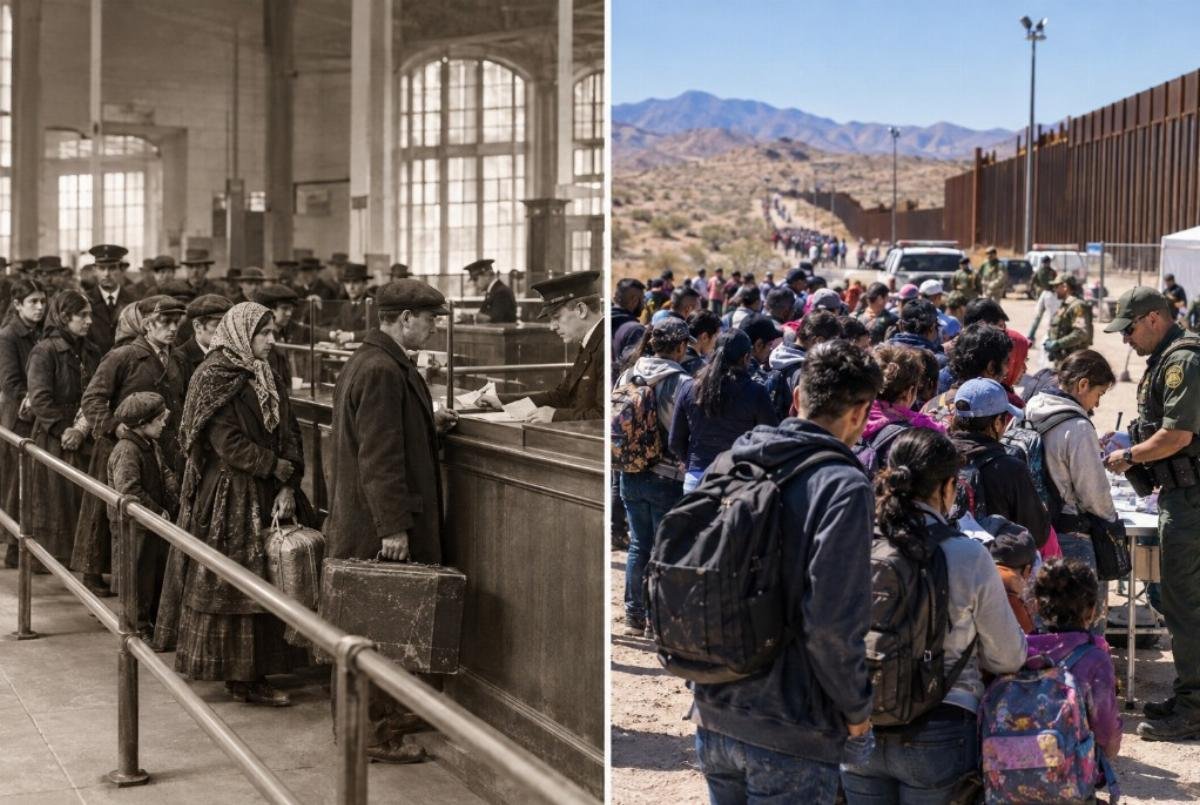
In a column published Friday, American Thinker contributor Eric Utter advances an argument that has circulated in restrictionist circles for years, but rarely with such a blunt sorting mechanism: immigrants are not a single story, and the country should stop pretending otherwise.
Utter’s essay, titled “Then vs. Now: Good and bad immigration,” divides the American immigrant experience into two distinct eras. The first, in his telling, delivered material and cultural gifts. The English brought common law and individual liberty. Germans built breweries and carried the orderliness of post-Reformation Protestantism, plus sauerkraut. Norwegians brought cultural tolerance, Finns their saunas, Swedes their screen sirens, Italians their cuisine, the French their arts, and Cubans their condos, HMOs, and a visceral hatred of tyranny and communism.
The second era, by contrast, gets no such credit. Utter writes that the majority of recent immigrants — whom he conflates entirely with illegal immigration — come from countries that reject individual rights and free markets, describing them as destitute nations “stuck in the Dark Ages.”
An accusation aimed at specific communities
The column sharpens its focus on Muslim immigrants, singling out Somalia, Afghanistan, and Pakistan. Utter claims many have arrived not to build but to dismantle, in his words, “the fabric of a once great nation” and to erase what earlier arrivals built.

He then attributes to unnamed “numerous imams and other Muslim figures” a three-part strategy for taking over the United States and the West: outbreeding through women’s wombs, mass immigration, and the exploitation of Western freedoms, openness, and decency. The column offers no source, organization, or specific individual for these purported statements, and the claim is presented as settled fact rather than attributed allegation.
Utter argues this approach has already worked “exceedingly well throughout the West in recent years,” though he acknowledges what he calls “some signs of a feeble pushback.” He attributes the weakness of that pushback to social and media pressure, writing that anyone who declines to “cheerfully and fully embrace this civilizational suicide” is immediately branded a far-right bigot, xenophobe, nationalist, hatemonger, or white supremacist.
The role of religion in his own argument
One of the essay’s more unusual turns is theological. Utter suggests that the New Testament commands to “turn the other cheek” and “love your enemy” will themselves be the mechanism of Western decline — the very ethical inheritance of earlier Christian immigration being turned against the societies that hold it.
From there, the column pivots to a broader claim: “Demography is destiny. Period.” Utter acknowledges that progressives dispute this, and predicts outrage at the assertion, but insists all of history proves it. The claim functions as the essay’s central premise rather than something he attempts to demonstrate with data.
He goes on to suggest that progressives either avoid teaching history or teach a heavily revised version of it — one in which, he writes, “all the truth has been extracted to make room for … The Agenda.” That passage gestures toward a deliberate ideological project without naming one specifically.
What the piece doesn’t do
Readers looking for evidence will not find much. There are no immigration statistics, no demographic projections, no citations for the imam quotes, and no distinction drawn between legal and illegal immigration despite the essay’s opening framing. The column is a declarative argument — an assertion of civilizational stakes — rather than a reported piece.
That style is consistent with American Thinker’s opinion vertical, and the piece closes with a fundraising appeal urging readers who agree to support the publication so it can continue paying staff and keeping “our ideas heard and our voices strong.”
Where this argument sits in the broader debate
The essay reflects a strand of contemporary immigration commentary that has moved from questions of enforcement and border policy toward questions of culture, religion, and demographic change. Where earlier restrictionist arguments focused on jobs, wages, or rule of law, this style of argument treats immigration as an existential contest between incompatible civilizations — and treats the earlier Ellis Island narrative as a usable contrast rather than a shared inheritance.
It also illustrates a rhetorical move common to the genre: pre-empting criticism by naming the labels critics will use before they use them. By framing any objection as an attempt to silence rather than to rebut, the column attempts to insulate its claims from ordinary evidentiary scrutiny.
None of that makes the argument automatically wrong, but it does mean readers should treat the piece as what it is: a polemic. The historical gifts catalogued in its first half — breweries, sauerkraut, saunas, condo construction — are offered as self-evident proof of assimilative value. Whether the absence of that same list in the second half reflects an actual absence, or simply the author’s framing choice, is a question the column never asks, let alone answers.
Source: www.americanthinker.com — https://www.americanthinker.com/blog/2026/09/then-vs-now-good-and-bad-immigration/