
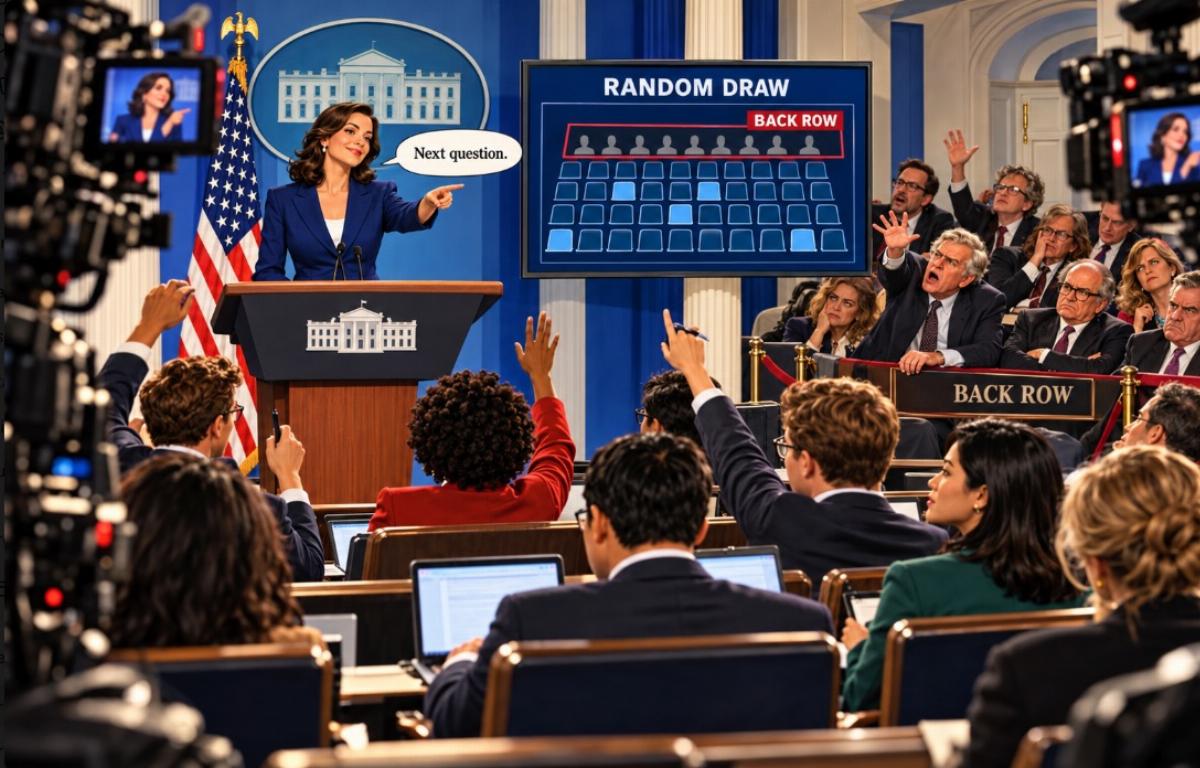
The White House Correspondents’ Association controls one of the most valuable pieces of real estate in Washington journalism: the right to sit in the James S. Brady Press Briefing Room. But a new column in American Thinker argues that this arrangement is a custom, not a law, and could be dismantled at any time — no matter what the courts decide.
The column, written by retired physician and media critic Ted Noel, offers what he calls a “simple fix” to a fight that has been unfolding in court: the WHCA’s lawsuit after the Trump administration barred certain reporters from the briefing room. The association, Noel writes, “is screaming because Trump banned their key lying, socialist, communist reporters” and had to go to a judge to get them back in. But in his view, winning in court doesn’t mean winning in the room itself.
Before getting to the specifics, it’s worth laying out what’s actually being proposed. Noel’s plan has three interlocking parts: full video and audio documentation, an end to the WHCA’s selection role in favor of a randomized system, and a press secretary who is under no legal obligation to call on anyone at all.
The recording requirement
First, Noel writes, every moment anyone is in the briefing room should be captured from multiple angles in high-definition video and audio. The logic runs in both directions. If reporters are disruptive, the footage provides grounds to remove them on the spot. And if the White House behaves badly, the cameras are running just the same. Noel frames it as a transparency measure with teeth — nothing happens in that room that isn’t on the record.
Scrapping the WHCA’s customary power
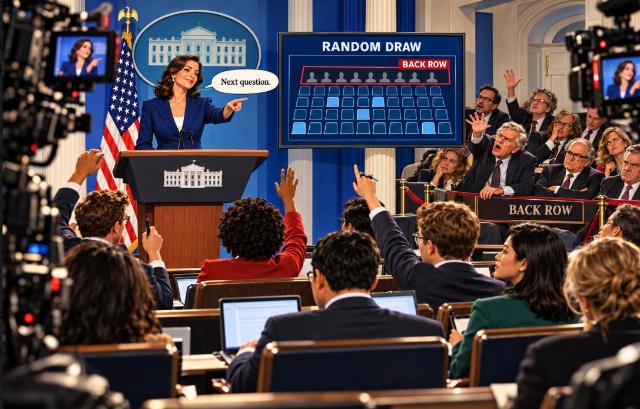
The core of his argument is that the WHCA’s authority over briefing room access derives from tradition, not from statute or a signed contract. If that’s true, then replacing the current system is a matter of policy, not legislation or litigation. He proposes a random draw — literally a computer generating random numbers — from a pool of reporters who apply for credentials. To keep the selection from being purely arbitrary, outlets could be weighted according to their latest audience figures, so larger news organizations have proportionally better odds. On top of that, a small number of daily “sponsor exemptions” chosen by the White House communications director would round out the seating.
Seating assignments, under the proposal, would be the communications director’s call. Noel suggests two possible approaches: leaving known bad actors in the back row, or going fully random and letting an outlet he characterizes as a “Drive-By” — a derogatory term for legacy media — land in a front-row seat. Either way, the point is that the WHCA no longer decides.
The leverage that remains
Here’s the part that Noel clearly savors: even if a reporter wins a seat through the lottery or through a court order, there is no rule requiring the press secretary to recognize them. He writes that if a disfavored outlet ends up in the front row, “there’s no rule that the Press Secretary has to call on them—ever.” That’s the mechanism by which the WHCA could, in his telling, win its case and still lose in practice. The association’s lawsuit gets a favorable ruling; the White House simply never says their name. A court cannot compel the press secretary to recognize a particular journalist, and Noel argues there’s no lawful way around that.
He sums it up with a line aimed less at legal doctrine than at morale: “The Communist News Network is in the room!” The exclamation emphasizes his point that physical presence and actual participation are two different things.
Removal, on camera
Noel closes the argument where the cameras come back in. If outlets that gained entry behave disruptively, he writes, there is “good cause to throw them out instanter (if not sooner).” And crucially, it’s all on camera. The recording requirement from the top of the column is what gives the ejection its justification and its proof.
What makes the column notable isn’t just the proposals themselves — weighting credentials by ratings, a daily lottery, a de facto blacklist by non-recognition — but the framing. Noel presents the entire dispute as a question of custom versus entitlement, and he treats the judicial ruling as a distraction from the actual levers of power. The WHCA can hold the legal high ground while the communications director holds the seating chart.
What the column is and isn’t
This is an opinion piece, and it reads like one. Noel is a retired physician and online commentator who writes critically about media from a conservative perspective; the American Thinker describes him as posting under the handle Doctor Ted, with a presence on X and a podcast. He writes the piece as a prescription — hence the medical framing that runs through his online persona — and he doesn’t pretend to offer legal scholarship. His core claim about the WHCA’s power being customary rather than statutory is stated as fact, not argued from case law. Whether that characterization holds up is very much the open question, and the courts are already engaged with a related one after the WHCA sought judicial relief over the barred reporters.
It is also worth noting what the column does not address. It doesn’t name the specific reporters who were banned or the specific outlets, beyond derisive shorthand. It doesn’t detail the court’s reasoning or the procedural posture of the case. And it doesn’t engage with the counterargument that press access to the president’s public appearances serves a First Amendment function beyond the convenience of any particular association or reporter — the argument that presumably animated the lawsuit in the first place. Those are not oversights so much as the natural limits of a short opinion column making a tactical case rather than a constitutional one.
Still, the proposal lands in a real debate. Access to the briefing room has been contested for years, with each administration testing the boundaries of who gets credentials and who gets called on. What Noel adds is a mechanism: an auditable lottery, weighted by audience, plus cameras and a press secretary who can simply look past the front row. The result, he suggests, is a system a court cannot touch — because no one’s entry is ever guaranteed, and no one’s question is ever owed.
Whether that vision is a fix or a workaround depends entirely on where you stand. But as a piece of political gamesmanship, it has a certain internal logic: let the other side win the ruling, then change the rules the ruling was about.
Source: www.americanthinker.com — https://www.americanthinker.com/blog/2026/09/fixing-the-white-house-briefing-room/