
Twenty-five years after nearly 3,000 Americans died in the deadliest terrorist attack on U.S. soil — with many more perishing later from exposure to toxic dust — one conservative commentator is asking a question that doesn’t fit neatly into either party’s talking points: what did the War on Terror actually change, and who won it?
Writing for American Thinker, retired teacher and frequent contributor Caren Besner uses the September 11 anniversary not to relitigate the battles of the past two decades but to measure their aftermath. The ledger she draws is not flattering. The Taliban, driven from power in Afghanistan two decades ago, are back in charge, and terrorist organizations again operate with a presence there. Iraq, once the centerpiece of the Bush administration’s push for a new democratic order in the Middle East, still grapples with armed militias, Iranian influence, and ISIS remnants — though it retains a functioning government and security forces.
What Was Won, and What Slipped Away
Besner doesn’t dispute the military achievements that followed the attacks. President George W. Bush told Congress on September 20, 2001, that the war on terror would begin with al-Qaeda but would not end there, and on October 7 the United States launched operations in Afghanistan against the terrorist training camps that al-Qaeda ran under Taliban protection. Two years later came the invasion of Iraq, which the administration believed held weapons of mass destruction. In the years that followed, the U.S. overthrew Saddam Hussein’s regime, fought al-Qaeda and other insurgents, helped stand up a new Iraqi government, and killed countless terrorists in drone strikes and other operations across Africa and the Middle East.
The problem, as Besner frames it, is that for every terrorist killed, others seemed to rise to take his place — a sobering verdict on a campaign that consumed trillions of dollars and thousands of American lives.
The Home Front, Then and Now
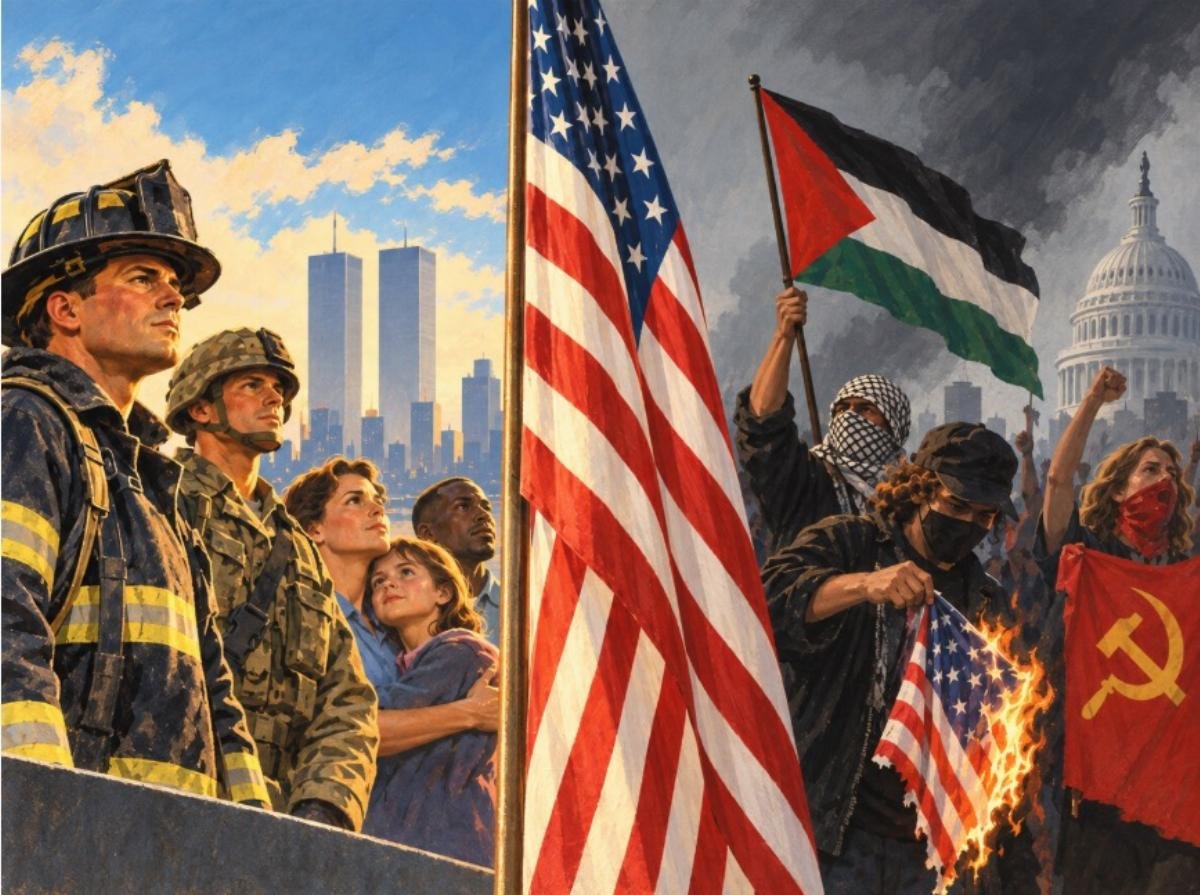
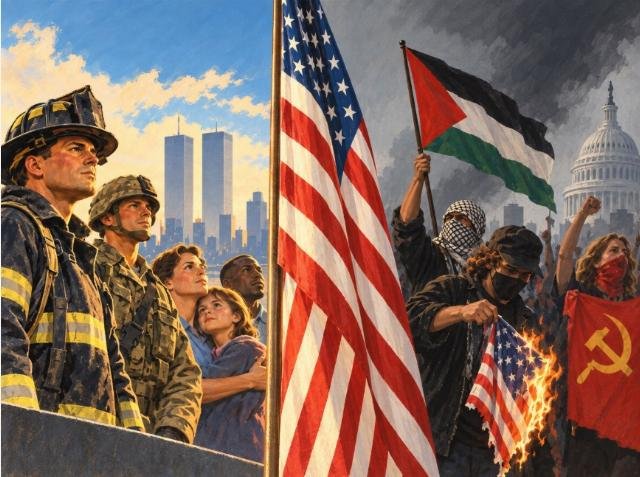
Where Besner’s argument turns sharpest is not abroad but at home. She sets up a series of contrasts between the country that existed twenty-five years ago and the one that exists today. Then, American flags appeared on houses and cars across the country. Now, she writes, demonstrators burn the flag while waving Palestinian flags and, at times, the hammer and sickle of the former Soviet adversary. Then, Americans proclaimed unity and love of country. Now, a deeply divided public watches protesters chant “Death to America” in American cities while antisemitism surges.
Then, law enforcement officers and service members were honored for their bravery. Now, demonstrators and politicians have called for defunding or dismantling police departments and sharply reducing the military. Then, family values and religious institutions enjoyed broad respect. Now, traditional family values are routinely mocked, and houses of worship are attacked and vandalized.
Even the symbolism of Ground Zero itself has shifted. Besner notes that New York City — the site of the attacks — now has a mayor whose positions on Islam, Israel, and the phrase “globalize the intifada” have generated intense controversy. She also points to political candidates who associate with figures who have openly said America “deserved 9/11.”
Those observations lead her to an uncomfortable conclusion: nobody may be working harder to bring down the United States than some Americans themselves.
The Paradox of Discontent
Besner finds something strange in that hostility. The Americans who most despise their country, she observes, rarely want to leave it — and of the few who do, many eventually return. Meanwhile, despite the vitriol directed at the United States by some of its own political leaders and by voices in mainstream and social media, she argues that billions of foreign nationals would move here today given the chance. Millions already entered the country illegally during the previous administration, she writes.
To close, Besner reaches for a line from the historian Will Durant: “A great civilization is not conquered from without until it has destroyed itself from within.” History, she suggests, may yet prove how prophetic those words were.
Why This Argument Matters Beyond Its Base
The essay is unmistakably a polemic, and readers who share its political priors will find in it a familiar catalog of grievances. But its central structure — the 25-year measuring stick — raises questions that don’t belong to any one faction. What does victory look like in a conflict without a conventional battlefield or a surrender ceremony? Can the institutions built to protect a country survive a population that no longer trusts them? And if the Taliban’s return to Kabul reads as a strategic setback, what should be made of the fact that the most visible damage Besner identifies is domestic?
Those are questions the piece poses more than answers. What it does insist on is a distinction its author thinks is often blurred: between criticizing a nation’s policies and rooting for its collapse. The Americans in her telling who wave other flags while chanting against their own country are not engaged in the first, she contends, but the second — and she suggests that for all the resources poured into fighting terrorism overseas over a quarter-century, the harder fight may be the one unfolding at home.
Source: www.americanthinker.com — https://www.americanthinker.com/blog/2026/09/a-historical-perspective-on-september-11-and-the-war-on-terror/