
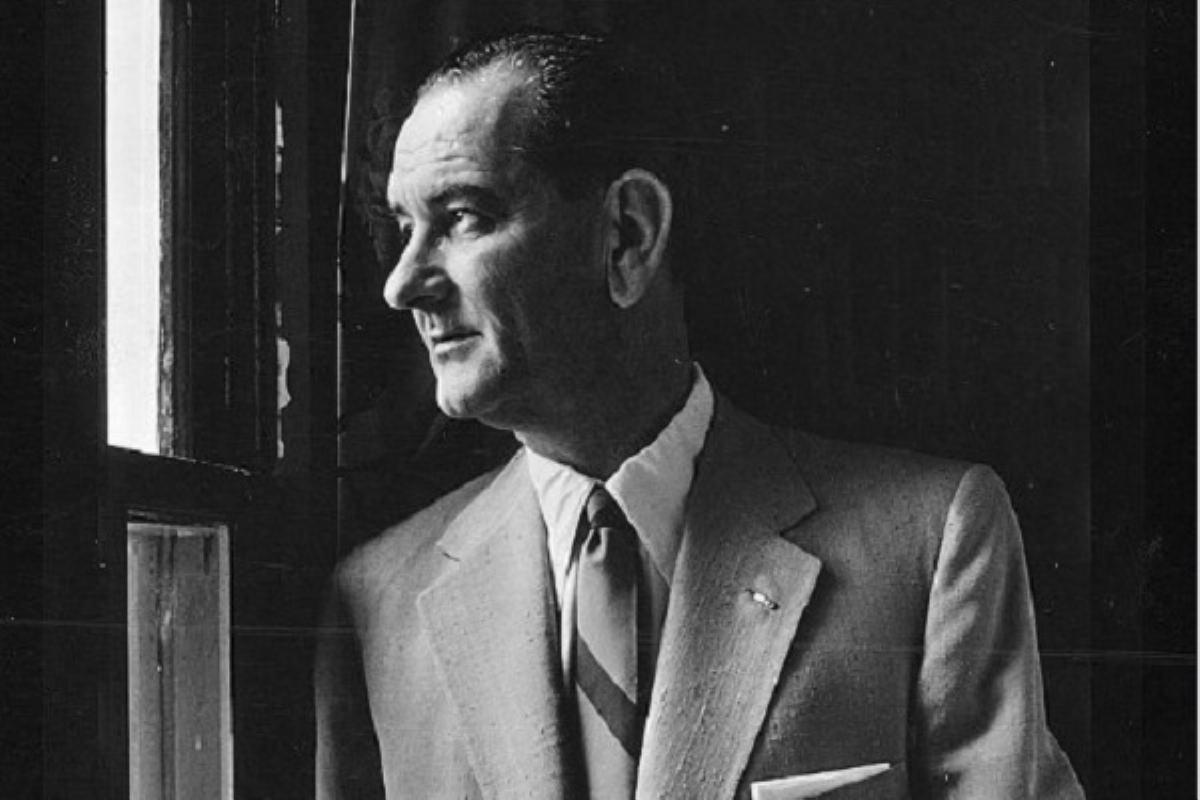
Sixty years after Lyndon Baines Johnson’s signature domestic programs began reshaping American government, American Thinker has published a lengthy reassessment of the 36th president that rejects the popular image of LBJ as a fundamentally decent man undone by a war he could not win. In the essay, writer Jeffrey Folks calls Johnson “a bungler and a megalomaniac” and argues that virtually everything he did as president was destructive.
The piece, dated September 18, 2026, takes direct aim at the “tragedy” framing that has long shaped mainstream evaluations of Johnson. In the Greek sense, Folks writes, a tragic figure is a great man brought low by a single fatal flaw — not a fundamentally ordinary man whose flaws were woven through everything he touched. Johnson, in this telling, was a president of average intelligence consumed by megalomania and a pathological need for admiration, whose entire life was a fanatical pursuit of the impossible with little reflection on the costs.
A Presidency Measured by Quantity
According to Folks, Johnson was fixated on volume over substance from the moment he took office. Knowing that presidencies tend to bog down late in the term, LBJ pushed relentlessly to rack up legislative wins in his early years. The author contends that this legislation was engineered less to serve the country than to cultivate gratitude among voters who would find themselves dependent on government — and, by extension, on Johnson himself.
The essay credits Johnson with signing the Civil Rights Act of 1964 and the Voting Rights Act of 1965 while expecting Black Americans to revere him for it. Folks writes that Johnson was wounded when younger, more militant figures supplanted Martin Luther King Jr. and when American cities began burning in 1965. Having believed he had done more for Black equality than any president since Lincoln, Johnson reportedly responded to the Black Power movement first with disgust, then by shifting his own positions to meet the demands of Black radicals. The author draws a parallel to contemporary progressives, whom he accuses of bending to any position to secure votes.
Folks goes further, arguing that Johnson — not Carter, not Obama — is the true origin of what is today called “woke” politics. In his account, Johnson’s commitment to equality of outcomes, and his determination to force that equality into existence through massive federal spending, launched everything from the War on Poverty to Head Start to federal jobs programs, each of which the essay describes as prone to inefficiency and corruption. He also claims Johnson accommodated Black Power and radical Hispanic movements even when their goals went beyond legal equality toward what he characterizes as superiority over whites and a form of reparations.
Vietnam and the Economic Hangover
The essay turns to Vietnam with the same thesis: Johnson believed he could win by spending and bombing more. Folks calls it the most costly war in nominal terms in American history, states that Johnson personally oversaw the targeting that produced most of the two million lives lost, and notes that he at one point considered nuclear weapons against North Vietnam. Johnson’s plan for victory, in the author’s telling, was simply “more,” with no accounting for consequences.
That spending, domestic and military alike, carried an economic hangover — the lost decade of the 1970s. The essay points to persistent stagflation, with inflation reaching nearly 15 percent in 1974 and staying elevated until Fed chair Paul Volcker’s high-interest-rate shock, peaking during Ronald Reagan’s presidency, finally brought it down.
Folks insists the overhang was cultural as much as economic. He ties the assassination of John F. Kennedy to a loss of American innocence, and describes the 1960s as an era when the sexual revolution unsettled traditional views of marriage and sex roles, pornography became rampant, and religious faith — near-universal in the 1950s — came into question. Johnson, he concedes, was not personally responsible for these developments, but the author argues LBJ projected a cynical, materialistic attitude that infected public life.
The essay even assigns the birth control pill a role in the story, noting it reached the market in mid-1960 but only became widely used during Johnson’s presidency, and linking it to widespread promiscuity, particularly on college campuses. By the end of LBJ’s term, the author writes, American sexual mores had been transformed — and not for the better.
A Wave of Doomsday Books
The piece catalogues the era’s intellectual mood as well. After Rachel Carson’s Silent Spring appeared in 1962, Folks notes a run of what he calls doomsday books and films: Paul Ehrlich’s The Population Bomb, Ralph Nader’s Unsafe at Any Speed, and novels including Slaughterhouse-Five, One Flew Over the Cuckoo’s Nest, Catch-22, The Bell Jar, and In Cold Blood. Each, along with its screen adaptation, contributed to a broad sense of alienation and disenchantment, in his reading. Johnson, he writes, presided over that shift without any idea where the country was heading.
Here the essay widens its indictment to Johnson’s mentor, Franklin D. Roosevelt. Both, Folks argues, were willing to abase themselves to any interest group or mode of behavior for political support — a trait he says lives on in today’s progressives and Democratic Socialists, whom he accuses of refusing to speak forcefully about transgender issues and antisemitism for fear of losing votes.
The conclusion is unsparing: Johnson was not a good man victimized by Vietnam. The escalation of the war, the War on Poverty, and the rest reflected his personality and political values, and in the author’s view his presidency is the seedbed of most of the problems with government spending and moral decline the country has faced since. Folks frames LBJ’s program as a compact with the devil that voters accepted at enormous long-range cost, and credits Reagan and Trump with beginning to reverse the damage nearly fifty years later — a reversal he says remains in doubt as socialism gains strength in the midterm elections.
American Thinker’s closing call is for readers to grasp the harm Johnson did and to work toward traditional values, small government, and fiscal balance. The author acknowledges the scale of that task but argues that if progressives could transform the nation’s direction within a decade in the 1960s, conservatives could return America to the Founders’ vision within a generation or two — with Trump playing a crucial role and a like-minded successor needed to carry the effort forward.
An Argument That Will Not Settle Quietly
Whether or not readers accept Folks’s verdict, the essay captures a durable fault line in American memory. Defenders of Johnson have long pointed to the civil rights legislation, Medicare, and federal aid to education as evidence of a consequential, if flawed, presidency. Critics have long countered that Vietnam and the Great Society’s unintended consequences outweighed the achievements. This new piece lands squarely on the critical side — and goes further than most by denying Johnson even the sympathy of tragedy. Sixty years on, the fight over LBJ’s record, and over what government owes its citizens, shows no sign of fading.
Source: www.americanthinker.com — https://www.americanthinker.com/articles/2026/09/lbj-60-years-of-the-not-so-great-society/