

Democrats love mass transit, and according to one conservative commentator, they love it so much they’re willing to accept a body count. That’s the thrust of a new American Thinker op-ed by Mike McDaniel, who argues that Minneapolis–St. Paul’s light rail system has become a magnet for violent crime — and that Minnesota’s political leadership is to blame.
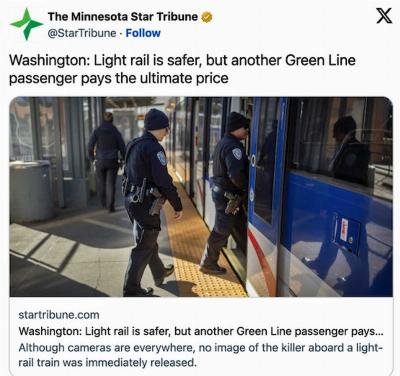
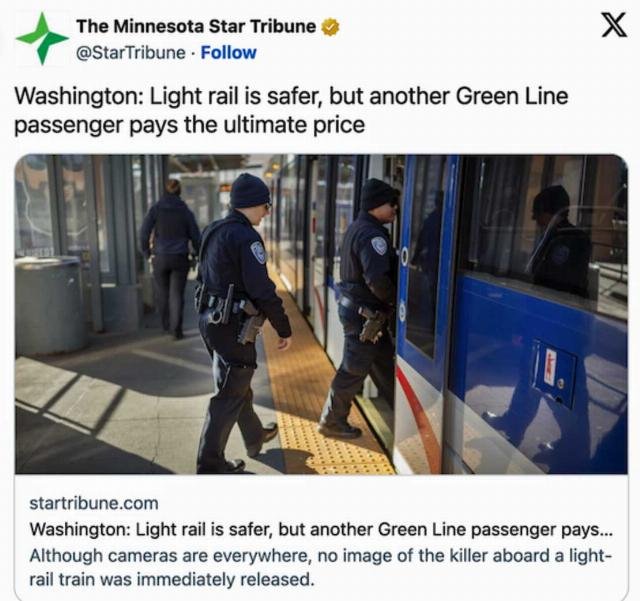
McDaniel’s piece, published October 19, leans on reporting from Powerline co-founder John Hinderaker and a November 2022 American Experiment study to make a broad case against public transportation as a Democratic project. But its sharpest passage is a simple observation about a Star Tribune headline: McDaniel compares it to the classic “Other than that, Mrs. Lincoln…” joke, suggesting the paper essentially reported that Twin Cities light rail is safe unless you happen to get murdered.
The Numbers Behind the Claim
The core factual assertion comes from that 2022 American Experiment study, which McDaniel cites at length. According to federal data referenced in the study, riders on Twin Cities light rail face a greater risk of being injured by an assailant than on any other light rail system in the country. The study’s authors described the figures as evidence of “years of mismanagement” at Metro Transit.
McDaniel stresses that the federal numbers capture only the most serious attacks and injuries, meaning the true toll is likely higher than what’s recorded. He offers a series of comparisons from the study: the Twin Cities are described as roughly twice as dangerous as Houston, more than twice as dangerous as San Jose and Dallas, and five times more dangerous than Los Angeles, Portland, and Buffalo. The rest of the country’s light rail cities, in his telling, aren’t even close.
“The Twin Cities are number one!” McDaniel writes, with no small amount of sarcasm.
Who’s to Blame, Per the Op-Ed
McDaniel doesn’t treat the safety gap as an accident. He lays out a chain of causes that reads like a checklist of conservative grievances against blue-city governance. At the top: the 2020 defunding movement and what he describes as a related wave of prosecutions against officers. Police forces, he argues, never recovered. Retirements and departures to departments where officers felt less legally exposed left staffing holes that cities have struggled to fill.
Recruitment has been so difficult, McDaniel claims, that some departments lowered standards dramatically — accepting applicants with DUI, drug, and even felony convictions — and still couldn’t fill the ranks. The practical result, as he frames it, is that there simply aren’t enough officers to patrol train cars, leaving criminals and people in mental health crisis to “rule by default.”
He also points to homelessness and drug addiction, describing light rail and subways as refuges for the homeless and for criminals of all kinds. And he names specific political targets: Governor Tim Walz, “DEI lunacy,” and what he calls self-inflicted Somali illegal immigration, folding them into a broader indictment of Democratic governance in the state.
A Broader Argument About Transit
The op-ed is as much a critique of transit policy as it is of Minnesota specifically. McDaniel argues that public transportation is only workable — though never economically viable, in his view — in major cities, most of which lean Democratic. Elsewhere, he says, it’s impractical, but that hasn’t stopped politicians from spending public money on it.
He casts light rail, electric buses, and high-speed rail as the current iteration of a long-running project, and he is especially harsh on California’s high-speed rail effort under Gavin Newsom, which he calls drastically behind schedule and catastrophically over budget. McDaniel notes that no track has been laid and no trains built, yet concrete and rebar overpasses and pilings keep rising. Future archaeologists, he jokes, might mistake the structures for monuments or ritual sites.
Existing subways, he predicts, may be the last ever built in the United States; tunneling is simply too expensive, even for Democrats. Neighborhood disruption from underground construction, he suggests, would be politically untenable.
Underneath the policy argument is a philosophical one. Quoting Townhall’s Amy Curtis, McDaniel contends that the push for mass transit is really about control — restricting individual freedom and the ability to move at will. He also accuses liberals of applying their “if it only saves one life” standard selectively: passionately invoked for some risks, quietly shelved when the risk is riding the train.
What the Piece Doesn’t Address
The op-ed is an argument, not an investigation, and it leans heavily on a single 2022 study and a chain of amplification through Powerline and Townhall. It does not examine what Metro Transit or Minnesota officials have said in response, nor does it weigh ridership trends, overall crime rates, or the raw number of incidents behind the per-rider comparisons. The federal data it cites measures serious injuries from assault, a narrow slice of the safety picture — a limitation McDaniel acknowledges but frames as proof the problem is worse than reported, not smaller.
Still, the central claim is stark and checkable: by the measure of serious assault injuries per rider, Twin Cities light rail ranks worst among American systems. Whether that’s a story about transit, about policing, or about the politics of a blue state is the question the piece wants readers to argue about — and McDaniel has little doubt about his answer.
His closing line is a roll call of blame: “Thank Tim Walz, DEI lunacy, self-inflicted Somali illegal immigration, defunding and prosecuting the police, and every other destructive lunacy Democrats celebrate.”
Source: www.americanthinker.com — https://www.americanthinker.com/blog/2026/10/mostly-not-deadly-minnesota-light-rail/