
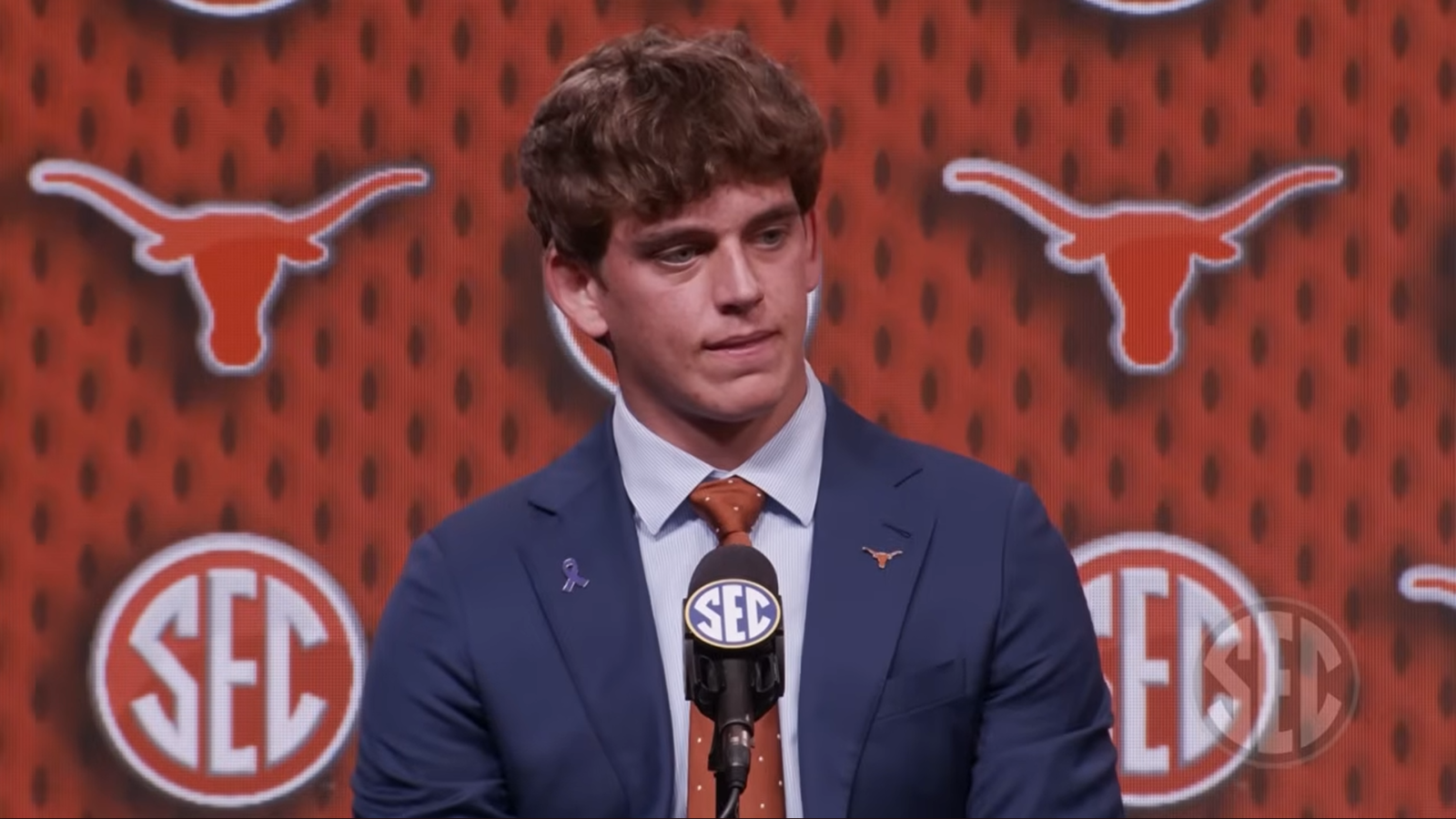
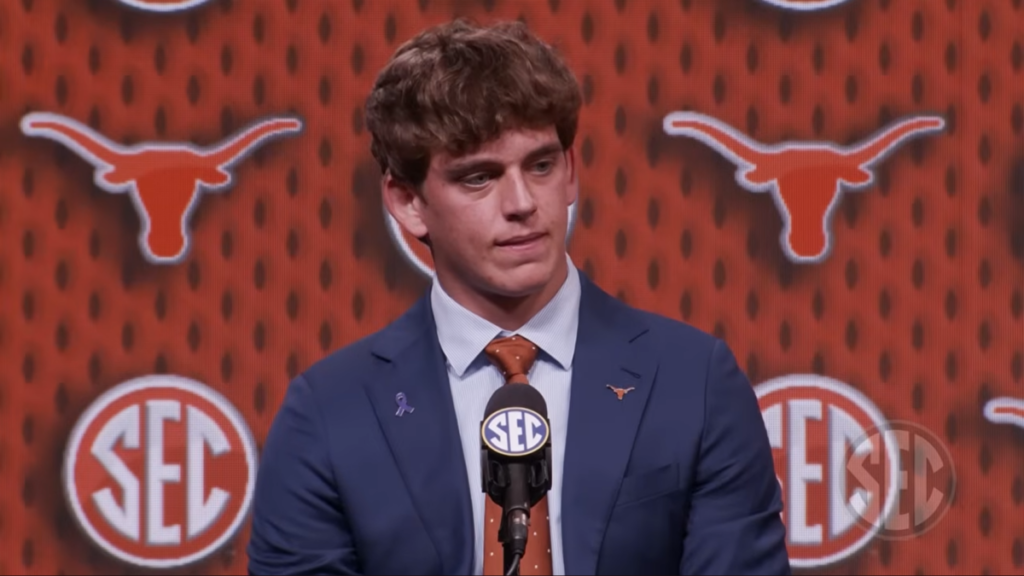
Texas Longhorns quarterback Arch Manning set off a firestorm in sports media this week with a single, offhand joke. The 22-year-old, speaking at a routine press conference ahead of his team’s season, said he’d seen a few AI-generated edits of Saturday’s dramatic fourth-quarter comeback against then-No. 1 Ohio State — including one depicting head coach Steve Sarkisian slapping ESPN sideline reporter Holly Rowe before sprinting away.
The remark drew laughter from the room. According to The Federalist, that laughter is what ignited what it describes as a media-wide meltdown, with prominent reporters attacking Manning and the journalist who asked the question.
The Athletic’s Katy Duffy, in a profanity-laced social media post, fired at both Manning and reporter Evan, writing that it was “weird” to be proud of asking a question that produced that answer and “disgusting to be hyping up the answer,” according to The Federalist. USA Today sports columnist Christine Brennan called Manning’s comments and the laughter they prompted “revealing and disgusting,” while NBC sports reporter Nicole Auerbach weighed in on the “laughter from all the men in the room,” calling it “so, so gross.”
The video that started it
The controversy traces back to Saturday’s game, when Sarkisian, energized by his team’s improbable 24-23 comeback win over Ohio State, shouted “Texas fight” and flashed the “Hook ’em Horns” gesture at the camera before running off to celebrate with his team. Rowe, an ESPN sideline reporter, had been attempting to pull Sarkisian for an interview. Video of the exchange shows her visibly frustrated and storming off camera.
Social media users quickly turned the moment into fodder for memes and AI edits, which is what Manning was asked about during Monday’s press availability. The AI video he mentioned — showing Sarkisian slapping Rowe — depicts something that never happened, and the absurdity of the imagined scenario is precisely why those in the room laughed, per The Federalist’s account.
A pattern of selective outrage, critics say
The Federalist’s central argument is that the volume of coverage devoted to the Manning saga is staggering relative to a broad category of stories it says receives far less attention: real violence against women involving professional athletes. The outlet notes that there is “no shortage” of athletes arrested for allegedly hitting female partners, and points to repeated on-court violence targeting WNBA players such as Sophie Cunningham and Caitlin Clark. Those stories, it argues, have not generated the same performative outrage as a quarterback laughing at a clearly fake internet clip.

One widely circulated social media post cited by the outlet underscored the point: Manning was criticized more for laughing at a meme than a professional football player was for an allegation of hitting a woman. The Federalist’s framing is that fake violence intended as humor is being treated as worse than actual domestic violence.
The outlet also raised the comparison of Manning’s uncle, NFL legend Peyton Manning, who once performed an SNL skit in which he pelted children with footballs — imagining the response if that clip resurfaced in today’s climate.
The apology
Manning ultimately apologized. The Federalist argues that was his only mistake, contending that apologizing to an outrage mob rarely satisfies it and often invites more. The outlet did not mince words about the reporters involved, calling the campaign against Manning an act of “stupidity” from what it characterized as “cosplay journalists.”
It also dug into Duffy’s history, noting she had previously called for Detroit Lions receiver Amon-Ra St. Brown to be slapped “again” over a touchdown celebration involving a Trump dance — a detail the outlet uses to argue that the moral outrage being directed at Manning is inconsistently applied.
For his part, Manning was responding to a lighthearted question about whether he’d seen any fun posts about the game. He said he had seen a few AI edits. That was, by The Federalist’s telling, the entirety of his transgression.
The episode reflects a broader pattern in sports media: jokes about fake scenarios get roundly condemned while allegations of real violence pass with comparatively little sustained coverage. Whether that asymmetry holds in the days ahead remains to be seen, but the volume of coverage already devoted to a 15-second press conference answer suggests the story has legs — even if the video at its center was never real to begin with.
Source: thefederalist.com — https://thefederalist.com/2026/09/16/sports-media-find-arch-mannings-ai-humor-more-offensive-than-players-beating-women/