
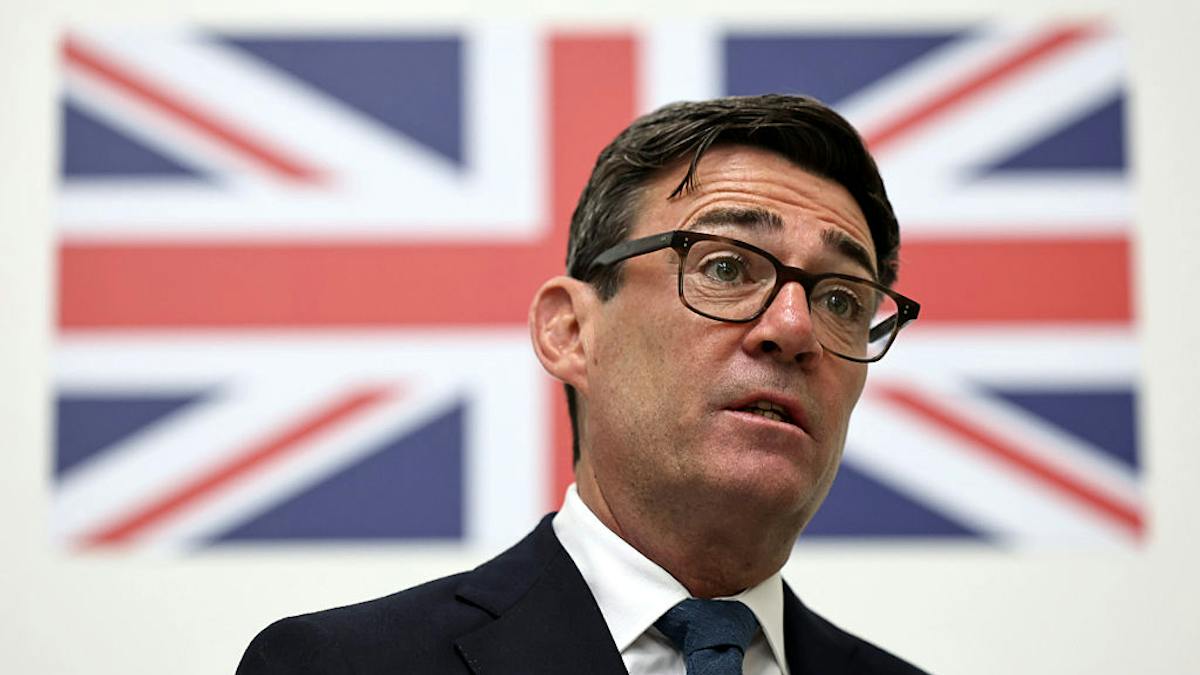
Britain’s new prime minister, Andy Burnham, is barely two months into the job, and already the transatlantic alliance is showing unprecedented strain, according to a Daily Wire op-ed by James Price, a former chief of staff to the Chancellor of the Exchequer and senior fellow at the Adam Smith Institute.
At the center of the rupture is a single line Burnham delivered at the dispatch box in the House of Commons, a spot where Winston Churchill once vowed Britain would “never surrender.” Asked by opposition leader Kemi Badenoch to shift £4 billion from housing benefits to the armed forces, Burnham refused and said: “National security cannot come at the expense of social security.” Price describes the remark as an “albatross” that will define Burnham’s premiership, arguing that the prime minister relegated the state’s first duty — defense of the realm — to a subordinate clause.
The numbers Price cites are stark. The British Army fields roughly 73,000 regular soldiers, its smallest size in more than two centuries — a force that could fit inside Manchester United’s Old Trafford stadium. By comparison, the United States has 80,000 troops stationed in Europe alone. Price adds that more than three times as many migrants have crossed the English Channel in small boats than there are regular Army soldiers, and points to Britain’s welfare bill as evidence of a system spiraling beyond control, noting that the rate of increase in disability claims since the Ukraine war began is higher than in Ukraine itself.
Israel Closes Jerusalem Consulate
Burnham’s difficulties predate the Commons exchange. Under pressure from the far left and Islamist elements in Britain, Price writes, the prime minister banned trade with Israeli settlements in the West Bank and described suffering in Gaza as “a scar on the conscience of the world.” Israel’s foreign minister, Gideon Sa’ar, responded swiftly: he ordered the closure of the British consulate in Jerusalem, expelled British staff from the Gaza aid operation, and barred 11 members of Parliament from entering Israel, including former Labour leader Jeremy Corbyn.
Sa’ar also made clear that Britain will proceed with plans to hand the strategically vital Chagos Islands — home to the American Diego Garcia base — to Mauritius, paying £50 billion to lease the territory back. Price attributes the move to pressure from an international court he describes as stacked with Chinese and Russian judges.
Trump Won’t Commit on the Falklands
Britain’s weakened diplomatic position has invited fresh challenges elsewhere. Argentina’s president, Javier Milei, is again seeking U.S. backing for his country’s claim to the Falkland Islands, which Argentina invaded in the 1980s before Margaret Thatcher retook them with Ronald Reagan’s support. Asked on September 3 whether Washington would stand behind Britain if Argentina moved on the islands, President Donald Trump said, “I always review every position. That’s just one of many.” In a later statement about the Iran campaign, Trump added: “Your country’s not doing well. Your country was not there to help me.”

Milei answered the next evening on Argentine television, calling the islands “Argentine, by history and by right, there is no debate about it.” Price counters that the Falklands have never been Argentine and notes that in a recent referendum, islanders voted to remain British by 99.8 percent — with just three voting no.
Trump also mused that he would like to see a united Ireland, a comment his team later acknowledged was aimed at damaging the British government over Labour’s weakness on Iran. Price observes that drawing Trump’s ire actually plays well for Burnham domestically, even as some Republican congressmen have floated — what Price hopes was jokingly — the idea of Wales and Scotland breaking away from England.
“Needless to say, this is not how the closest of allies, blood brothers in almost every major conflict for well over a century, should treat each other,” Price writes. The dynamic, he argues, has made supporting America — and even the Republican Party — nearly impossible in British politics today.

A Strategic Weakness, Not Just a Spat
Price frames the moment as more than a diplomatic squabble. Britain, he notes, is the closest of the Five Eyes intelligence partners, sharing code-breakers with the U.S. since 1946. It holds one of three vetoes on the UN Security Council that Washington can rely on, and it is the only European nuclear power whose deterrent operates alongside America’s. Its special forces, he adds, are among the finest in the world.
“I don’t remember seeing Argentina or the Republic of Ireland standing shoulder to shoulder with the USA during our long wars against tyranny,” Price writes. He calls the erosion of the Special Relationship a strategic weakness for the Western alliance, not merely a tragedy.
Price is candid about his own sympathies, describing a “romantic view” of the alliance — one shaped in part, he says, by being married to a Hoosier — and a belief in Churchill’s vision of the English-speaking peoples. That view, by his own admission, is increasingly isolated in Britain and apparently in the United States as well.
Neither Burnham nor Trump will hold power forever, Price concludes. But the Special Relationship, he argues, must outlast them both.
Source: www.dailywire.com — https://www.dailywire.com/news/how-andy-burnhams-domestic-politics-is-fracturing-the-transatlantic-relationship