
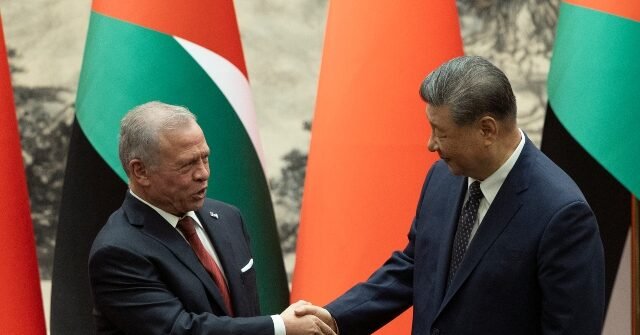
As Beijing’s strategic bet on Iran shows signs of unraveling, China is reportedly seeking to expand its economic footprint across the Middle East, recalibrating its approach in a region increasingly defined by shifting alliances and economic competition.
According to a report by Breitbart, Chinese officials and state-linked firms are looking to deepen trade and investment ties with key Gulf states and other regional players, a move that signals a pragmatic response to the diminishing returns of its partnership with Tehran.
A Waning Alliance
The report highlights that China’s once-vaunted relationship with Iran — anchored in a 25-year cooperation pact and billions in infrastructure investment — has faced mounting challenges. Economic pressure, international sanctions, and Tehran’s internal instability have all contributed to what the report describes as an ‘imploding’ bet.
Chinese investments in Iranian oil, transportation, and telecommunications have yielded less than hoped, according to the report, and Beijing is now hedging against further losses by diversifying its Middle East portfolio.
Gulf Courtship
In contrast, China is accelerating engagement with the Gulf Cooperation Council (GCC) states, including Saudi Arabia, the UAE, and Qatar. The report notes that Chinese trade with these countries has grown substantially, and Beijing has been courting Gulf sovereign wealth funds to finance joint projects in technology, renewable energy, and port infrastructure.
This pivot is not entirely new — China has long balanced its relationships between Iran and the Arab monarchies — but the scale and urgency have intensified as the Iran bet turns sour.
Economic Diplomacy Over Geopolitics
Analysts cited in the report argue that China’s approach in the Middle East remains primarily economic rather than overtly political. Unlike the United States, which has entrenched military alliances and security commitments in the region, China has largely avoided entangling itself in the sectarian and geopolitical disputes that roil the area.
Instead, Beijing has positioned itself as a neutral economic partner, willing to work with all sides. That posture has allowed China to maintain warm ties with Iran and Israel, with Saudi Arabia and Iraq, even as regional tensions simmer.
But the report suggests that China’s patience with Iran is wearing thin. Tehran’s resistance to Beijing’s demands for better repayment terms on loans, as well as persistent corruption and inefficiency in Iranian state agencies, have frustrated Chinese officials and business leaders.
The Bigger Picture
The report places China’s Middle East recalibration in the context of its broader strategic competition with the United States. As Washington restructures its own Middle East posture and focuses on the Indo-Pacific, Beijing sees an opening to consolidate its economic influence without directly challenging American security guarantees.
Chinese state media have touted the Belt and Road Initiative (BRI) as a driver of regional connectivity, and Middle Eastern ports such as the new Chinese-managed terminal in Abu Dhabi are key nodes in that network.
Yet the report cautions that China’s expansion is not without risk. The Gulf states, while eager for Chinese capital, have shown themselves to be wary of over-reliance on any single patron. They continue to balance Beijing against Washington and other partners.
Moreover, the report notes that Chinese companies have faced operational hurdles in the region, including cultural barriers, local regulations, and occasional security threats. The murder of a Chinese engineer in tribal areas of Pakistan — part of BRI’s overland segment — underscores the perils of infrastructure expansion in volatile zones.
What’s Next?
As China’s bet on Iran fades, the report says, a more pragmatic Chinese policy is emerging. Beijing is likely to maintain a baseline relationship with Tehran to retain access to energy resources and geopolitical leverage, but it will not make the same level of commitments it once did.
Instead, China is expected to focus its political capital and financial firepower on stable, cash-rich Gulf markets, where returns are more predictable and diplomatic dividends more immediate.
That pivot, if sustained, could reshape economic dynamics in the Middle East, drawing the region further into Beijing’s orbit while leaving Iran more isolated than before — a development with profound implications for the balance of power in the region.
For now, according to Breitbart, the message from Beijing to its regional partners is clear: China remains a long-term player, but its loyalties are to its own economic interests, not to any single ally.
Source: www.breitbart.com — https://www.breitbart.com/asia/2026/08/25/china-seeks-to-deepen-economic-footprint-in-middle-east-as-its-bet-on-iran-implodes/