
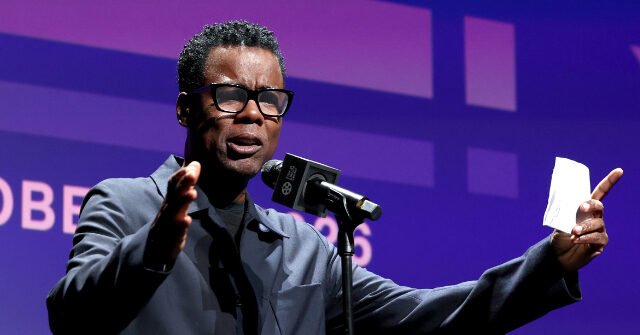
Chris Rock has never been shy about going after wokeness, but the comedian’s latest critique comes with an extended historical analogy. In a recent appearance on The Daily podcast, Rock compared the institutionalization of progressive scolding to the Salem witch trials, arguing that once an apparatus for rooting out wrongdoing gets built, it starts manufacturing targets to justify its own existence.
Breitbart News reported on the interview, which marks another stop on what has become a running theme for Rock — a performer who built his career on skewering hypocrisy from every direction now aiming squarely at the cultural left.
‘The Old Testament Has No Forgiveness’
Rock framed the problem in theological terms. “The problem with wokeness is we’re in the Old Testament right now,” he said. “And the Old Testament has no forgiveness. The Old Testament didn’t work. So they had to write a remix called the New Testament.”
It is a characteristically Rock formulation: take a lofty idea, strip it down to plain language, and land the punch on the word “remix.” The implication is that a moral system without a mechanism for redemption becomes, in practice, a machine for punishment. There is no exit ramp, no path back into good standing — just an ever-expanding list of the condemned.
The interviewer then asked whether Rock saw anything redeeming in the past decade of woke leftism. His answer was not encouraging. He noted that when ideas get “institutionalized,” they tend to go badly, and reached for the most famous example of institutionalized accusation in American history.
“The Salem witch hunts,” Rock said. “I’m sure the first three witches they caught were actually fucking witches. But then you open up a witch office and now you’ve got to start lying. Now you’ve gotta fucking make s— up because you’ve got overhead. You’ve got to justify the witch hunters fucking pensions and shit.”
Stripped of the profanity, the argument is about incentives. A genuine problem — real wrongdoing, real witches, depending on which century you’re standing in — creates a demand for investigators. The investigators build a bureaucracy. The bureaucracy needs a caseload. And a caseload has to come from somewhere, even when the original supply of genuine offenders runs dry. Rock’s point is that the machinery of accusation outlives the justification for it.
Friendship, Forgiveness, and Ridicule
Rock was careful to draw a distinction between forgiveness and an absence of standards. Advocating for the former, he said, does not mean accepting abusive behavior. “You can reprimand your friends,” he said, describing that kind of correction as “also part of friendship.”
He put the thought more plainly a moment later: “If you’re only friends with your friends when they’re good, they’re not your friends.”
That line lands harder than it might on first read. The logic of public shaming, as practiced over the last decade, often treats any association with a person who has fallen short as itself a kind of contamination. Rock’s version of friendship assumes that people will fail, that saying so is part of caring about them, and that the relationship survives the correction. The alternative — severing ties at the first infraction — is less a moral standard than a risk-management strategy.
For a comedian who has spent decades working in a business built on saying the wrong thing on purpose, the distinction is not academic. Rock’s own career has been shaped by the tension between provocation and consequence, and he has been unusually willing, in recent years, to say out loud what a lot of performers only say privately.
A Concession on Cancel Culture
Rock’s critique was not entirely one-sided. He also said he was glad cancel culture emerged around 2014, because it gave attention to people who might not previously have had a voice. It is a notable concession from a man who has spent several years publicly criticizing the movement that produced it, and it complicates the easy framing of Rock as a pure anti-woke crusader.
The timeline he cites is roughly right. The years around 2014 saw the rise of a more aggressive, social-media-driven form of accountability that began on campuses and in progressive online spaces before spreading into media and entertainment. Whatever one makes of its excesses, the period did shift whose stories got told and whose complaints got heard.
The Trump Comment
Rock’s latest remarks arrive during a press tour for his new film, Misty, and he has used the promotional circuit to make headlines of a different kind. Last week, per Breitbart’s account, he said that President Trump was right in his claim that the news media is full of lies and fake news.
“I’m not a fan,” Rock said of Trump. “But it’s weird when somebody gets one thing right, and the one thing almost clears them of all their other sins. The news is fake. He got that right.”
The construction is telling. Rock goes out of his way to establish that he is not a supporter, then concedes the point anyway — the reluctant admission of someone who prizes accuracy over tribal loyalty. Whether the news is, in fact, “fake” is a broad claim that resists simple verification; what Rock is describing is his own assessment, offered as one item on a longer ledger of disagreements.
Rock’s willingness to criticize wokeness has been building for years. His 2023 special Chris Rock: Selective Outrage made the theme explicit, and it has since become a recurring subject in his interviews. What is different now is the frame he is applying. Rather than mocking specific absurdities — the language policing, the apology tours, the ritual firings — he is arguing that the whole system has a structural flaw: it was built without an exit.
The Salem comparison does a lot of work in that argument. The witch trials are the standard historical shorthand for a community turning on itself, for accusations that become self-validating, for a process that cannot be stopped once it starts because stopping would mean admitting the process was wrong. Rock’s addition is the bureaucratic detail — the witch office, the overhead, the pensions. It is a comedian’s instinct: find the mundane administrative reality underneath the moral drama and let it do the damage.
Whether the analogy holds is a matter of opinion, and Rock presents it as one. But it captures something about the current moment that more careful commentators have struggled to articulate. A culture that can only escalate, that has no mechanism for forgiving, and that has built institutions dependent on finding new offenders, is going to keep finding them — real or not. That, at least, is Rock’s contention, delivered in the language he has always used: blunt, profane, and hard to forget.
Warner Todd Huston is a Breitbart News reporter. Follow him on Facebook, Truth Social, and X/Twitter.
Source: www.breitbart.com — https://www.breitbart.com/entertainment/2026/10/05/watch-chris-rock-compares-wokeness-to-salem-witch-trials/