
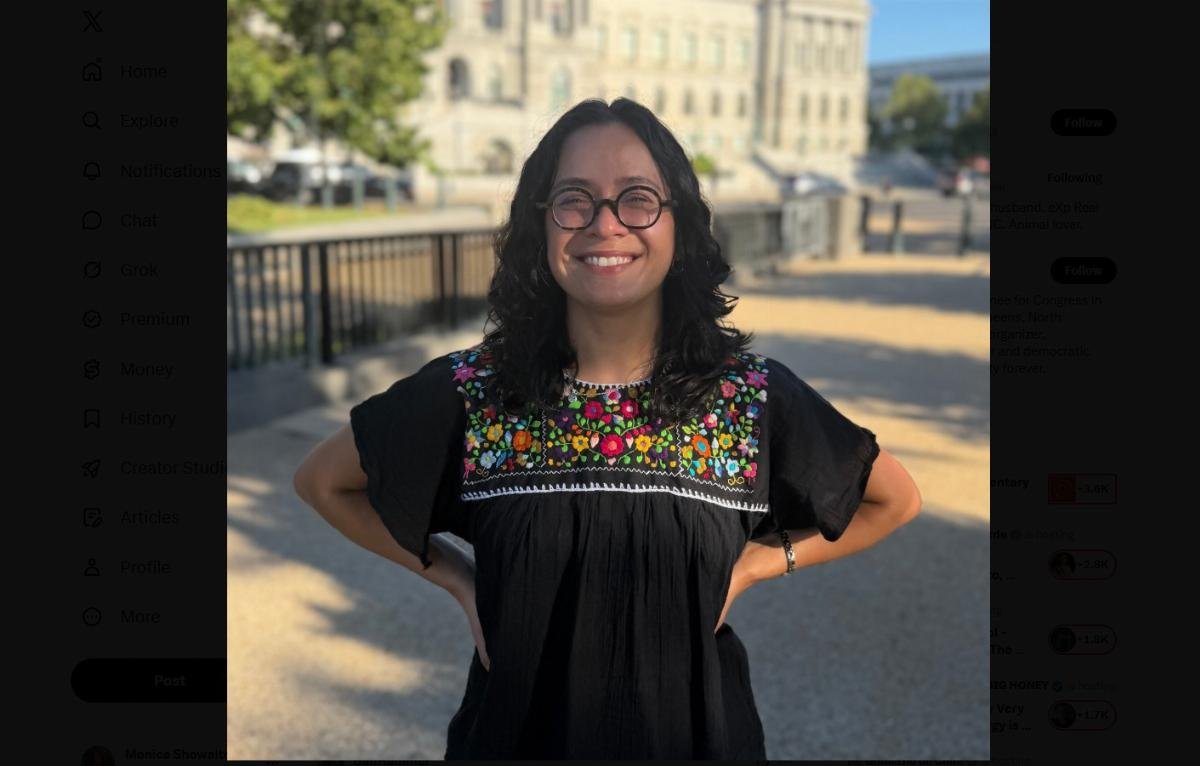
There are campaign slogans, and then there are statements that invite voters to ask which country a candidate is actually asking to represent. According to an American Thinker commentary by Monica Showalter, Claire Valdez, a Democratic Socialist of America-linked candidate running for a safe New York State Assembly seat in Queens’ 37th District, has offered voters the second kind.
Showalter, who says she first flagged Valdez in a recent piece about the wave of DSA-aligned candidates running for office — noting at the time that Valdez was “all in” on abolishing ICE — argues that the candidate has now gone further, publicly framing her campaign in the language of Mexican history and Mexican national struggle rather than American civic life.
“Our land and our labor”
The centerpiece of Showalter’s critique is a social media post in which Valdez writes that “215 years ago, Mexicans fought an empire that demanded our land and our labor. And we won,” before adding that she will “carry that fight with me to Congress as New York’s first Mexican American representative,” and that she draws strength not only from Mexico’s history but from its present.
For Showalter, the pronouns are the story. The “our” and the “we,” she writes, are doing “a lot of heavy lifting” — evidence, in her reading, that Valdez’s loyalties and identifications sit somewhere other than with the United States. In Showalter’s account, Valdez treats the Spanish empire as the villain of a personal grudge, and appears to cast the United States in that same imperial role today, a fight she intends to continue from elected office.
She is not, Showalter contends, “strengthened” by America’s history, but by Mexico’s — a history Showalter characterizes in starkly negative terms, citing the anticlerical Freemason-led faction that banned the Catholic Church in the early twentieth century and triggered the Cristero resistance, decades of one-party rule that the writer Mario Vargas Llosa once called “the perfect dictatorship,” and widespread poverty that she attributes to expropriations and nationalizations in a country she says otherwise had much going for it.
A warning about “the Mexican model”
Showalter’s argument then moves from history to policy. If Valdez wants to pursue corporations and the investors and jobs they bring, she asks, is she proposing to follow the Mexican economic model in the United States? Showalter points to the socialist and Freemason-era expropriations that began around World War II, a period she describes in harsh terms, writing that Mexico functioned as a de facto ally of the Nazis in its effort to push back against the United States.
The columnist also raises a broader concern about dual loyalties, writing that Mexico has recently been caught holding meetings in Mexico City about how to manipulate U.S. elections. Against that backdrop, Showalter argues that Valdez has “broken new ground” by not concealing what Showalter describes as loyalty to Mexico over the United States. Her conclusion is blunt: she sees no gratitude toward America, no identification with America, and no obvious reason why Valdez would want to serve here rather than there — and predicts New York voters will elect her anyway.
The Crenshaw reply
Showalter also highlights a response from Sen. Dan Crenshaw, who pressed Valdez on the basic logic of her announcement. In his post, Crenshaw asks which Congress she intends to carry the fight to — “Ours? Mexico’s?” — and who exactly is being fought: “Spain?” He closes by urging her to read a book if she does reach Congress, adding wryly that most DSA members haven’t, so she would be breaking new ground.
The exchange captures a real dispute about how candidates with immigrant heritage should talk about their backgrounds on the campaign trail. One reading holds that a candidate invoking ancestral history is simply telling a personal story, and that discussions of colonialism and labor are standard fare in left-wing politics. Another reading — the one Showalter presses — is that Valdez’s phrasing, particularly the repeated “we” describing Mexicans who fought an empire two centuries ago, marks a step beyond biography into something closer to national allegiance.
What is not in dispute, based on the source material, is the substance of Valdez’s words: she identifies herself as a Mexican American candidate, she frames her candidacy as carrying forward a fight she associates with Mexican history, and she describes herself as strengthened by Mexico’s present as well as its past. Neither is the fact that she is seeking office in New York, not Mexico.
The stakes Showalter sees
Showalter’s piece is less a news report than an argument, and it reads that way from the first line — she opens by suggesting Valdez “sounds like she should be running for Mexico’s congress.” Her broader claim is that Valdez is one of a larger cohort of DSA-linked candidates whose politics she considers extreme, and that Valdez’s willingness to speak so openly about Mexico marks a departure from candidates who keep quieter about such identifications.
Whether voters in the 37th District share that concern is, ultimately, the only poll that matters. But Showalter’s column raises a question that campaigns rarely answer cleanly: when a candidate says “we won” about a war fought before the United States existed in its current form, who is the “we” on the ballot on Election Day?
Source: www.americanthinker.com — https://www.americanthinker.com/blog/2026/09/meet-claire-valdez-the-latest-dsa-lunatic-leftist-running-for-new-york-s-state-assembly-for-mexico/