
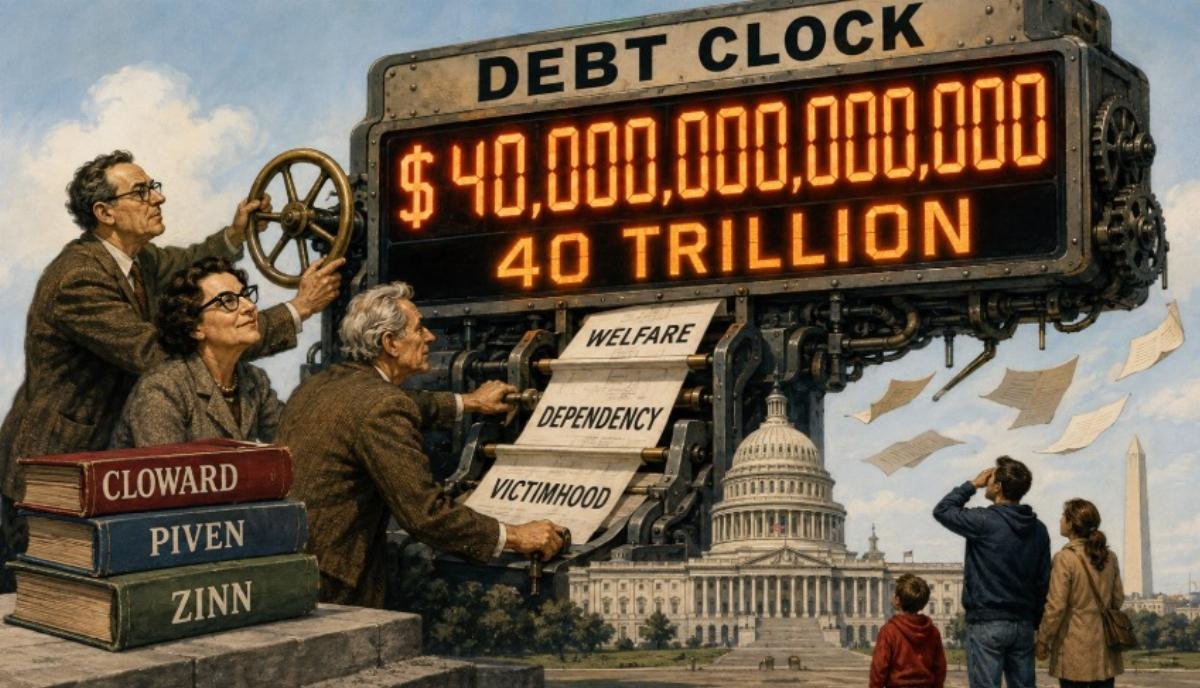
It was February 20, 1989, when the National Debt Clock first ticked to life, a month after Ronald Reagan left the White House. Back then, the debt stood at $2.7 trillion—a figure that, in hindsight, seems almost quaint. Today, that same clock has crossed $40 trillion, and the numbers have become almost impossible to grasp.
For many Americans, the reaction to such figures is a mix of numbness and bewilderment. How did we get here? According to a recent opinion piece by Vince Coyner at American Thinker, the answer lies not with tax cuts or military spending, but with three intellectuals and their ideas: Richard Cloward, Frances Fox Piven, and Howard Zinn.
The Cloward–Piven Strategy: A Plan to Overwhelm the System
Coyner argues that Cloward and Piven’s 1966 strategy was never just about welfare reform—it was a roadmap to collapse the federal government by flooding it with redistribution demands. The goal, as the authors themselves wrote, was to create a permanent dependency class that would vote for Democrats: “If organizers can deliver millions of dollars in cash benefits to the ghetto masses, it seems reasonable to expect that the masses will deliver their loyalty to their benefactors.”
That strategy, Coyner contends, has been followed by Democrats for sixty years. It required a complicit media to sell the idea, and it worked. But it wasn’t alone.
Howard Zinn: Rewriting History for a Generation
Coyner points to Howard Zinn’s A People’s History of the United States, published in 1980, as the cultural companion to the Cloward–Piven political project. Zinn portrayed America as a nation built on the oppression of minorities, women, and the poor—a history that, by Zinn’s telling, was designed to maintain the power of white elites. The book sold millions of copies and is used by nearly 200,000 teachers, including a quarter of high school history teachers.
The result, Coyner argues, is that less than half of young Americans are proud to be Americans, and the stage was set for a political ecosystem built on victimhood and government largesse.
The Numbers Add Up—But the Blame May Not
There’s no denying the fiscal trajectory. In 1989, the national debt was about $11,500 per American. Now it’s roughly $116,000 per person. Unfunded liabilities—mostly Social Security and Medicare—have ballooned from about $4 trillion to $130 trillion, or $250,000 per person. Back in 1989, it would have taken the average worker a year and a half to pay off their share; today, it would take five years.
But attributing this entirely to the Cloward–Piven strategy is a stretch. Coyner glosses over the fact that the debt grew 184% under Reagan, a Republican, and that both parties have contributed to the spending spree. The ‘tax cuts and military spending’ narrative he dismisses is not just Democratic spin—it’s a widely accepted economic reality. The Reagan-era debt explosion was driven by tax cuts (which reduced revenue) and a military buildup (which increased spending). Democrats did not force those policies; they mostly opposed them.
Still, Coyner insists that the Cloward–Piven–Zinn playbook is the real culprit. He points to modern figures like AOC and Detroit’s Abdul El-Sayed as executors of the strategy, and he warns that the path leads not to ‘socialist nirvana’ but to fiscal Armageddon.
Coyner’s piece is a provocative take, but it’s also selective. It ignores the role of unpaid-for tax cuts, wars in Iraq and Afghanistan, and a global economic crisis that required government intervention. It also treats a 1966 academic paper as an all-powerful阴谋, giving its authors more credit than they ever had. The Cloward–Piven strategy was never officially adopted by any party; it was a theoretical proposal that was largely forgotten until it was resurrected as a conservative talking point in recent years.
What is true is that America’s debt is unsustainable. This year, the federal government is expected to spend 25% more than it takes in, a gap that has persisted for nearly a decade. The question is whether we can fix the problem without demonizing academics or rewriting history ourselves.
Coyner concludes by recommending Paul Johnson’s A History of the American People and Harold Evans’ They Made America as correctives to Zinn’s ‘cancerous’ narrative. It’s a reminder that history is always contested—and that the fight over how we tell it has real consequences for how we vote and how we spend.
Whether you buy Coyner’s thesis or not, one thing is undeniable: the debt clock keeps ticking, and no amount of finger-pointing will make it stop.
Source: www.americanthinker.com — https://www.americanthinker.com/articles/2026/08/cloward-piven-and-zinn-told-us-they-wanted-to-bankrupt-america/