
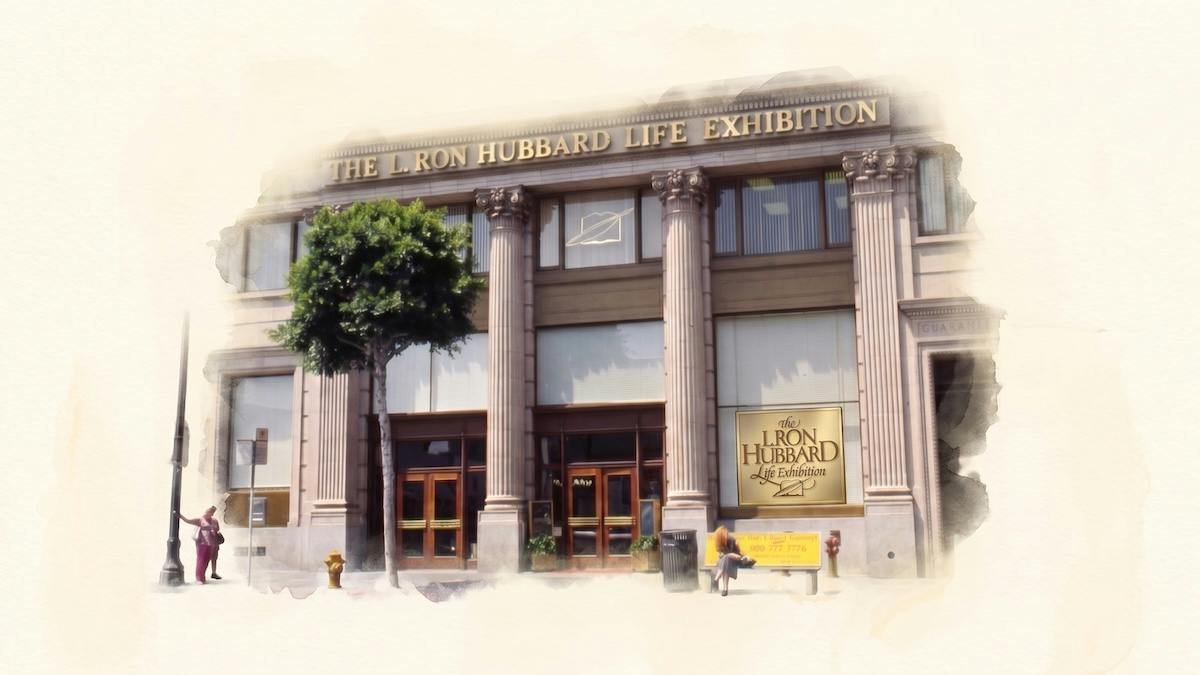
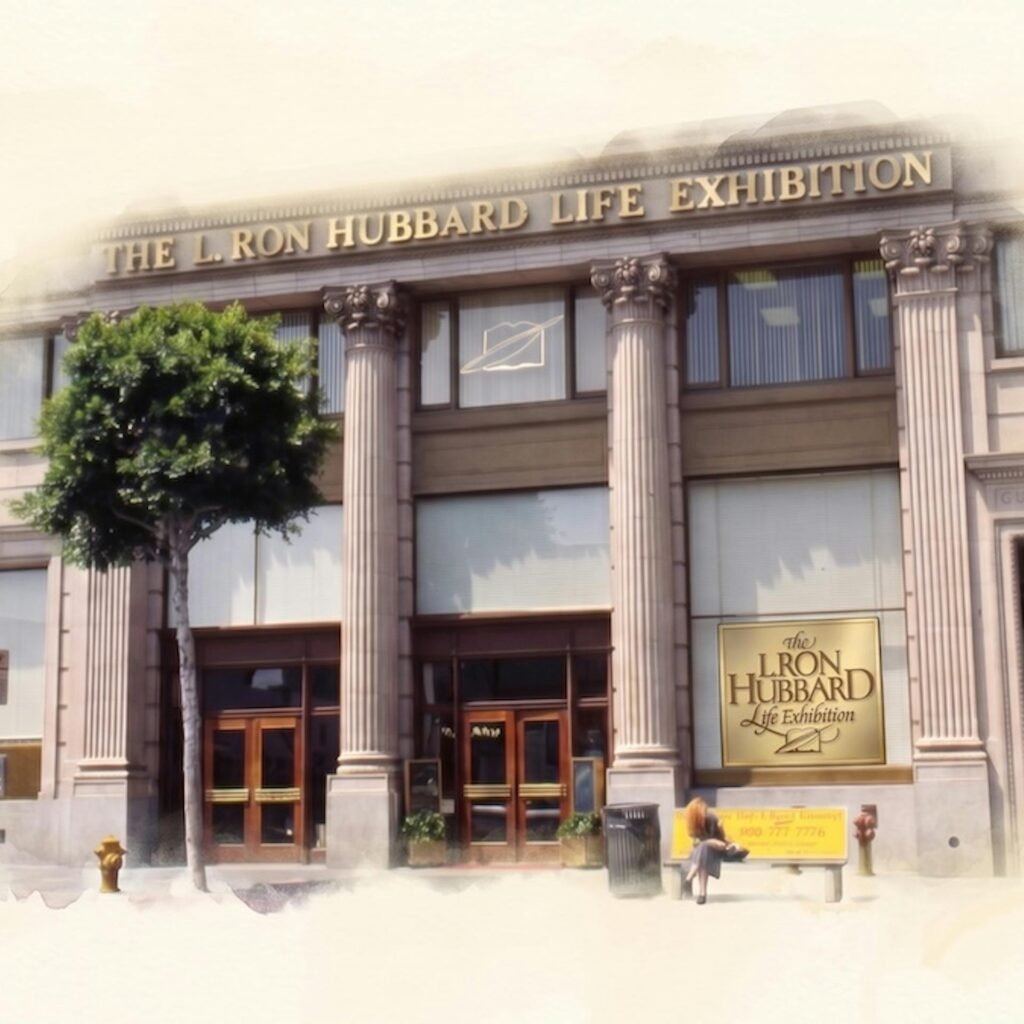
In a first-person account published by The Daily Wire, a reporter recounted taking a privately booked, four-hour tour of the Museum of L. Ron Hubbard along the Hollywood Walk of Fame in Los Angeles — a walkthrough that began with a scheduled 2 p.m. appointment, a locked door, and a host named Elsa.
According to the account, the writer arrived early and noticed a gold bust of the founder in the lobby before being buzzed inside by Elsa, who greeted the visitor with a German accent and an unblinking smile. Behind her sat a bookshop devoted almost entirely to Hubbard, aside from a stack of Writers of the Future anthologies, the annual contest winners whose judges have included Orson Scott Card and, while living, Frank Herbert.
When the writer asked whether Card was in the building, Elsa shrugged with what the author described as “a telling smile.” She confirmed the science-fiction author is not a member, adding that the church works “with all talents regardless of status.” She then framed the shop as a preface to the tour: Scientology, she said, is “not theological” but “an applied study of the sciences.”
Opening film: Boy Scout, Navy lieutenant, ‘only major religion of the twentieth century’
After swiping an ID card, Elsa led the visitor through double doors and into a theater seat for what she called “our introductory presentation.” A narrated film laid out Hubbard’s biography: born in Nebraska in 1911, a Boy Scout at 12 who met President Calvin Coolidge, “the youngest Eagle Scout in history” by 13, a traveler to Asia at 16, a nuclear physics student at George Washington University, a Navy lieutenant recommended rather than drafted who commanded two vessels and was wounded in combat, and a veteran who cured himself at the Oak Knoll VA hospital before publishing “Dianetics” in 1950.
The film closed on a somber note — Hubbard died in 1986 — before the narrator asked, “What kind of man could have founded the only major religion of the twentieth century? … A man such as L. Ron Hubbard,” as a smiling photo of the founder faded in and the music swelled.
The Daily Wire writer then offered a point-by-point rebuttal. Hubbard was “likely not the youngest Eagle Scout,” given the lack of comprehensive records from the era, though he did meet Coolidge. He traveled to Asia but privately journaled that it was “trashy.” He attended George Washington University but flunked entry-level atomics before dropping out. He was removed from both ships he commanded and was not wounded in combat, though he was an Oak Knoll patient after the war. “Dianetics” was a bestseller, and Scientology does carry traits of a major religion — but it is not the only one founded in the twentieth century, the piece noted, listing the Nation of Islam, Falun Gong, Jehovah’s Witnesses, Rastafari, and, according to its members, the Church of Satan.

Battlefield Earth dioramas and a ‘Mission Earth’ pitch
The tour moved past a newspaper stand of pulp titles — Cosmic, Astounding, Unbelievable, Beyond — and life-size dioramas from Hubbard’s fiction. An orange alien loomed over a device across from a caveman reaching for it, scenes from “Battlefield Earth” (1982); nearby, a ’50s-era cockpit held two semi-human figures from “Mission Earth” (1985-87). Each book sat in a glass case below.
Elsa told the visitor she was on book seven of the “Mission Earth” series. When the writer said the books demand rereading, she agreed: “Exactly!”
A volcano erupts, then an ad for antidepressants
Next came a small theater with a pressed curtain and an extended stage. Elsa vanished behind the visitor, the lights dimmed, and the curtain pulled apart to reveal a giant sculpted volcano that “erupted” in red and orange light. A screen rose from the floor and played what the writer described as “an early commercial for antidepressants,” with a narrator asking, “Are you unhappy?” and a woman asking, “Does your life lack meaning?” before promising, “In this video, you will learn the secrets of Dianetics, and how to apply them to the betterment of your life.” Then the projector clicked off and the curtain closed.

“What?” the writer recalled asking aloud. “Where were the secrets?”
An up-close e-meter demo on the second floor
Elsa then led the way upstairs to a display of what the author called “Geiger-toasters” — antique Hubbard Electrometers in deco-radio casings. The writer asked directly whether they were e-meters, prompting Elsa to ask, with a sharper tone, what the visitor had heard. The writer said only that the devices came up in college in LA, and Elsa eased, inviting the visitor to take the handles.
The e-meter measures resistance to electrical flow through a person completing the circuit; auditors calibrate it during sessions while asking questions intended to release “engrams,” which the writer characterized as spirit demons. The piece cited podcaster Lex Fridman, who, in conversation with ex-auditor Aaron Smith-Levin, described the device as “a real device you can calibrate to probably get an outcome that you want.”
“With this technology, I can tell what you’re thinking — more or less,” Elsa told the visitor, according to the account. When the writer asked whether she was an auditor, she nodded, gleaming, as the meter’s arrow swung far right.
The Daily Wire piece does not present the tour as a news event so much as a firsthand look at how the church curates its founder’s legacy for visitors — a walkthrough in which a smiling bust, sepia-toned biography, science-fiction dioramas, and a live e-meter demonstration carry the message. The church has long disputed critical characterizations of its practices and history; the account’s factual annotations of the introductory film reflect the writer’s own review rather than an on-the-record response from Scientology representatives.
For readers, the detail that lingers may be the one Elsa offered at the door: that the tour’s premise is not theology but “applied study of the sciences” — a framing the reporter let stand only until the volcano erupted.
Source: www.dailywire.com — https://www.dailywire.com/news/what-i-saw-at-the-scientology-founders-museum