
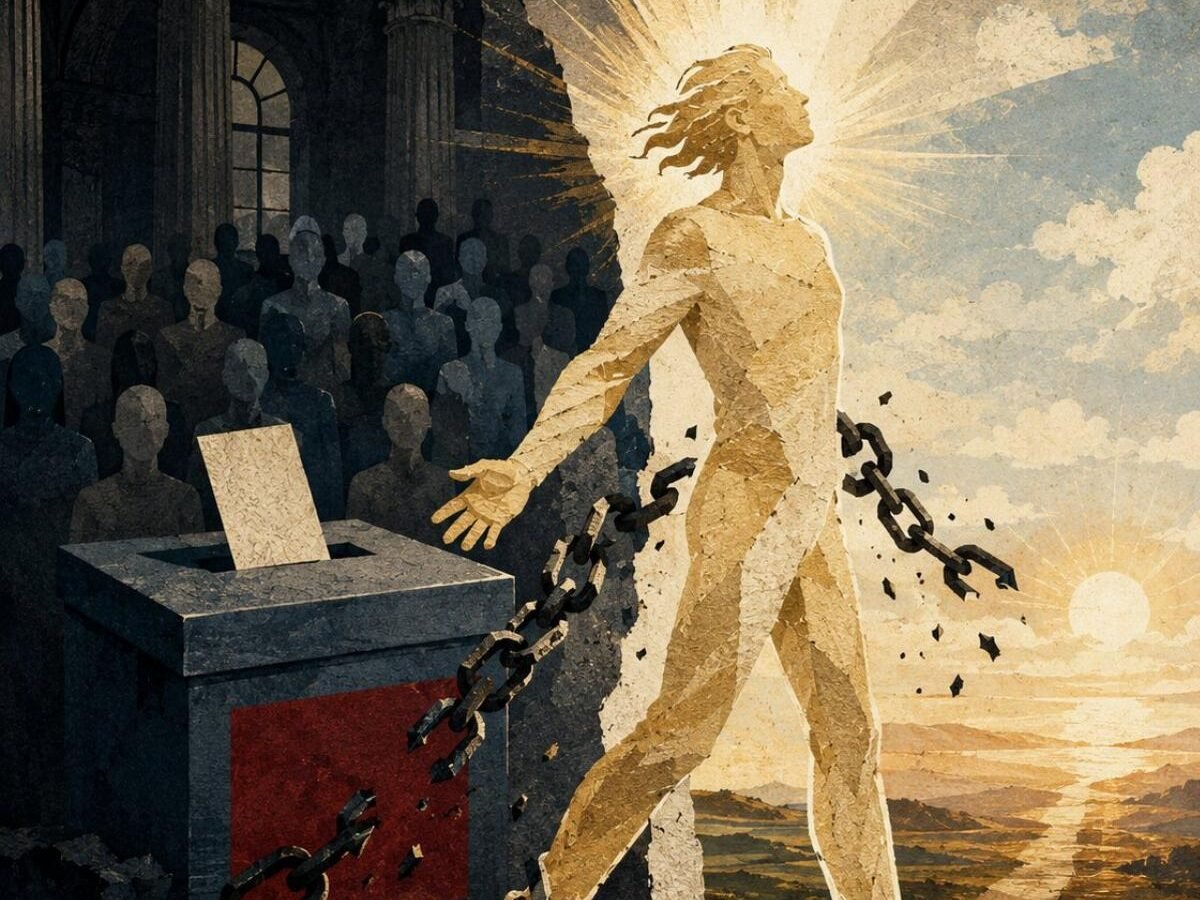
In a new commentary for American Thinker, writer J.B. Shurk makes a provocative case that democracy, when understood as unbridled majority rule, poses a grave threat to individual liberty—and that freedom, not democracy, should be the true object of civic devotion.
Shurk’s essay, published September 4, 2026, opens with a stark warning: “Democracy invites despotism.” He argues that if 51 of every 100 citizens can impose their will on the other 49, then property, personal weapons, and even children are vulnerable to majority whims—whether through redistribution, disarmament, or public-school indoctrination.
The piece draws on political philosophy to underscore its point, citing Hobbes, Locke, and Adam Smith’s “invisible hand” as evidence that self-interest, not benevolence, often drives human action. Without moral virtue and constitutional restraints, Shurk contends, democratic systems can devolve into a “state of nature” where humanity’s worst impulses flourish.
Democracy vs. Freedom: A Distinction With Consequences
Shurk is careful to distinguish democracy as a mere process from freedom as a foundational principle. “There is nothing inherently virtuous about democracy,” he writes, pointing to authoritarian regimes like North Korea’s Democratic People’s Republic of Korea and the People’s Republic of China—both of which cloak despotism in democratic-sounding names.
The author challenges the assumption that collective decision-making is inherently wiser than individual judgment. “Democracy is a coin toss,” he asserts, asking whether a kingdom with a benevolent king might not be preferable to a democracy filled with criminals. “It is the veneer of legitimacy that makes authoritarianism look shiny and sparkly.”
For Shurk, true liberty rests on the recognition of “inviolable, natural, God-given rights”—speech, religion, association, and self-defense—that exist “despite majority rule,” not because of it. He invokes the Declaration of Independence’s language that all men are “endowed by their Creator with certain unalienable Rights.”
The Constitution’s Original Design
Shurk argues that the U.S. Constitution was designed to be a limiting document, not an empowering one. He points to the Preamble’s assertion that government legitimacy flows from “We the People” and emphasizes that any power not specifically delegated to the federal government remains with the states or the people.
The piece highlights the Ninth and Tenth Amendments as crucial safeguards. The Ninth ensures that the enumeration of rights cannot be used to deny others retained by the people; the Tenth reserves undelegated powers to the states or the people. Together, Shurk argues, these amendments form a “redundancy within the U.S. Constitution that is meant to preserve human liberty.”
A Nation That Traded Freedom for Democracy
Shurk poses a rhetorical question: How did a federal government with limited delegated powers become so vast that it “encroaches upon nearly every aspect of our private lives”? His answer: Generations of Americans “progressively traded freedom for democracy.” In the name of the people, he contends, lawmakers, presidents, and judges have ignored the Constitution’s plain text—including the Ninth and Tenth Amendments—to “steal our inalienable rights and liberties.”
The commentary concludes with a call to action: “In order to reject democracy’s despotism, the American people will have to demand their rights and liberties back.” Shurk emphasizes the importance of free speech, writing, “Now more than ever, the ability to speak our minds is crucial to the republic we cherish.”
American Thinker, a conservative online publication, regularly publishes opinion pieces on constitutional interpretation and limited government. Shurk’s essay adds to a longstanding debate over whether democracy or liberty should reign supreme in American political thought—a question that continues to animate discussions on the right and among constitutional scholars.
Source: www.americanthinker.com — https://www.americanthinker.com/articles/2026/09/freedom-is-much-more-important-than-democracy/