
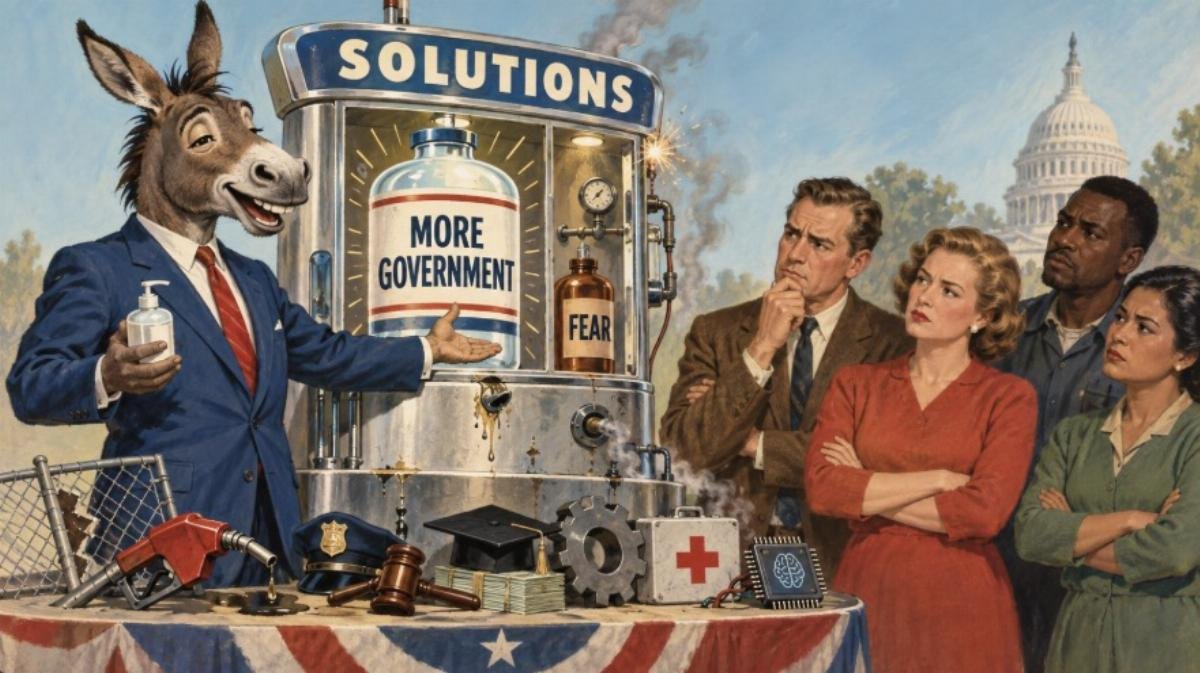
Democrats have spent months warning that artificial intelligence poses a sweeping threat to workers, consumers, and national security — and now they want voters to trust them to solve it. That, at least, is the argument driving a new American Thinker column by Jack Hellner, who contends that the party’s record on the major issues it has claimed to champion makes its promises on AI ring hollow before the details are even written.
Hellner’s central claim is familiar to readers of the outlet: Democrats identify a crisis, position themselves as the only ones capable of managing it, and then — in his telling — deliver policies that make the underlying problem worse. He opens with a dose of sarcasm, suggesting that because Democrats have handled everything else so well, they will surely devise sensible rules for artificial intelligence. The rest of the piece is devoted to explaining why he does not believe it.
An old handoff, revisited
One of Hellner’s sharpest points is a matter of political history. He notes that Kamala Harris was given responsibility for the administration’s approach to AI back in 2023, when she led a meeting with technology executives while President Biden’s public schedule was being lightened ahead of his reelection announcement. He points to an Axios headline from that period — “Biden lightens his White House schedule, lets Harris take lead in AI meeting” — as evidence that the issue was handed off rather than seriously managed.
Now, Hellner writes, Harris is lecturing President Trump about how he must handle both China and artificial intelligence. He uses her own words introducing the topic to make the case that the expertise was never there, quoting her remark that “AI is kind of a fancy thing” and that “it’s two letters. It means artificial intelligence, but ultimately what it is is it’s about machine learning.” For Hellner, that formulation is the whole story: a flashy assignment with little substance behind it.
A tour through the Democratic record
Most of the column is a memory-lane exercise in which Hellner runs through policy areas where he says Democratic governance failed, building toward the conclusion that AI will be no different. On immigration, he writes that the Biden-Harris approach amounted to opening the border to nearly everyone, including terrorists and gang members, while enriching NGOs and Mexican cartels. He adds that sanctuary cities and states cheered those policies and that many Democrats would abolish ICE outright.
On energy, he says Democrats set out to destroy oil, gas, and coal companies, raised mileage requirements to unaffordable levels, and handed kickbacks to political supporters without regard for the price increases or job losses. He asks, pointedly, whether the policies changed the climate at all or merely made a lot of green boosters rich.
On crime, Hellner argues Democrats have spent years installing soft-on-crime judges and prosecutors, favoring no-bail laws and even commercial driver’s licenses for people in the country illegally, with police routinely bashed and victims given little sympathy. He cites falling crime rates under Trump as proof that the direction should be reversed.
The list continues. On Iran, he writes that the Obama and Biden administrations pursued a policy, alongside European partners, that rebuilt Tehran’s finances so it could build more weapons and support terrorists. On education, he calls it a matter of throwing money at the problem while working hard to block poor children from school choice. On student debt, he accuses Biden of dictatorial and unconstitutional debt cancellation. On manufacturing, he warns of China becoming the main supply-chain source while policymakers do nothing. On welfare, he says the approach produces generational poverty rather than upward mobility. On health care, he accuses Democrats of lying about Obamacare, promising lower premiums and freedom of choice that never materialized.
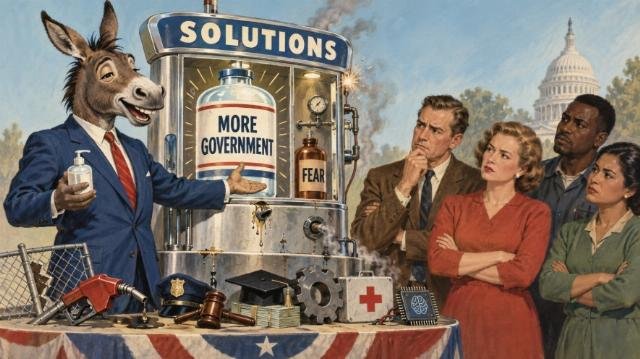
The unifying thread, as Hellner frames it, is a preference for more government control over everything and higher extraction of money from companies and individuals to pay for it.
The real purpose of the panic
The column’s most politically pointed passage comes near the end, where Hellner argues there is a strategic reason for the alarm. He writes that he understands why Democrats are trying to scare everyone — it is always part of their playbook — and that they plainly do not want a campaign centered on their radical, unproductive, and unpopular policies. The implication is that AI anxiety functions as a shield, moving the debate away from the administration’s record and onto a terrain where Democrats can pose as protectors.
His bottom line is that blocking AI in the United States while China races ahead would be a terrible solution, and that a party whose policies he credits with solving nothing should not be trusted to design the rules for the most consequential technology of the era.
What the argument is, and isn’t
It is worth being clear about what this piece does. Hellner does not engage with any specific AI legislation, executive order, or regulatory framework, because he does not need to — his objection is to Democratic competence in general rather than to any particular AI proposal. The strongest version of his case is that credibility is earned through outcomes, and that a party should not be granted authority over a new domain when voters have not been satisfied with its stewardship of old ones. The weakest version is that it proves too much: by the same logic, no party with an imperfect record on any issue could ever legislate on anything new.
Whether readers accept the premise depends largely on whether they accept the policy scorecard he lays out. But the piece does capture something real about the moment: both parties are now competing to define who will oversee AI, and each is using the other’s record as the primary evidence. Hellner’s contribution is to make that case from the right with unusual directness — no hedging, no policy counterproposal, just a flat assertion that the people promising to fix AI are the same people who broke everything else they touched.
For voters weighing those claims, the column functions less as an analysis of artificial intelligence than as an argument about trust. Hellner’s answer to the question of who should regulate AI is, in effect, not them.
Source: www.americanthinker.com — https://www.americanthinker.com/blog/2026/09/democrats-create-an-ai-panic-and-then-falsely-promise-solutions/