
When Montgomery County, Maryland, renewed its push to bar firearms within 100 yards of “places of public assembly,” it swept churches and synagogues into the same category as courthouses and jails. The Justice Department responded on August 3 by filing suit against the county, arguing the newly enacted Bill 23-26 collides with the Second Amendment.
As the department put it in its announcement, the law “prohibits carrying firearms at thousands of locations, and also creates an arbitrary 100-yard exclusion zone around each location,” applying “even if the person carrying a firearm is duly licensed and has the express consent of the property owner.”
Writing at American Thinker, Mike McDaniel frames the suit as a rare bright spot for a right he argues would otherwise be eroded piece by piece — and as a moment when American Jews in particular are rethinking what self-defense requires.
A second suit, and a different set of claims
The DOJ action is not the only courtroom challenge. Representing the Silver Spring Jewish Center and Rabbi J. Menashe Shapiro, the New Civil Liberties Alliance has filed its own suit against the county. According to McDaniel, that complaint argues the law “violates the First Amendment right to free exercise of religion by prohibiting synagogue members from acting according to their beliefs.” It further contends the measure runs afoul of the Establishment Clause by substituting government judgment for that of religious leaders, denies the Second Amendment right to keep and bear arms, and violates the Fourteenth Amendment’s equal protection guarantee by discriminating on the basis of religion.

McDaniel concedes a point that cuts against the simplest reading of the case: Maryland synagogues, he writes, do not appear to be singled out. The law reads as another broad blue-state effort to declare nearly everywhere a “sensitive” location, which under the Supreme Court’s decisions in Heller and Bruen is a category the Court meant to keep narrow.
What ‘sensitive places’ was supposed to mean
The argument here is about line-drawing. In McDaniel’s telling, the Court’s intent clearly covers places like jails and courtrooms — not churches, synagogues, or other ordinary gathering spots. Maryland, he writes, is pushing the envelope by writing laws its proponents know to be unconstitutional.
That framing may face headwinds. Lower courts have split over how far the Bruen framework allows legislatures to go in designating sensitive places, and the Supreme Court has yet to resolve the question with any precision. McDaniel does not engage those lower-court rulings; his focus stays on what he sees as the plain logic of the decisions.
The policing gap argument
Underneath the constitutional claims sits a practical one. McDaniel points to a growing recognition among American Jews that police, however willing, cannot be everywhere. Departments like to catch criminals in the act, he notes, but they have no legal obligation to protect any individual citizen — a point he ties to the Supreme Court case Castle Rock v. Gonzales.
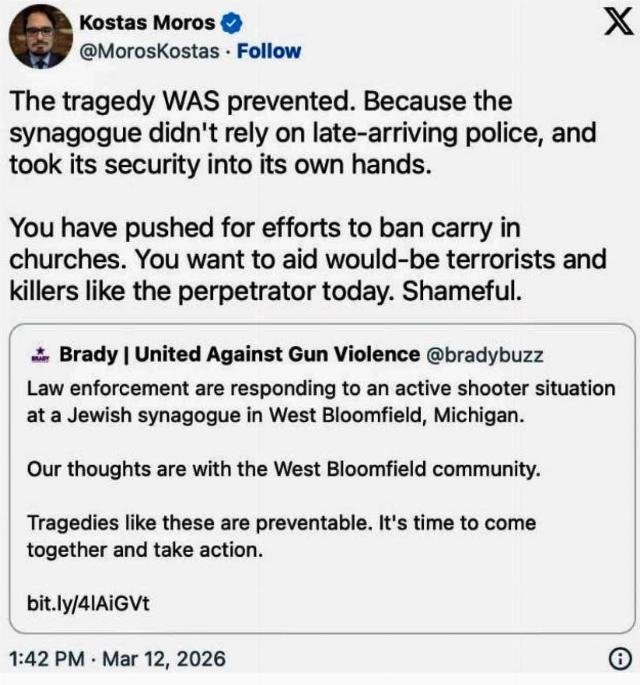
He pairs that with what he describes as a sharp rise in antisemitic violence, which he attributes to the Democratic Party and to what he calls Communist and Islamist elements working to take control of it. American Jews, he writes, are coming to treat “Never Again” not as an awkward slogan but as a necessary reminder of what survival demands.
The piece reaches back to his own March article at American Thinker, titled “Should churches have security teams?” His answer then was “Yes. Yesterday.” He argued the question isn’t whether congregations should organize security, but how visible that security should be — concealed weapons for a low-key team, or rifle-resistant vests and long arms where the local threat is higher. He noted the irony that the danger tends to be greatest in blue urban areas that work to disarm citizens and often show hostility toward Christians and Jews.
The volunteers who stopped waiting
Some security volunteers in Montgomery County, McDaniel writes, are no longer waiting for the courts. They are defying the county’s restriction while litigation proceeds. That posture carries its own legal risk: a favorable ruling after the fact does not necessarily erase exposure for conduct that occurred while the law was on the books.
McDaniel also credits the Trump administration for the DOJ’s intervention, closing with the claim that absent Donald Trump, the Second Amendment would be just another unalienable liberty Democrats would deny.
The two suits now move through the courts on overlapping but distinct theories — one centered on the Second Amendment, the other on religious liberty and equal protection. For the congregations involved, the stakes are concrete: whether armed volunteers can stand watch outside sanctuaries while the legal fight unfolds.
Source: www.americanthinker.com — https://www.americanthinker.com/blog/2026/09/the-doj-sues-to-keep-maryland-from-denying-synagogues-protection/