
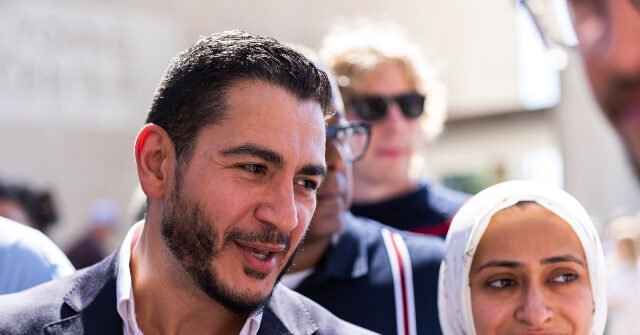
Michigan Democratic Senate candidate Abdul El-Sayed has received more than $25,000 in campaign contributions from at least six men who signed a 2012 letter expressing support for the Muslim Brotherhood and urging a “purge” of Egypt’s media and police, according to a report from the Washington Free Beacon cited by Breitbart News.
The donations span El-Sayed’s current Senate bid and his 2018 run for governor, the report said. The revelation lands in the final stretch of a race against Republican Mike Rogers, who raised the issue directly at the candidates’ televised debate on Wednesday night.
A letter from 2012
The letter, published in 2012, carried the signatures of 46 people described as “leaders of the Egyptian community” in the United States. It appeared days after Egypt’s then-president, Mohamed Morsi, unilaterally expanded his own powers — a move that set off protests and deepened the country’s political crisis.
According to the Free Beacon, the signers voiced support for Morsi’s “revolutionary actions” and criticized voices in the United States and Europe that opposed the new regime. The letter also called for a purge of the country’s media and police.
“Dr. Abdul Rahman El-Sayed” of New York was listed as the 33rd signature, the Free Beacon reported. The timing coincided with El-Sayed’s time as a medical student at Columbia University.
The donors
Among the signers who have given to El-Sayed is Dr. Hany Saqr, who identified himself in the letter as part of the “Egyptian Association in America.” He contributed at least $1,000 to the Senate campaign, according to the report.
Saqr was named in a 1990s phone directory of U.S.-based Muslim Brotherhood leaders included in a filing by federal prosecutors in a terror financing case, the Free Beacon reported. He also drew attention for referring to Egyptian President Abdel Fattah el-Sisi as a “dog of the Jews” over his opposition to the Brotherhood.
Another signer, Ahmed Shehata, wrote an opinion piece for Roll Call in December 2013 criticizing the pressure on the Muslim Brotherhood and calling for Morsi’s reinstatement. A year later, he pushed back against efforts to designate the group a terrorist organization, the report said. Shehata, the CEO of Islamic Relief USA, donated $500 to El-Sayed’s Senate campaign and the same amount to his 2018 gubernatorial bid.
The largest contributor among the letter’s signers is Dr. Hesham Gayar, an oncology and proton therapy specialist at Michigan’s Barbara Ann Karmanos Cancer Institute. Signing in 2012 as a member of the “Egyptian Foundation,” he has given at least $7,000 to the Senate campaign and nearly as much during the 2018 race, according to the report.
Other contributors include doctors in Michigan and Texas who attended medical school in Cairo, the Free Beacon reported.
Rogers presses the attack
At Wednesday’s debate, Rogers used the report to question El-Sayed’s loyalties and argue he would pose a national security risk in the Senate.
“So, being bought off by the Muslim Brotherhood, having donors to his campaign from Hamas that support Hezbollah, is not a problem?” Rogers said. “If you are going to go to the United States Senate, we need to know: Are you for America or are you for these terrorist groups overseas? You can grin, and you can smile, and you can talk real pretty, but I’m going to tell you what, that is a risk to our national security.”
The Free Beacon’s reporting is the latest in a series of attacks on El-Sayed over alleged ties to the Muslim Brotherhood, a connection he has faced repeated criticism over during the campaign.
The El-Sayed campaign has not responded publicly to the specific donor figures in the report, and Breitbart’s account did not include any statement from the candidate or his team addressing the donations or the 2012 signature.
What the report does and doesn’t establish
The Free Beacon’s findings document financial support from individuals who signed the letter — not any coordination between those donors and El-Sayed’s campaign. The report does not allege that El-Sayed endorsed the letter’s contents or that the donations were given in exchange for anything. It also does not establish that El-Sayed shares the views expressed by the other signers.
What it does show is that a network of donors connected to the 2012 letter has given steadily to El-Sayed across two campaigns, and that his opponent intends to make the association a central line of attack before November.
Source: www.breitbart.com — https://www.breitbart.com/politics/2026/10/22/abdul-el-sayed-funded-by-fellow-co-signers-muslim-brotherhood-support-letter/