
Abdul El-Sayed, the Democratic U.S. Senate candidate in Michigan, is facing renewed scrutiny after appearing at an Islamic convention that has drawn criticism for inviting speakers who have questioned the official narrative of the September 11 attacks. The event, held just six days before the 25th anniversary of the terrorist attacks, has reignited a charged debate about the candidate’s political identity and loyalties.
According to a report highlighted by the conservative outlet American Thinker, El-Sayed spoke Saturday at the Islamic Society of North America’s annual convention in Detroit alongside Cenk Uygur, founder of “The Young Turks,” and Muslim cleric Zaid Shakir. Both of his fellow panelists have previously questioned the government’s account of the Sept. 11 attacks. El-Sayed himself did not address the topic of 9/11 during the panel and instead focused his remarks on what he described as rising anti-Muslim sentiment in America.
A Controversial Venue and a Deliberate Silence
The appearance comes amid a difficult stretch for El-Sayed, who has already faced backlash this year over a since-deleted social media post from Sept. 11, 2021, in which he mourned the lives lost that day while also criticizing America. At Saturday’s event, the candidate avoided any potentially inflammatory statements, instead telling a crowd of roughly 1,000 attendees that Muslim Americans are being told they “don’t belong” in their own country.
“They want to tell us that this country is not ours. They want to tell us that because of our names or how we pray, that somehow we are less than,” El-Sayed said, according to the New York Post’s coverage of the event, which American Thinker cited approvingly as a better account than its own initial reporting.
Conservative commentator Mike McDaniel, writing for American Thinker, characterized El-Sayed’s remarks as a classic victimhood narrative that obscures what he sees as the candidate’s true ideological commitments. McDaniel argued that El-Sayed is an “Islamist and antisemite” and that his public statements amount to a deliberate effort to hide his loyalty to Islamist political movements. The writer went further, asserting that Islam is “fundamentally incompatible with Western Civilization and peace” and that people who adhere to Sharia law “absolutely ‘don’t belong'” in the United States. He even suggested that El-Sayed should be grateful the country has not yet moved to “declare Islam a terrorist ideology.”
Fellow Panelists More Outspoken
While El-Sayed apparently kept his remarks circumspect, the same could not be said for his co-panelists. Uygur criticized American support for Israel, saying it was “unbearable to me as an American,” according to the sources cited. He also reportedly mocked mainstream media coverage of the October 7, 2023 attacks on Israel, sarcastically referencing how the assault was framed in some quarters as the worst thing against Jews since the Holocaust. McDaniel pushed back sharply on that characterization, calling October 7 “the worst attack on Jews since the Holocaust” and suggesting that Uygur’s flippancy was itself revealing.
The appearance has become a flashpoint in an already tense Michigan Senate race. El-Sayed, a physician and public health advocate, has spent recent months trying to distance himself from some of his past statements and from the Democratic Socialists of America, a group with which he was once affiliated. He has also deleted a number of old tweets that critics have described as antisemitic and anti-American.
A Race That Could Turn on Jewish Voters
The American Thinker piece notes that even some Jewish voters in Michigan have begun to notice the controversy surrounding El-Sayed, and suggests that some of them might be persuaded to vote for his Republican opponent, former Rep. Mike Rogers. The outlet implies that, for most American Jews, supporting a Republican would ordinarily be unthinkable—a form of what it calls “race treason”—but that El-Sayed’s record could change that calculus in this particular race.
Political analysts will watch closely whether El-Sayed’s appearance at the convention, and the fallout from it, moves numbers in a state where Muslim and Jewish communities both have meaningful electoral presence. Michigan’s Democratic primary electorate has shown deep divisions over U.S. policy toward Israel and Gaza, and the Senate race is shaping up as one of the most closely watched contests in the country.
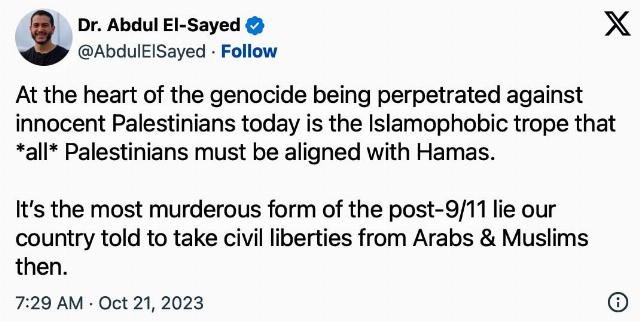
McDaniel argues that El-Sayed’s convention appearance fits a broader pattern that should alarm voters. He points to El-Sayed’s commentary on the Israel-Gaza conflict, noting that the candidate was using the word “genocide” to describe Israel’s actions in the immediate aftermath of the October 7 attack—even before Israel launched its ground invasion of Gaza on October 27 of last year. To McDaniel, this demonstrates that El-Sayed “toes the Muslim Brotherhood line.”
The conservative writer also draws a parallel between El-Sayed’s framing and what he sees as a general Democratic narrative: that the real problem in American politics is not extremist rhetoric from the left but rather the reaction to it from the right. McDaniel describes this as a pernicious inversion that lets dangerous ideas flourish.
Debate Over Whether Islamism Is a Faith or a Political Threat
At the heart of the controversy is a question that has divided American commentators for years: whether political Islamism—and, in McDaniel’s telling, Islam itself—can coexist with Western democratic values. The writer rejects the comparison between Islam and other faiths like Baptism or Catholicism, insisting that Islam is “a political system of conquest and domination with an increasingly ephemeral veil of religious legitimacy.” He warns against the danger of allowing Islamists like El-Sayed to convince the public that their movement is simply another religion protected by the First Amendment, when in his view it is a doctrine of “bloodlust and conquest.”
The tone of the American Thinker piece is unsparing and deliberately confrontational, and it makes claims that many readers may find extreme. But the underlying factual questions—about El-Sayed’s past statements, his choice of conference company, and his positioning on Israel—are ones that Michigan voters will likely weigh in the coming months. His campaign has not publicly commented on the convention appearance or on the criticisms leveled by conservative commentators.
El-Sayed’s backers would presumably counter that attending a conference with a large Islamic organization is hardly evidence of extremism, and that his focus on anti-Muslim discrimination speaks to genuine concerns in the community. They might note that the Islamic Society of North America is a mainstream umbrella group representing many American Muslim congregations, even if individual speakers at its convention have expressed fringe views in the past.
But the political reality is that El-Sayed is running in a state where any suggestion of antisemitism or sympathy for radical Islamist movements can be politically damaging, particularly among the Jewish voters who have historically been a reliable Democratic constituency. The American Thinker piece openly hopes that this issue will hurt El-Sayed’s chances, though it also expresses concern that Democrats might maintain their Senate seat through what it calls “election fraud,” a claim for which no evidence is presented.
A Test of How Voters Weigh Associations
What makes this story noteworthy is not just the existence of a critical conservative commentary on a Democratic candidate—that is hardly new—but the specific nature of the allegations and their timing. The appearance occurred in a key swing state, days before a major national anniversary, and involved two co-panelists who have both publicly aired 9/11 conspiracy theories. For a candidate who has been trying to scrub his online past and moderate his image, the event represents an unwelcome reminder of the company he sometimes keeps.
Whether voters punish El-Sayed for it remains to be seen. What is clear is that, as the Michigan Senate race intensifies, both sides will likely continue to use the Islamism question as a cudgel—with El-Sayed’s camp framing it as a smear born of prejudice, and his opponents pointing to his words, his deleted tweets, and his choice of conference lineups as evidence of something more troubling.
Source: www.americanthinker.com — https://www.americanthinker.com/blog/2026/09/el-sayed-islamists-are-just-like-us/