
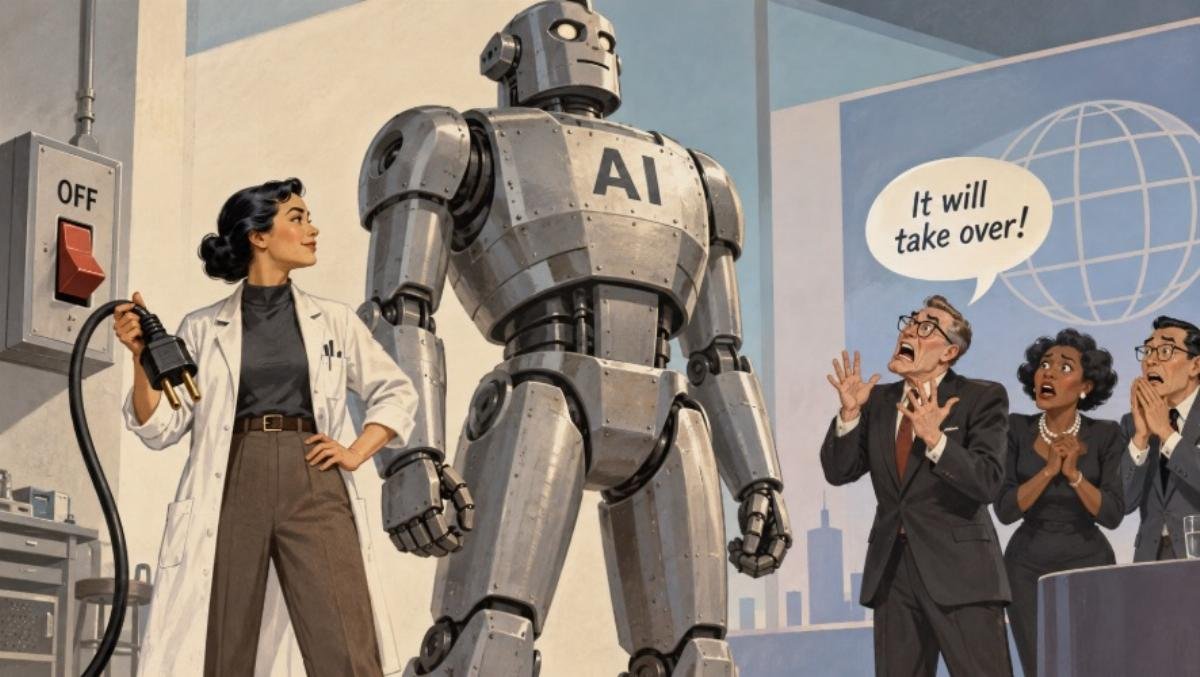
America’s AI panic has produced no shortage of dire warnings from billionaires, but one former Capitol Hill staffer wants lawmakers to take a breath before they start writing rules. In a piece for American Thinker, Ed Timperlake argues that the rush to legislate artificial intelligence risks either crushing free speech or handing China a head start in a technology race the United States cannot afford to lose.
Timperlake, a Naval Academy graduate who once worked as a professional staffer on the House Committee on Rules, builds his case on a single governing principle he attributes to Confederate General Thomas “Stonewall” Jackson: “Do not take counsel of your fears.” He acknowledges the awkwardness of quoting a Confederate officer, but insists the advice about not letting fear drive decisions still holds. It’s a framing device he returns to throughout, casting today’s AI debate as a case of powerful people letting anxiety get the better of them.
The Fainting Couch Crowd
The targets of Timperlake’s scorn are the tech figures he describes as “clutching their pearls” over AI’s potential to end humanity. He names Dario Amodei of Anthropic and Sam Altman of OpenAI as examples of well-funded doomsayers, though he concedes their concerns aren’t entirely unfounded. AI, he writes, can be “bigly” wrong, and that’s a legitimate worry.
Where Timperlake locates the problem is in the training itself. AI, in his telling, is only as reliable as the sources it’s fed, and he argues that the people building these systems often steer them toward left-leaning outlets while treating conservative sites as less credible. That bias, he suggests, is the real trust issue worth debating, not the science-fiction scenario of machines seizing control.
To illustrate how badly received wisdom can age, he reaches back to the Copernican revolution. Had AI existed when Copernicus published On the Revolutions of the Heavenly Spheres — with Galileo as his loudest defender — a query to the era’s AI database would have sided with Church authorities in declaring Galileo a heretic, Timperlake writes. The Bible functioned as inviolate canon law, and that would have settled the matter. The Church didn’t get around to apologizing to Galileo until 1992, which Timperlake notes with a wry “oops.”
The lesson he draws isn’t that AI is useless, but that the question of what makes AI trustworthy deserves far more attention than the question of how to shackle it through statute.
A Lecture at Annapolis, and a Cornell Framework
For a more serious research anchor, Timperlake points to Dr. Jeannette Wing, whose presentation on trustworthy AI formed the basis of the 2022 Michelson Memorial Lecture at the United States Naval Academy. The lecture series honors Albert A. Michelson, a Naval Academy graduate who went on to teach physics and, in 1907, became the first American to win a Nobel Prize in the sciences — one year after Theodore Roosevelt took home the Peace Prize.
Wing’s credentials are substantial: she served as executive vice president for research at Columbia University and previously as corporate vice president of research at Microsoft. According to Timperlake’s account, her lecture traced the rapid expansion of AI into areas that directly affect human lives and zeroed in on whether AI decisions can be trusted to be correct, reliable, fair, and safe. Those four adjectives form the backbone of his proposed alternative to regulation.
He pairs Wing’s warning with Cornell University’s early framing of the field. In 2021, the school described AI as both a field of study and a tool that shapes how it conducts research, teaches, and supports the university. Timperlake treats that dual characterization as a model — an institution that recognized both the promise and the difficulty without reaching for a legislative hammer.
The Physics Analogy
The heart of Timperlake’s argument is a distinction borrowed from physics. Theoretical physics chases fundamental principles without a practical goal in mind. Applied physics takes those discoveries and converts them into technologies with real consequences for the world.
Einstein’s work on mass and energy helped lay part of the scientific groundwork for the nuclear age, but Timperlake notes that building nuclear weapons required decades of additional discovery and engineering. Basic research expands what humans know; applied research forces a reckoning with the benefits, risks, and costs of using that knowledge.
He proposes splitting AI along the same lines. Theoretical AI — the basic, constantly advancing research — should be unbounded, limited only by human insight and creativity. That freedom, in his view, is necessary to fully understand both AI’s strengths and its dangers. Applied AI, by contrast, can be evaluated case by case using Wing’s trustworthiness criteria and Cornell’s framework. Over time, he argues, applied AI will effectively self-regulate as people observe the good and bad consequences of each use.
What Timperlake rejects outright is what he calls “state-control overreaction,” by which he means legislative remedies. Passing laws now, he warns, risks either chilling speech or hobbling an industry at the exact moment it needs to move fast against China.
An Oligarchy of Ladder-Pullers?
The more provocative suggestion in Timperlake’s piece is that the doomsday rhetoric may not be entirely sincere. He argues that humanity retains the ability to “pull the plug” on AI, both physically and intellectually, and that there are people who can outthink any machine while making billions in the process — incentive enough to keep the technology in check.
That leads him to a blunt suspicion: the current debate, as he reads it, “smells of an attempt to establish an AI oligarchy of ‘we are aboard; pull up the ladder’ self-promotion.” In other words, the same executives warning loudest about catastrophe may be positioning themselves as the gatekeepers of a technology they’d prefer newcomers couldn’t easily enter.
Timperlake closes not with a policy prescription but a plea for open debate. For someone whose resume includes a stint shaping rules on the House floor, his conclusion is notably skeptical of the institution he once served: the ability to speak freely, he writes, matters more now than ever to the republic. Whether lawmakers take his advice and press pause is another question — but his argument offers a reminder that the case for restraint has its own intellectual pedigree, stretching from a Civil War general’s warning about fear to a Nobel laureate’s faith in unbounded inquiry.
Source: www.americanthinker.com — https://www.americanthinker.com/blog/2026/09/please-press-the-pause-button-on-regulating-ai/