

Five years after Texas enacted a law effectively banning abortion beyond six weeks of gestation, the statute remains at the center of a heated national debate. This week, The Federalist published a lengthy defense of the law, arguing that media coverage of a recent wrongful death lawsuit misrepresents both the facts of the case and the legal landscape in Texas, and that the timing of the coverage is designed to influence the upcoming midterm elections.
At issue is a lawsuit filed by the family of Tierra Walker, a 37-year-old San Antonio woman who died in December 2024. According to court filings cited by The Federalist, Walker had a series of chronic health conditions before she became pregnant in September 2024, including obesity, uncontrolled hypertension, severe asthma, a seizure disorder, Type 2 diabetes, gastroparesis, and a history of complicated pregnancies. The lawsuit alleges that Texas officials and medical professionals showed “deliberate indifference, discrimination, and medical mistreatment” that led to her death and that of her unborn child.
The Federalist reports that Walker knew she was pregnant and was already experiencing health complications at five weeks gestation — a detail it says undercuts a common claim by abortion opponents that most women don’t know they are pregnant until after a heartbeat is detectable. In the months leading up to her death, Walker was in and out of the hospital with seizures, nausea, vomiting, and pain associated with high blood pressure. Doctors warned she was at a “high risk of death,” but according to the lawsuit, they declined the family’s requests for an abortion because they did not believe the pregnancy was the root cause of her problems.
The lawsuit comes nearly two years after Walker’s death and a year after Pro Publica published an article alleging she died after being unable to get an abortion in Texas. The Federalist notes that just three pages into the lawsuit, the plaintiffs suggest the state’s abortion limit is “unconstitutional.”

Medical Experts Question the Lawsuit’s Focus
Dr. Christina Francis, CEO of the American Association of Pro-Life Obstetricians and Gynecologists, told The Federalist that blaming Texas law for Walker’s death is “not only misplaced, but really has no basis in reality.” Francis, who said she had not personally reviewed Walker’s medical records, identified “multiple instances where, at least from the available information, it appears that her care was just not handled appropriately.”
According to the autopsy included in court filings, Walker died on December 30 after being sent home from the hospital days earlier with a preeclampsia diagnosis. The cause of death was listed as hypertensive cardiovascular disease with superimposed preeclampsia. Francis noted that preeclampsia is very rarely seen before 20 weeks, so early symptoms are usually not due to the condition. Regardless of timing, she said, discharging Walker from the hospital multiple times “is not consistent with any kind of medical standard whatsoever.”
The lawsuit also targets politicians who passed and enforce pro-life laws, claiming that Attorney General Ken Paxton and Texas Medical Board Executive Director Stephen Brint Carlton imposed a “merciless blanket prohibition on abortion that intimidates doctors into inaction and breeds extreme fear among Texas’s medical establishment.”
The Federalist contends that Texas law already made exceptions for abortion when a doctor believes a medical emergency necessitates it, and that the state further clarified its position in 2025 with the Life Of The Mother Act, which explicitly permits abortion when a woman’s life is at risk of serious injury or death if the pregnancy continues.
Francis said that four and a half years after the Dobbs decision, there is no justification for physicians to claim they don’t understand their state’s law. “We certainly have had plenty of time now for physicians to familiarize themselves if they’re practicing in a state that has one of these laws,” she said. “It certainly is inherent upon them to understand their law.”
In Walker’s case specifically, Francis said she “didn’t see any clear indication in the court filing that any doctor had said to them, ‘yes, we think that we should end her pregnancy, but we can’t because of Texas’s law.'” Even if that were true, she added, it would not be a correct interpretation of the statute. She also noted that while pregnancy may have exacerbated some of Walker’s conditions, her symptoms likely would not have been immediately resolved by an abortion.
“[Walker] very clearly, especially once she had the diagnosis of preeclampsia at 20 weeks, very definitely would have qualified to have an early delivery under Texas law,” Francis said. She pointed out that the Texas Supreme Court has already ruled that the law allows doctors to intervene when a woman has a complication that could potentially lead to death, even if death is not imminent — a ruling widely publicized in the Amanda Zurawski case.
Political Timing and Media Framing
The Federalist argues that Walker’s case is one of many tragedies being used by abortion rights advocates to blame pro-life laws for deaths caused by medical malpractice. It notes that no state, including those with strict abortion limits, prohibits doctors from treating complications like miscarriage, ectopic pregnancy, or preeclampsia. Yet, it says, corporate media accused Texas and its elected officials of indirectly killing Walker.

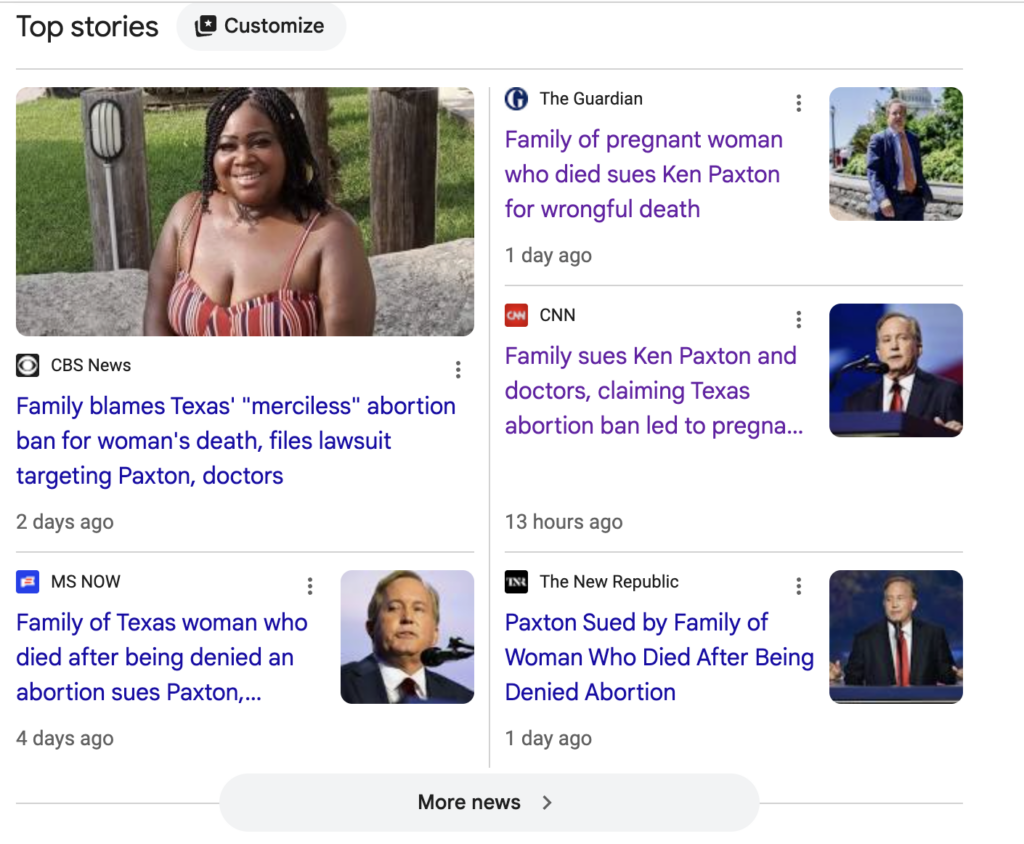
The family filed the petition just months before the statute of limitations for a wrongful death suit in Texas was set to expire. The Federalist claims that media outlets used the timing of the lawsuit to target Republican Senate candidate Ken Paxton, who is named as a defendant and has a record of pro-life enforcement as attorney general, just two months before the November midterm elections. Multiple outlets, it says, not only included Paxton’s name in headlines but also made him the featured image. CBS, for example, concluded its article with a quote from Walker’s mother telling Paxton to “go to hell.”
Francis told The Federalist that while Paxton’s inclusion in the lawsuit makes for easy political fodder, she hopes people will look at the root cause of Walker’s death. “It was not the Texas law,” she said. “It was, I think, really a lack of attention to how sick she was, and managing that appropriately.”
The Federalist’s piece concludes by arguing that media and abortion activists have spent years deceiving Americans into believing that pro-life policies will lead to women’s deaths, despite what it describes as evidence that such laws save lives. It frames the Walker case as the latest example of that pattern, timed for maximum political impact ahead of the midterms.
The debate over Texas’s abortion law and its consequences is likely to continue as the November elections approach, with both sides pointing to individual cases as evidence for their positions. What remains undisputed is that Tierra Walker died after multiple hospital visits, and her family is seeking accountability through the courts. Whether that accountability should extend to the state’s abortion laws, as the lawsuit alleges, or to the medical care she received, as Francis suggests, is a question that will play out in legal filings and public arguments in the months to come.
Source: thefederalist.com — https://thefederalist.com/2026/09/18/media-spread-more-deadly-lies-about-texas-heartbeat-law-just-in-time-for-midterms/