
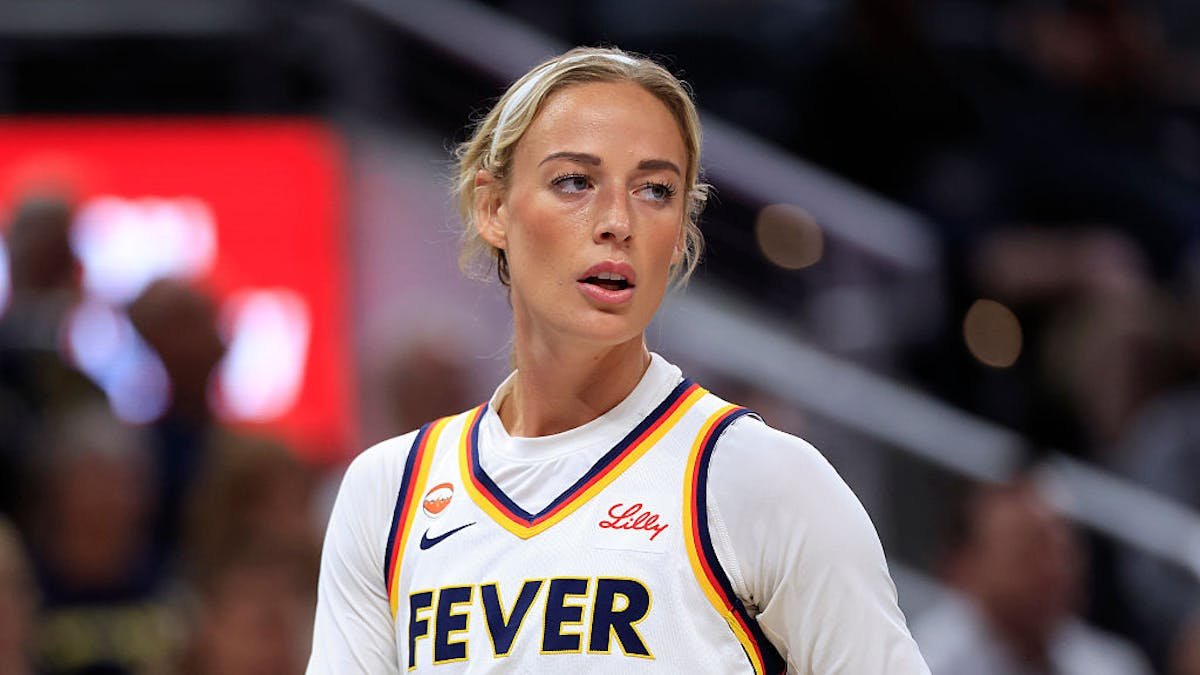
Jennifer Sey, CEO of XX-XY Athletics and a prominent advocate for sex-based categories in sports, is alleging that a mother and daughter were forced to cover up shirts supporting Indiana Fever guard Sophie Cunningham during a recent WNBA game in Atlanta. The incident, she says, is part of a broader pattern of league and arena officials suppressing messages that affirm biological reality in women’s sports.
According to Sey, writing for The Daily Wire, Kasey Thomason and her daughter Annie attended Sunday’s Fever-Dream game at State Farm Arena wearing red, white, and blue shirts from Sey’s company, XX-XY Athletics. The shirts were in support of Cunningham, who recently made headlines for saying it’s “common sense” that girls’ sports should be for girls only.
With about two minutes left in overtime, a woman sitting two rows ahead—wearing a “Protect Trans Kids” shirt—pointed at the Thomasons and spoke to security, Sey reports. A security guard then pointed back at Kasey and Annie. Within minutes, the pair were told they could either cover their shirts with free “Wellness Night” tees sponsored by Emory Healthcare, or be escorted out of the arena.
The Thomasons put on the stadium shirts to see the end of the game, which the Fever won. But Sey says the woman who had flagged them then mouthed, “I like your shirt,” in an act she describes as “pure snitchy vindictiveness.”
“The Fever won that night, but free expression lost,” Sey wrote.
A Pattern of Suppression
Sey frames the Atlanta incident as one of several recent episodes in which pro-Cunningham messages have been targeted by arena and league officials. She points to a July 28 game in Seattle, where 16-year-old Ahnaleigh Wilson and a friend sat courtside wearing XX-XY tees and holding a sign thanking Cunningham. Celeste Keaton, co-owner of the Seattle Storm, confronted the girls, called them “effing insane,” and left them in tears. The league later suspended Keaton for five games.
Sey also describes an incident in Minneapolis days later, where she and Riley Gaines—a former collegiate swimmer and fellow advocate—sat courtside with XX-XY tees. Gaines held a small sign reading, “Sophie, thank you — a girl mom.” At halftime, arena security told Gaines to put the sign down because it contained a player’s name. Meanwhile, Sey notes, shirts reading “Trans Kids Belong”—including one worn by Minnesota Lynx Coach Cheryl Reeve—faced no such restriction.
“The WNBA, the team leadership, the stadium brass – they want everyone to believe that the message at the games is anti-Sophie, pro-trans and that anyone who supports Cunningham is just a bigot,” Sey wrote. “But in fact, the pro-woman, protect-women’s-sports message is everywhere on the ground at these games, no matter how hard the league tries to suppress it.”

Sophie Cunningham’s Stand
Cunningham, a guard for the Indiana Fever, was not initially seeking controversy, according to Sey. In July, she told ESPN that she wants to protect young girls and keep their sports and locker rooms girls-only. She simply answered a question honestly, Sey says, and has not walked it back despite pressure.
Sey describes celebrations in support of Cunningham as drawing moms and daughters who simply want sex-based categories preserved. They bring balloons and cookies. Counter-protesters, she says, are aggressive and mean-spirited, using megaphones to drown them out and hurling insults.
“League and arena officials treat expressions of support for fairness as the problem while treating the erasure of those categories as settled morality,” Sey wrote. “Messages and t-shirts that affirm biological sex are policed by stadium security. Messages that deny it are celebrated, put on the jumbotron, and featured in the TV broadcast.”
The Corporate Angle
Sey also notes that the gifted shirts in Atlanta came from Emory Healthcare, a stadium sponsor that operates a transgender clinic. Though Georgia law restricts pharmaceutical and surgical interventions for minors, Sey says the institutional alignment is “clear enough.”

Sey argues that the WNBA, arenas, broadcasters, and corporate sponsors are trying to manufacture a consensus that does not exist. She says ordinary people are showing up to take a stand for fair competition, and the more the league suppresses the message, the faster it spreads.
“Biological reality does not care about branding partnerships or ‘Wellness Night,'” she wrote.
Sey concludes that the movement is not driven by hate, but by the obvious: that males and females are different, and that girls deserve categories that protect their opportunities, safety, and achievements. She adds, “The crazy part is that it was ever controversial to say so.”
Kasey and Annie Thomason put on the stadium shirts to stay and watch the rest of the game, then spoke out. Sey writes, “Game on.”
The WNBA and the Atlanta Dream have not yet responded to requests for comment on the incident described by Sey.
Source: www.dailywire.com — https://www.dailywire.com/news/jennifer-sey-supporting-sophie-cunningham-is-a-court-side-crime