
Election integrity experts told a House Judiciary subcommittee this week that the thousands of noncitizens discovered on New Jersey’s voter rolls likely signal a far wider problem in states that pair automatic voter registration with driver’s licenses for people who are not U.S. citizens.
“New Jersey may be just the tip of the iceberg on this issue,” Josh Findlay, senior fellow for secure elections policy at the America First Policy Institute, testified during a hearing titled “Restoring Election Integrity: Oversight of Voter Fraud in New Jersey,” as reported by The Federalist.
New Jersey election law attorney Jason Sena put it more bluntly. “The problem is much broader than the state admits,” he told the subcommittee, arguing that public records from Hudson and Bergen counties show noncitizens registered to vote both before and after the window the state has blamed for the error.
How the numbers shifted
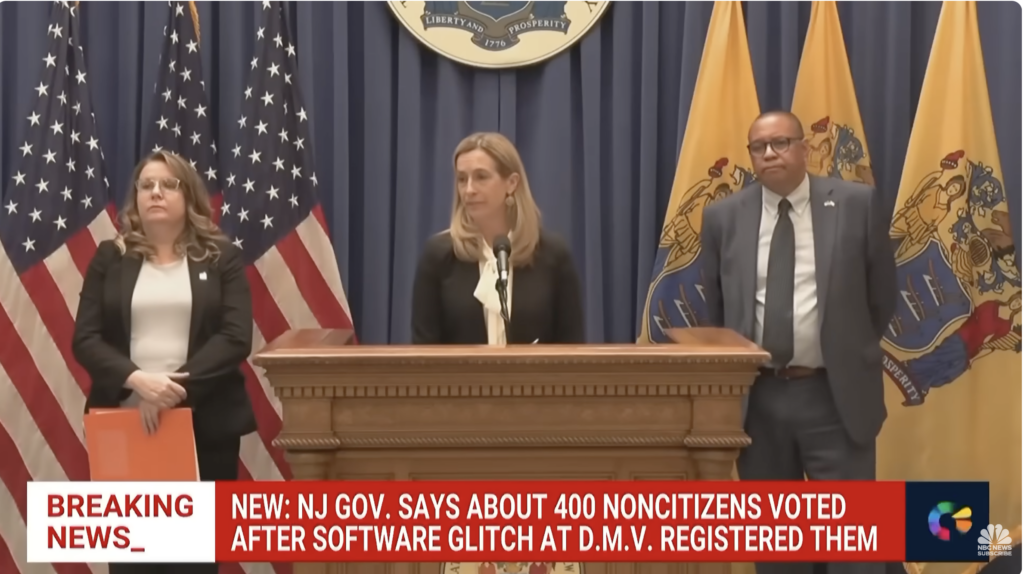
In late July, first-term Democratic Gov. Mikie Sherrill held a press conference acknowledging that roughly 6,600 noncitizens had ended up on New Jersey’s voter rolls in 2023 and 2024, and that about 400 of them went on to vote. The governor has since revised that figure, saying only about 340 of the 6,600 accidentally registered noncitizens cast ballots. According to Sherrill, the state has moved approximately 5,100 of those registrations into “deleted status,” while roughly 1,450 more have been switched to a rejected status pending further review.
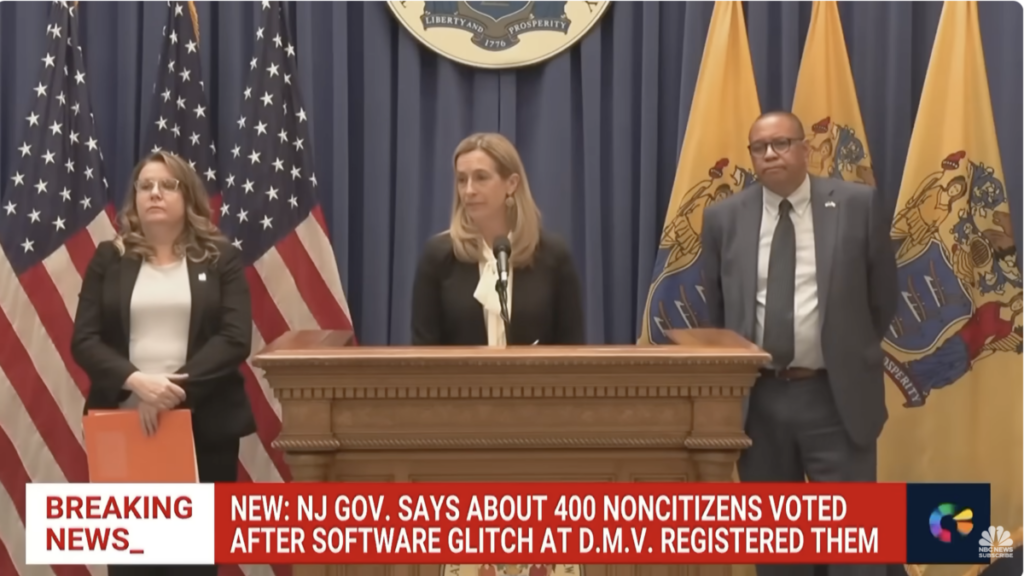
At her press conference, Sherrill said she was “appalled by the reckless failures” and by “the lack of transparency shown by those in charge at the time,” adding, “We have no evidence at this time that any elections were swayed.”
Sherrill has blamed a software glitch at a longtime license printing vendor for the New Jersey Motor Vehicle Commission. But a spokeswoman for that firm, IDEMIA, which holds contracts with several New Jersey agencies as well as the federal government, has said “there was no glitch or software error,” and that the problem did not originate on the vendor’s end.
Rep. Jeff Van Drew, R-N.J., who chairs the Judiciary Committee’s Subcommittee on Oversight, said during the hearing that the company has cooperated with his investigation while Sherrill and her administration have not. “There’s still a lot we don’t know about, why this happened and why it took so long for the public to know about it,” Van Drew said, adding at another point that the situation amounted to a cover-up.
Witnesses describe a built-in problem
Findlay told the panel that in New Jersey, registering noncitizens may not have been a malfunction at all. “In New Jersey, the problem is built into the process,” he said.

Justin Riemer, president of Restoring Integrity and Trust in Elections, testified that the state’s automatic registration system was not designed to verify citizenship in the first place. Applicants, he said, were registered even after indicating on the Motor Vehicle Commission form that they were not citizens; the front end of the system, he explained, relies entirely on an applicant’s attestation of citizenship with no further check.
The backdrop, according to the source article, is a 2019 law signed by then-Gov. Phil Murphy that extended standard driver’s licenses and non-driver ID cards to noncitizens starting in May 2021. The Motor Vehicle Commission estimated at the time that the change opened license and ID access to more than 450,000 illegal aliens of driving age. MVC Chief Administrator Sue Fulton said the move would improve lives and enhance public safety, and assured a legislative committee that noncitizens would not be able to register to vote.
Sena pointed to county-level records as evidence the issue extends beyond the state’s stated timeline of June 2023 to June 2024. “Records show noncitizens were permitted to register to vote outside that timeframe and through other nonMVC methods, which confirms as a matter of fact that the problem is bigger than state has admitted,” he told the subcommittee.
The hearing also featured sharp partisan exchanges, with subcommittee Democrats, including Rep. Jasmine Crockett of Texas and Judiciary Ranking Member Jamie Raskin of Maryland, drawing criticism from the article’s author for steering toward attacks on President Trump rather than the topic at hand.
A national overlap
The witnesses argued New Jersey is not an outlier. According to the National Conference of State Legislatures, 19 states and the District of Columbia allow illegal aliens to obtain driver’s licenses, while 24 states and D.C. run automatic voter registration systems meant to sign up eligible individuals when they interact with government agencies. Experts told the subcommittee that the overlap between the two policies is where the trouble lies.
The source article cites several examples. Oregon, which uses the same backend opt-out registration system as New Jersey, announced in 2024 that staff had misidentified nearly 2,000 registrants as U.S. citizens on its rolls — an error the Oregon Department of Transportation tied to a drop-down menu in the system. The Associated Press reported at the time that the mistake occurred in part because Oregon has let noncitizens obtain driver’s licenses since 2019 and automatically registers most people when they get a license or ID.
In California, the statewide voter registration system has no specific cancellation code for noncitizenship, so the secretary of state’s office cannot say how many noncitizens have been removed from the rolls, if any, because it does not track that information, The Federalist reported last month.
In Minnesota, the article notes, illegal immigrants could potentially cast ballots by presenting a valid state driver’s license issued under that state’s licensure law. During a Minnesota House Fraud Committee hearing last year, Republican Rep. Patti Anderson asked whether that was the case, and Elections Director Paul Linnell did not provide a direct answer. Findlay later wrote that the exchange “captures a significant issue facing Minnesota voters,” adding that “a state’s election system that is lacking basic safeguards is not one to trust.” Minnesota also allows voters to vouch for as many as eight other people at the polls without identification, relying on personal attestation.
The article also notes that the Republican National Committee has taken action on the issue in recent weeks, though the source material is truncated at that point.
With roughly 50 days until November’s general election, the hearing’s central claim — that documented noncitizen registrations represent a fraction of a larger, systemic vulnerability — remains disputed. Sherrill has said there is no evidence any election outcome was affected, while the witnesses who testified before Van Drew’s subcommittee say the full scope of the problem has yet to be disclosed.
Source: thefederalist.com — https://thefederalist.com/2026/09/18/thousands-of-noncitizens-on-jerseys-voter-rolls-represent-just-the-tip-of-the-iceberg/